
17 Tons, and What Do You Get?
Another day older, if you're lucky

Considering that I didn’t begin interviewing World War 2 veterans until 1987, some 42 years after the war, it only makes sense that I interviewed a number of veterans who were playing hide-and-seek with the Angel of Death. There was Joe Bernardino, who had just arrived home from the hospital when I called him on a whim because he lived in Rochester, N.Y., and I was in the area. There was Samuel Feiler, the 101st Airborne dentist who was on meds and was a little loopy and in a very good mood but his wife, whom he met in London after D-Day and married before Operation Market Garden, was there to jog his memory. And there was Andy Schifler.
Andy called me in 1995 on the toll-free phone number I got to boost sales of the first edition of Tanks for the Memories. He wasn’t calling to talk to me or to order a book, but he saw the number in the 712th Tank Battalion newsletter and wanted to give Paul Wannemacher, the battalion association secretary, an update on his health.
He said he went into the hospital for cancer surgery. Two hours after he came home, his wife died. Then his doctors found a tumor in his head. They operated, and he lost his sight. Eventually, 28 percent of his sight came back.
I couldn’t take much more.
“What company were you in?” I interrupted.
“D Company,” he said.
This was one of those situations where I knew I might not get another chance to interview someone. I very much regretted not trying harder to interview Vladimir Kedrovsky, the battalion’s third and final commanding officer, after I heard he had a stroke, and then he passed away.
“Where do you live?” I asked.
“Chicago,” Andy said.
“Can I pay you a visit?” (I would have to come out from New Jersey, where I lived at the time.)
“Sure,” he said. “Call before you come, to make sure I’m still alive.”
Three weeks later I was in Chicago. As it turns out, Andy’s interview is an important part of the project I’m working on through a series of Substacks, about the role of the 17-ton “light” Stuart tank in the 712th Tank Battalion, where the heavier Sherman tanks got much of the attention.
Interview with Andy Schifler
D Company, 712th Tank Battalion
Chicago, May 6, 1995
Andy Schifler: Pete Krolczyk, one of the boys, used to live down the block. I never saw him. You know, I feel so guilty, nobody ever got together.
Aaron Elson: Did you ever go to any of the reunions?
Andy Schifler: I had the one in Rockford, and Harrisburg. See, my wife didn’t feel good. I tried to get the boys, too, I called them. Everything’s happening today.
Aaron Elson: I know. I talked to Mauzer, and I called Hilding Freeberg. I’m going to see him later. He lives up north of here. I’m going to call him later today and see if we can get together. But I’ve got a feeling you’ve got some good stories to tell.
Andy Schifler: Oh, no, no, not, because we, most of us, the same guys stayed together, like Fletcher, he was my assistant driver and Charlie Miller, the one from Ohio, he was my gunner, and then O’Brient. We only had four men. [O’Brient was Lieutenant Lex O’Brient, the platoon leader.]
Aaron Elson: Four in a crew. You were the driver?
Andy Schifler: Yes.
Aaron Elson: And you had that same tank for 4,000 miles?
Andy Schifler: 4,600 miles.
Aaron Elson: From England, or...
Andy Schifler: All the way from England...
Aaron Elson: Did you have an odometer? How did you tell it was 4,600 miles?
Andy Schifler: We had that speedometer. Every day we used to change our panels, you know, carry morphine in your hat all the time; we had to have it because you were away always. I saw my captain maybe three or four times during the war.
Aaron Elson: Now your captain was ]Alton] Wagnon?
Andy Schifler: Wagnon.
Aaron Elson: Your rank was what?
Andy Schifler: T-4. Then the kids give me a sergeant’s rating. See, I’m more or less, when we formed the 10th Armored I was driving the G-2 officer, and we’d meet all the trains that come in. They’d come in at night. We got about three hundred, four or five hundred men. It took a while. Like, little Mauzer and I, when we crossed the river and had supplies, when we were sleeping and driving in water, and it was cold. That’s the time when Sparks and I don’t know who else, they were bringing some wounded guys back, and us guys, Mauzer and I, we got to one of the pillboxes; it took us all night in order to get back. That was rough, it was rough. Then Mauzer don’t feel too good when I talk to him; he said he goes to the hospital every so often.
Aaron Elson: So Mauzer was on that patrol, too? [This was in the vicinity of Dillingen, when the battalion crossed the Saar River in early December of 1944.]
Andy Schifler: Oh yeah, he was with us supplying, but I don’t know who else went with Sparks.
Aaron Elson: So you were on the patrol that brought the wounded guys back?
Andy Schifler: No, Sparks was. And we were coming back from a pillbox that had to have whatever we supplied them with, then we were coming back.
Aaron Elson: With the wounded guys?
Andy Schifler: No, them guys come back, they were separate. We were like, Mauzer and I had to go to a certain pillbox, and these guys, Sparky and I don’t know, [Art] Horn was there or, I don’t know who all was with them. So they...
Aaron Elson: The reason that I’m interested in the patrol when you brought the wounded guys back... [my father was wounded on one of these patrols.]
Andy Schifler: Oh, they took care of those. I wasn’t there at all. We got on whatever boat they had to try to get us back, because they were just, oh in that area, they knew stuff was coming in.
Aaron Elson: And that was at night?
Andy Schifler: That was, well, we went out, it must have been about 5 or 6 in the evening. That’s dark already.
Aaron Elson: How did you get across the river?
Andy Schifler: Boat. We got across. But then when you get across you had to stay in water, I don’t know how many blocks, because the shells, every time they fall, they fall short, the enemy knew there was stuff going along there, see, that wasn’t only our boat. There was a lot of other traffic going. Then we got, what town, I couldn’t remember the town, all I was doing, I’d get the orders, and I’d just go. And we had two or three radios where you keep communication, you hear your captain talk to O’Brient, headquarters, the 90th wanted to know what’s happening.
Aaron Elson: O’Brient, did he start out as a sergeant, or did he come in as a lieutenant?
Andy Schifler: I think he come from a military school. He wasn’t a regular, no. When we got in service, there were all West Point officers. All cavalry.
Aaron Elson: Now, do you remember the battalion commander, Whitside Miller, the one everybody couldn’t stand? Whiteside or Whitside. He was the colonel right after you were taken out of the 10th Armored?
Andy Schifler: Miller, Miller. Was he a West Pointer?
Aaron Elson: Yeah, he was an old Army.
Andy Schifler: He must have come in in ‘40, or 39. But we did get some West Point officers. Then when the cavalry got together more or less, we started getting from military academies.
Aaron Elson: Do you remember the name Chamberlin?
Andy Schifler: Well, the man that was in charge of our cavalry, I’ve got the book but I don’t ... His brother was the chief of staff for the cavalry, retired chief of staff, and his brother was the lieutenant colonel. Then from there we went into the 10th Armored.
Aaron Elson: You know, what I’m hoping you can tell me, is something amusing, something funny about life in the cavalry.
Andy Schifler: (laughing) In the cavalry? We had all remounts. Horses that had never been ridden, or never shoed. Never had shoes on.
Aaron Elson: So you had to shoe them?
Andy Schifler: Well, our blacksmiths. There were regular smiths.
Aaron Elson: So what did that do to the horse? Did that make them ornery?
Andy Schifler: (laughing) See, we used to get, I don’t know, 21 horses or so as remounts, and you had to keep them away from the other horses for about a month. They were isolated. You don’t bring them right to the other horses. They have to be shod, but all you could hear was, us guys were a bunch of goofballs, we didn’t know what the hell a horse, you had to learn how to bridle them, had to learn to balance by falling backwards, learn how to sit on a horse.
Aaron Elson: I didn’t know this, you fall backwards?
Andy Schifler: You had to lean back, so your equilibrium, get the feel of the horse.
Aaron Elson: On the horse?
Andy Schifler: On the horse.
Aaron Elson: So did people fall off?
Andy Schifler: They had to, guys were watching, a general inspector or something, you had to jump a horse over a hurdle, blindfolded, no stirrup. Eighty percent of the guys went on the ground. But it’s a good thing it was sand. Because some horses wouldn’t jump. The horse that I had was a jumper, he liked to jump, he wouldn’t shy. Some of these others would come to the hurdle, they’d shy away and knock you off. Oh, we had, I had three Chinamen in my tent, they come in, in the cavalry, they couldn’t do nothing.
Aaron Elson: In the cavalry?
Andy Schifler: Yes. So I had them in my tent. There were four of us in a tent. And they’d be talking Chinese, one from, I think one was from San Diego, one from Los Angeles and one from Pittsburgh. My staff sergeant was the last American out of that 38th Parallel in China. He played that Chinese game with them. They used to take him, every weekend he went with the Chinamen. He’d play that peg game, I don’t know...and our first sergeant...
Aaron Elson: Who was your staff sergeant? Was that Seeley?
Andy Schifler: Stolid Camp Seeley.
Aaron Elson: Was that named after the sergeant? [Actually it was named after the whistlestop train station where the recruits were dropped off.]
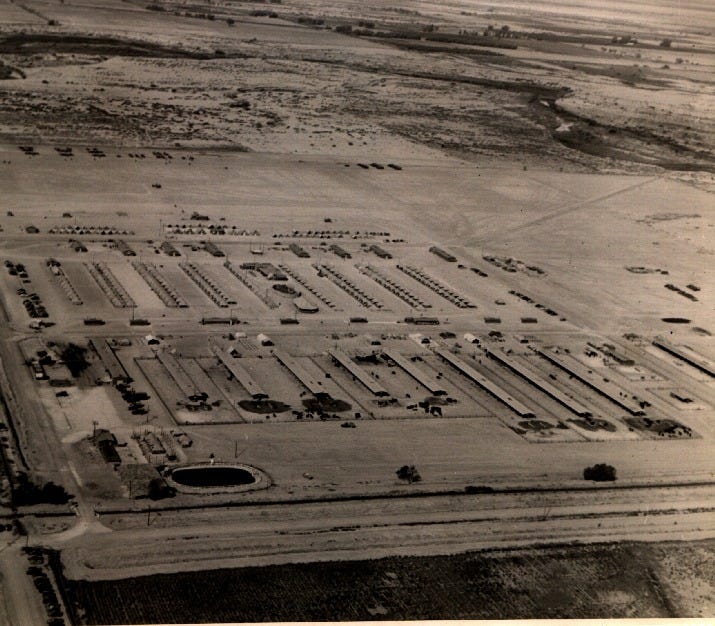
Andy Schifler: That’s where, El Centro, it was about 12 miles from El Centro.
Aaron Elson: Do you remember your sergeant’s name?
Andy Schifler: Our sergeant was Roberts, first sergeant. He was a British; he was an Australian but he was a British officer for about 13 or 15 years, I don’t know, and then he got into our Army, and he was like 13 years as a first sergeant. He got out of it, I don’t know what happened, whether he finished his term or what. But he was a mean guy. I mean, he was mean. A rough man.
Aaron Elson: What would he do?
Andy Schifler: Ohhh, my, he bent over. He had a step where his tent was, he’d go all the way down to the floor with his mouth without bending his knees. Roberts. He was...
Aaron Elson: He could bend over and touch the floor with his palms?
Andy Schifler: The ground. About that high from the ground. But he was a rough man. They all, the officers, followed his instructions. If there was something wrong, they asked Roberts. He was a rough man, my god.
Aaron Elson: What, did he get into fights?
Andy Schifler: No. You couldn’t look him in the eye. He’d say something, and you think you’re gonna repeat it back to him. I saw him hit a guy, he went through two tents.
Aaron Elson: Really?
Andy Schifler: Yeah. He didn’t take no...But he liked me, I had it good. See, I had my brother was one of the first Americans in Australia, it took them 45 days, they looked at the people in Australia, and he knew that he was in his homeland.
Aaron Elson: How did your brother get to Australia?
Andy Schifler: Oh, 45 days on a boat.
Aaron Elson: What led him to go to Australia?
Andy Schifler: They went in to, to go to Guadalcanal and all that after a while. So, yeah, 45 days, and I don’t know, one of my best boyfriends, he was in the embassy for Eisenhower; he sent the message out for the invasion day, Kurtz, yeah, he’s passed away about four years ago, and he was, I don’t know, he was, I tried to meet him in England and we had that, we had to stay in our area, restricted, because we were ready for our move.
Aaron Elson: Now your brother, what service was he in?
Andy Schifler: He was in the Signal Corps. He left Camp Gordon. Yeah, when you got in a tank outfit, you were lost, because you were with the same crew all the time, see, when we were in the battalion, we slept in the tank and all, wherever we went, you weren’t in a group, you were always with your crew. That one time, the guy was doing a chicken and Patton come out to us, we were the furthest point, so he wanted to see what’s going on, and he says, “Forget about it.” The guy was laying down, “You’ll be on the move after this.” And sure enough, we covered 200-some miles that time, during the Ardennes. [This was when the 712th Tank Battalion traveled north to join in the Battle of the Bulge; the distance was closer to 100 miles.]
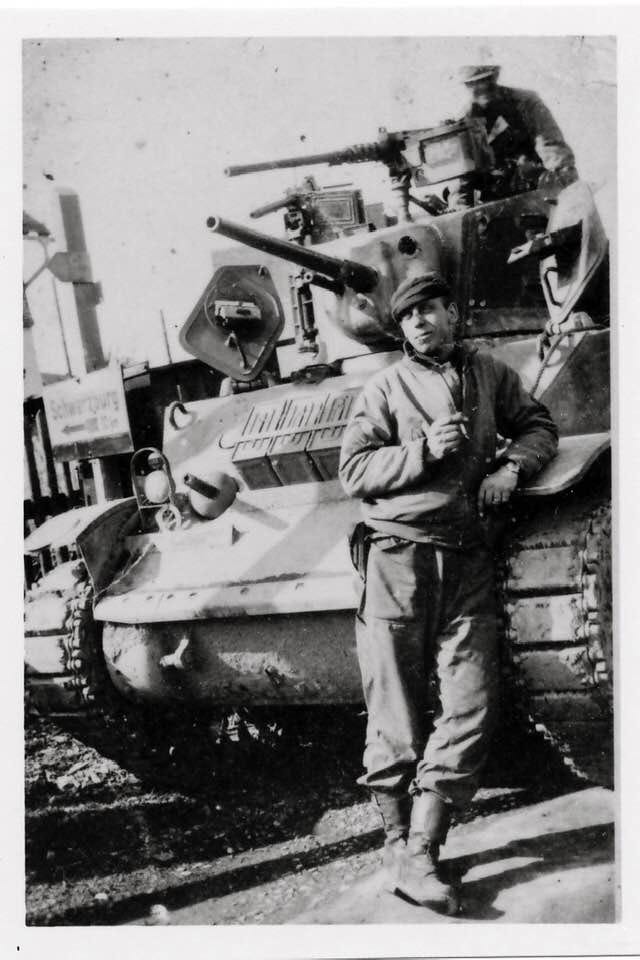
See, if we were in a bunch, you could talk. But during the war, you weren’t together. You were either on guard or on, and when them screaming meemies come in, that was the first time I ever heard them. That’s when we got tied up with I think the 82nd Airborne [part of the 712th was briefly attached to the 82nd in Normandy]; those things would scream like, (screeching sound), scare the shit out of you, and this was in the night now, when they did it. But you get used to it. And then, McNulty, and I think Jensen, that’s the tank that got hit, that intelligence said the French worked on that road, and these guys didn’t concentrate that, I don’t know how many miles, maybe 30 miles from Paris. They wouldn’t let us go then into Paris; they said they were going to let the French go in. I think we had our officer, a couple of officers in Paris already, intelligence. But that’s why they didn’t keep their mind on what they do, now here’s the tank, and one of these 88s, I don’t know, a couple hundred yards away.
Aaron Elson: And they didn’t see it?
Andy Schifler: No, because they thought the French...
Aaron Elson: They thought the road was clear.
Andy Schifler: And so, if you had some guys that were with you, you could write, a battalion that stayed on the front for about 298 days out of 310 days, there was only a few men that were left, I mean that didn’t get wounded. I think half of our battalion got Purple Hearts, I think half.
Aaron Elson: 498.
Andy Schifler: And with the battalion was I don’t think only about 1,100 or 1,200 men. Because we had four people in the tank, we had about 15 tanks, and then maybe two or three ...
Aaron Elson: And the ones who didn’t get wounded, a lot of them went, I won’t say went nuts, but got a little affected by it. Battle fatigue, I guess you’d call it.
Andy Schifler: Oh, I got a book, on that battle fatigue. I don’t know if it’s the Vets or the Legion. Anybody up to 200 or 240 days was completely fatigued. And us guys spent 298 days. And you don’t see that on the air or nothing. Nobody ever mentions it. That’s why they kept, Patton was gonna give a new division into our, instead of the eleven or twelve hundred men they wanted about seventeen, eighteen thousand men to replace us, and he said no, we’ll keep ‘em. But I can’t remember the towns, because all I would go, go this way, go that way. Then the little [Piper] Cub come around and he’d drop something or give you maps or something. But there’s a lot of credit to the 712th that they never got. Because you’re tied up with all the other groups and Corps, and they forget about you. It was nice of the 90th to take care of us. That time, they had one officer or two officers, an observer, and one of the other officers, and a new driver in a jeep, they told him to follow, they’re going through a minefield by walking. This recruit, and he knocked a tripwire or something and started running, and then he got all...
Aaron Elson: The jeep got blown up?
Andy Schifler: All of them. They didn’t have no jeep.
Aaron Elson: Now did you see that?
Andy Schifler: No, we heard. We used to hear a lot of communications, because O’Brient had to call Wagnon was on the phone, the damn thing, “What’s happening? What’s happening?” He was usually about 20 miles behind the line, with the headquarters.
Aaron Elson: And the radio would carry that far?
Andy Schifler: That time we were on flat land, didn’t have much terrain. When we were on the mountain, you know, like, somebody had, the Germans called us the forest mountain tankers. We went on a mud road, and a German farmer says “Nichts.” There’s no road. He says it’s only a walking trail. Then that disappeared. We come to a place where there’s a wash; we guided our tanks right down the wash, went down I don’t know how many feet down. Nobody threw a track. I’m telling you. We were mostly on back roads. That jeep that got hit, you know, stopped, in that town. They had the bedsheets out. They captured, I don’t know if it was two of them or one of them, the one I know that we heard, the German officers would come out of the woods right away, the people would, so he took them as a prisoner. He knew the Americans were coming up. But what the people were doing (unintelligible). They shelled that town for I don’t know, 12 hours, I think. One shell I think every 15 minutes, something like that.
Aaron Elson: Who did the shelling, the Germans?
Andy Schifler: The Americans. The town, because what they did? For having a truce and then attacking. That one day, in the morning, we would split up, go with the infantry, advance. The infantry wouldn’t go first. They wanted us to go at the point. We waited, waited, it was about 11:30 then. The guys were by the haystack, the mine didn’t sink down. Then we went, where the sun was on there maybe five or six hours, and we crossed that minefield; we didn’t even know it was a minefield. That’s something. Well, we were fortunate.
Aaron Elson: Do you remember the incident with the bedsheets, was that late in the war, near the end, when they put the bedsheets out and then attacked?
Andy Schifler: That was probably in the center, in the middle, because on one occasion, I know, one of the guys got shot in the first jeep. You know what the guys did? They were shooting the pigs and everything. A German had his hands up, it was an old guy, one of these Home Guards. They riddled him. You know, the guys are already, your mind was...This guy, well, anything in the way...
Aaron Elson: That was when the guy got shot in the jeep?
Andy Schifler: You’d better skip that. One time we were in an area, we were, resting. There must have been about, oh, I don’t know, maybe five or eight tanks. We were there for about four hours. And then one of my friends, Benda (James G.), he wanted something to eat, I said “Come up in my tank,” and I’m leaning out of the tank. There was an airburst or something, and as he climbed over, he got hit in the arm, instead of me getting hit right in the head.
I went under the tank, it’s that high. I looked in the tank. It’s all [scattered] rations, everything. So that was a close one. Benda saved me there.
Aaron Elson: Who was that?
Andy Schifler: Benda.
Aaron Elson: He was wounded?
Andy Schifler: Yeah. He got hit in the arm. See, the trouble is, certain platoons got tied up with the C Company a lot, and ours, we didn’t get tied up much, we were more of a loose outfit, go out to a certain point, you had a map, about six feet long and about two feet wide, you find what point you’re looking for. Maybe it covers an area about a mile or two miles or three miles. You go where the Cub or whoever took the pictures, then they relay it to us. But I remember one time we were on the road, and this officer stops us, he said, “You see my men up there on that hill, getting slaughtered?” So O’Brient, your job is to go there, your job was to go to a certain point. He didn’t go. Because that officer called for reinforcements, and reinforcements were coming up. Our business was to go to a checkpoint that was made out for us. They want to know if there’s any bridges, where the enemy lies. Our job wasn’t fighting. Our job was picking up information. Any information. We had a guy, we picked up a guy you said, “Where the hell were you the last two days?” He was dropped off from an airplane, wanted to know how many bridges were left. There weren’t any bridges left.
Aaron Elson: But that’s what they did, they dropped him out of a plane, so he could see?
Andy Schifler: You know, we would have had to, this guy would have to report back, they’d send him right to the intelligence, there’s no bridges. They wanted to know what...You know, I could have had beaucoup of cameras and that, every town we come to, everybody had to bring in cameras, guns, and then we’d vacate, and the military government would step in. They had to put that in right away. They knew when they had to have MPs with you, so we had maybe a few of them on the tanks. Their job was to get in there and straighten out the civilians, put the law in. But you’ve got to give those MPs credit, they weren’t the MPs that were in the rear echelon, these were fighting MPs.
Aaron Elson: Did you grow up in this area?
Andy Schifler: Yeah. No, I lived here about 46 years. My wife came here when she was 11 years old, in 1928. She just passed away two years now.
Aaron Elson: What was your wife’s name?
Andy Schifler: Mary. I have her picture in the book that we have, we took pictures in Harrisburg that time. Mike Solomon, he was there, he was the first guy I met.
Aaron Elson: He must have been a character.
Andy Schifler: Oh, he was, that Mike...
Aaron Elson: You know, he won’t say a word, he won’t talk about the war.
Andy Schifler: I won’t even talk about the war. My grandchildren, I never talk about it. I just put those pictures up about a year ago, after my wife passed away. It was up in the attic, and so I put that up. I figure that’s the only thing I have to show if I pass...My boy lives about a block and a half from here, and his in-laws live right across the street. They were feeding me, because I couldn’t see those months. And he comes once or twice a week, he’s so busy, tied up, he’s with baseball here at the park. We had three fields we took care of; now we have a field out in Jackson Park right by the lake, that’s for Mount Carmel. They have some doings, I don’t know if that’s today, a banquet or baseball doing.
Aaron Elson: What does he do, your son?
Andy Schifler: He’s with AT&T. He’s putting up a new communications center in Rolling Meadow. He’s been working out there with this benefit organization for all retirees, 140,000, so he’s a specialist now in I guess communications, setting up a, a braintrust, from all over the world he has people come over.
Aaron Elson: I have so little material on D Company, and also on B Company. When the book came out I got a letter from somebody in B Company, and he was very upset, because here it was very important to him...
Andy Schifler: I know what you mean.
Aaron Elson: And I didn’t really think that much about it. The people that I knew from the reunions, I used their stories, and it happened to be mostly A Company and C Company.
Andy Schifler: They were replacing, I don’t know how many men they lost. I think they lost mostly all the officers.
Aaron Elson: A Company went through lieutenants, my father was one. He lasted a few weeks.
Andy Schifler: And most of the sergeants were replaced. The tank crews, I don’t know how many they lost. You know, the mediums had to go in all the time. If we get stopped, we’d call for air force or artillery, or we’d call for C Company or B Company to bring something out. If we had to move any guns, they used us. Most of the time we moved nights. We never slept. I never slept. Very seldom. I never slept. Even now, I don’t sleep.
Aaron Elson: You have to sleep sometime. But that must have been amazing, being on the front all the time like that.
Andy Schifler: I had guys sitting on this side, guy sitting on this side, move to the left, move to the right. I didn’t see nothing. You didn’t see where you were going. Maybe you covered five miles in six, seven hours.
Aaron Elson: Did you have a periscope, or something you could look out?
Andy Schifler: Yeah, but at night you didn’t need that. Ninety percent of the time I always had it open. But when you come to a hot spot you had to bring it, because the gun would have to traverse, and if you got that lid up, them guys in the turret, they could do it. No, I had, I was in the tank the whole winter. The only hot spot was the transmission, that’s where I’d keep my C rations, when I wanted something warm.
Aaron Elson: It got real cold, didn’t it?
Andy Schifler: Ohhh, ah, that’s cold. See, that’s when they didn’t want to change, put new men in. He knew what he had. Everybody had a sense already. One time O’Brient says, “Get in there,” so I went into a little open spot, and I could see to the left of me, maybe two, three hundred yards away. We’re there about an hour and I’m watching, finally I see something moving way out. I said “O’Brient, look over to the left...”
Tape 1, Side 2
Andy Schifler: ...We’re being about surrounded now, because they’re coming from that side. I says, “Looks like we’ll have to move or they’re gonna get us.” He said, “Go to your left when you get out.”
I said, “No, I’m going to my right.” I remember. What I see, I remember. Because he didn’t know that, I’m the driver, I know where I’m going. That was a hot one that time.
When we got hit, we come to this one town, O’Brient says, “Park on that corner.” No sooner I parked on that corner, than an 88 opened up. I didn’t even hear the shot. I heard the building falling apart. The heart pounded so loud, somebody’s hollering “Shut up! I want to hear.” But everybody’s heart was pounding. I backed out of there in a hurry. Ah, I was lucky.
Aaron Elson: The building that you were parked next to...
Andy Schifler: I didn’t hear the shot, I heard the building, that’s how close, we used to figure out, when you hear the shot, you could just about time it, how far away it came. You were already trained for that, too. You know, everybody...
Aaron Elson:: Started cursing? They were cursing each other?
Andy Schifler: Yeah.
Aaron Elson:: It sounds like you were angry rather than afraid, maybe.
Andy Schifler: I was. It’s a funny feeling. But you get, the time we were laying in a building, sleeping; we figured, they said we’re gonna have a company of infantry come in, it’s in the evening already. What town was that? Schipery or, like my name, Schiff-ari, I don’t know. [This is where Andy earned the Silver Star. More on that later.] Well, we had the tanks on that corner; we figured everything’s gonna be nice. It got dark. Ssshhp. They blew up one tank, they burned the other one. I ran around, I got into my tank, and drove that out of the barn, because we had two tanks I think in the barn. Then I got around, I got back where I could get O’Brient and my gun crew. Then in the meantime the other guys had already started theirs, and then our infantry come from the, there was only one way they could get out, and that’s the way they got out, the way they come in. It was youths, mostly youths.
Aaron Elson: The Hitler Youths?
Andy Schifler: Yeah, and they had bazookas, what do they call them?
Aaron Elson: Panzerfausts?
Andy Schifler: There was one town, we got in there, we got the Hitler Youths. The people in that town nearly killed them, we had to stop them. I said how come? He said, “We’d walk on the sidewalk, they’d knock us off.” They had to go in the street. The Germans. That’s how these kids were trained. Half the Germans didn’t want them.
Aaron Elson: So then what happened after, you captured some of the Hitler Youths?
Andy Schifler: We kept going. Our job was just to keep going. Up in that mountain, we come to that town, I don’t know, a health resort or something for the Germans they had. We come to it. One guard hands the gun to us. We kept going. We had to go, because we had some infantry on us, and we had to go to a certain...So we knew the infantry’s coming up by truck, they’re gonna stop in this convalescent area, so that’s all I...We never came back to the same spot, never. Once you were gone you’re gone. You tell that to somebody, some guy says, oh, you know, “I’ve fought from Chicago to Los Angeles and back in enemy territory, never, no Americans. Which was true. You know how many people we picked up, prisoners of war, or like these Allies that were taken in the, you know, that mine, where all that buried treasure was. [The Merkers salt mine, which was depicted in the movie Monuments Men]. We were close there, but they let the other team go in. And there was billions of dollars in art and gold. That was true. That was true, because the people that we picked up that were working down there, all that gold, oh, I don’t know, and we were this close by, we could have gone there, but they said no, we’ve got to go.
Like in Paris, we should have gone into Paris. That was wrong by letting the French take credit. We even killed a French woman; she was doing, when we hit Normandy, she was doing spy work, sending messages. They shot her right there. She was directing cannon, artillery on you.
Aaron Elson: Who was it who, did they execute her or did they...
Andy Schifler: They shot her...
Aaron Elson: From the tank, or from the infantry?
Andy Schifler: The guys, he was a blacksmith, Miles? No, not Miller, well he was a farmboy...they were shelling like hell, and there’s three guys helping ... Mills. He died I think a year or two ago. He felt so sorry for that.
Aaron Elson: What did your father do?
Andy Schifler: My father came here, eighty some years, he worked for Kuppenheimer. He was a schlagermeister, you know, a tailor. A custom tailor, he wasn’t like production. Then the union started telling him they had, this is about maybe seventy-some years ago they had everything, so he went into the tobacco work, for Copenhagen, he went into that, and he worked for, he should have stayed as a tailor. The boys on Maxwell Street where we have our, it’s Jewish now, Mr. Grossman says, “Stay here, Andy, you could come every weekend.” Oh, you know, my father working in that, he started losing his feeling. He said, “You could stay here and measure off the pieces.” He should have, but...Ah, that’s...
Aaron Elson: He came from Germany?
Andy Schifler: No, we’re Slovenians. They migrated out of Russia 500 years, I think, out of Russia, into Czechoslovakia, Poland, Austria, down into Italy, then Trieste. My mother’s name is Droxler. She was a, what would you call it, her aunt, her mother died, she was ...
Aaron Elson: An orphan?
Andy Schifler: She’d become like an orphan. She had brothers, two brothers and a sister. She knew she had somebody but she never met them. The only time she ever knew she had a sister was after the war, my mom was about fifty years old and the sister was about 28 years older, never knew that she had, you know, they were sisters. That lasted only about two years.
Aaron Elson: Did the sister get in touch with her?
Andy Schifler: No, my mother was taken by the aunt, and the aunt brought her out to a farm, from the lord of the farm, and the aunt disappeared and the farmer was paying her, my mother never got a penny. She lived in the barn, and my aunt and another woman, they come to America, they were, same thing, they were like slaves or, and my father, his brother, and this other man, they sent the money over to get the girls. Lubljana is the biggest town in, this is, they come from around, what do you call it, my father come from Three Head Mountains, these were mountains in(?), and my mother come from the village around where there’s a church in the middle of a lake in the mountains, and that was all shot up by the Germans.
AE: How did they meet?
Andy Schifler: My father met her when he was down there, then he had to go to school to be a tailor, he had to go four years to Lubljana. Yeah, a funny thing.
Aaron Elson: So when did he come to America, your father?
Andy Schifler: It must have been about 1909 or something, because my oldest brother was born in 1917. See then, by the time my father got organized here, he had to get money, borrow some money, to get my mother over, and then my mom and my father, then they all lived together for three, like they do today, in one, my mother, my father got a job, my father was a tailor at that time. Then when my mother got, she worked for a while for (?) hospital, that was before she got pregnant. Then the oldest brother was born, he’d be 81 years old now, who knows, around 29th and Calumet, that was Gold Coast, see that’s where we were at. Then my other brother was born there, too. I was born on the North Side. My father’d become a flat janitor...
Aaron Elson: A what?
Andy Schifler: A flat janitor. But there was no elevator, and four stories, and all that garbage. But it was a good job, my ma liked it because the Jewish people, like the doctor was there. They fed her good.
Aaron Elson: Now are you Jewish?
Andy Schifler: Who knows? Maybe...Who knows? Pop could speak it now and then. This Jacob Kurtz, he was Jewish. Oh yeah, we had some, my brother had, when he moved, he rented, a lot of hotels in the cotton belt and he was a painter, and the family that had the hotels gave the business to my brother.
Aaron Elson: So how many brothers were you?
Andy Schifler: Three of us. That’s all. I was the baby.
Aaron Elson: Now one brother was in the Signal Corps?
Andy Schifler: The older brother. And my second brother was the one that was in Australia, Guadalcanal. We just about followed, see I’ll be 79 in July. My brother was in February, he was 80.
Aaron Elson: Were you drafted, or did you enlist?
Andy Schifler: No, I enlisted. My draft board was rotten.
Aaron Elson: How was that?
Andy Schifler: My brother got called in; I figured I might as well go in, about a week or two after he went. But he put me under a draft. I never was called in. But they caught this guy later from the draft board, when I was in the cavalry, that he was taking money and keeping the other guys from going in.
Aaron Elson:: That’s the first time I heard of anything like that.
Andy Schifler: My brother with the short foot, they tried to draft him in. One foot was about three inches shorter than the other.
Aaron Elson: That was the middle brother?
Andy Schifler: The oldest one. He had a diploma, diesel. He went to school for diesel, he went to (?), they wouldn’t hire him. They said they trained their own people. That’s before the war, back in ‘34, ‘35.
But my mother lived to be 94 or 95, she died about three years ago. She was out in Tampa, with her daughter in law. My brother died in ‘79; he had two pacemakers, he was playing cards, and the other guy smokes like a steam engine. He said, “If I’m gonna die...”
Aaron Elson:: You must have smoked during the war.
Andy Schifler: I smoked during the war, because the fellows I knew, one would say, “I ain’t talking to you.” Then the other guys would be burned up because I gave you the cigarettes. I smoked until 1952.
Aaron Elson:: What made you quit?
Andy Schifler: I just quit. Then I lost my hearing on one side, and I figured I’d better stay off the cigarettes.
Aaron Elson: Were you married during the war?
Andy Schifler: I got married May 18 coming up, it would be 48 years, 49 years.
Aaron Elson: How did you and Mary meet?
Andy Schifler: We ordered coal. We went to a coal dealer...
Aaron Elson: Her father?
Andy Schifler:Her father. Bootleg coal. It was out of a mine. He’d bring it over to the apartment building, he got like six dollars a ton.
Aaron Elson:: Your dad was a janitor at that point?
Andy Schifler: No, but we knew him by having coal. And he wanted us to marry, like the gang, my father, my uncle, and Mr. (?) and all these guys were a gang like, and he wanted one of the Gypsies to marry the daughter, because this youngest girl married Kitts(?), and he belonged to that (?) too. Because then, I wrote a couple of letters during the war to her, and I come back from the war, I made a date, I’d seen her about a half an hour, I was engaged. She liked me, her father... [You’ll notice all the question marks. This is because at this point in the interview, Andy and I are in a restaurant having lunch!]
Aaron Elson: Did she write to you during the war?
Andy Schifler: A couple of times. But we were scattered so much, you couldn’t, it wouldn’t pay...
Aaron Elson: Did you write to your folks?
Andy Schifler: Once in a while, but I didn’t want to, see, when I left to go in the Army nobody saw me off, I just got on a streetcar and took off. I come back home, did the same thing, got out of camp, got on an electric, one of these el trains or whatever, and I come back home. There was no...
Aaron Elson: Now how did you wind up in the cavalry?
Andy Schifler: They wanted men. We were to go to the Philippines, and we had to have all the horses trained for the tropics. That’s why they had us down in that desert, 130 degrees. I was lucky I didn’t go there, because one of my friends, he got caught when they took him as prisoner, the Japs captured, he made that march, and then when he got released from the hospital after the war, he lived I think two or three years after that; he died. He got married, couldn’t work. Most of us guys that were in the Army, I would have had to go, but this guy’s brother was a chief of staff, retired, and he knew what’s happening; he wouldn’t have sent his brother...We were alerted twice, we loaded the trailers with horses, in the desert one time, that’s about 170-some miles to San Diego. They called that off. Then we were in the mountain camp, Campo, right on the Mexican border. We were loaded again to go, we had 70-some hours, they canceled that. We were lucky.
Aaron Elson: Had any of the older guys been in the Philippines and come back?
Andy Schifler: Not our boys. We were all European.
Aaron Elson: No, when you went into the cavalry, the oldtimers who were there already?
Andy Schifler: You only had a handful of oldtimers. They come from Monterrey Presidio. They sent half the oldtimers up to the mountain, and half the oldtimers in the desert. Most of the guys were 30, I mean 27 years. The guy that was a dogrobber for our colonel, I think he was a Filipino, and he had about 28 or 29 years, and he had to get, they were giving a, what do you call it, a pension, because he had 30 years to try to stay. He cried; he wanted to stay in, that’s all his life was, he was a dogrobber for the colonel.
Aaron Elson: What was a dogrobber?
Andy Schifler:: To take care of the colonel’s horse, and boots. That time, we got $21 a month, and we had to pay for ice, drinking water, we didn’t have no money. We didn’t have no $40, $50 a month. We had to pay for laundry. We’d change our clothes, you’d take your clothes and wash them, hang them up, a half hour they were all dry, you didn’t have no humidity.
Aaron Elson: Did your horse have a name? Did you name your horses?
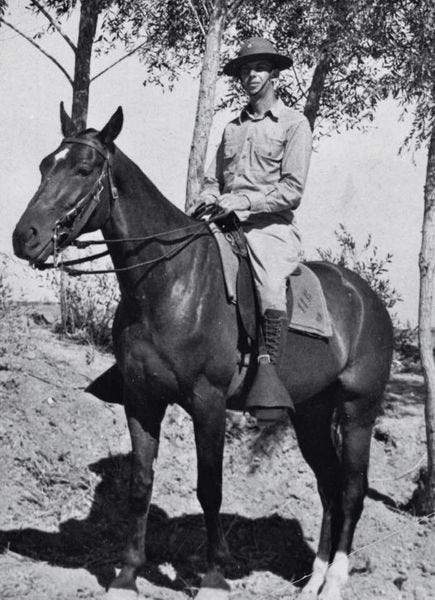
Andy Schifler: I just once, I didn’t take a remount. Cy. They all had numbers. You couldn’t shoot that horse. A civilian had to shoot them.
Aaron Elson: Why was that?
Andy Schifler: They’d maybe hold a court martial. And maybe they had a few of these left when they moved from Monterrey, maybe we had another dozen for about a year. You couldn’t do nothing for a while. They tried. They broke one in for the colonel, they tied him up, they beat the hell, yeah, don’t get caught, you’d get about 20 years.
Aaron Elson: Really?
Andy Schifler: Yeah. Doing what they were doing. Two-by-fours. They broke him in...
Aaron Elson: With a two-by-four? Explain to me how they would do this?
Andy Schifler: Well, on the Q.T. [I should note that when I told Dale Albee, another ex-cavalryman, what Andy said about two by fours, he said there was no way. I would guess that a smaller piece of wood might have been used. But who knows? I initially thought I might have heard Andy wrong, but here it is in the transcript!]
Aaron Elson: But they were wild horses?
Andy Schifler: Yeah, but you couldn’t break them in. Unless you had to break them with a 2-by-4 or something. [This is a little better. He probably meant “or something” on the first reference.]
Aaron Elson: And how would they do that, they’d whack the horse?
Andy Schifler: Get a rope on him, they had something solid, so it’d come to the end, fly up in the air, and just drub him.
Aaron Elson: Really?
Andy Schifler: Yeah, that’s life. And you couldn’t do that. So you had to have them as outlaws, and they’d hold a court martial. Maybe got five numbers, six numbers. The government wants to know what happened to it. And the civilian that shot the horse has to account...
Aaron Elson: You’re losing me. Why would a civilian shoot the horse?
Andy Schifler: They wouldn’t let the Army do it. You’re supposed to be a lover of the animal. That animal has more rights than you. If you fell off the horse, they’d have to get the horse. They left the guy out in the desert.
Aaron Elson:: Did you ever have to take two horses at once, or three horses?
Andy Schifler: Oh yeah. When we were up in the mountains, you had to change horses, every so many, maybe you’d ride one hour and lead two. We had about, I don’t know, a couple of thousand horses down there, and you only had a handful of men, because they were figuring on going (?). You tell some of them guys that were in the cavalry, they’ll...
Aaron Elson: Were there any like special horses”
Andy Schifler: We had horses for polo, but these horses were in there before the war started. These were all the West Point officers, Spanish, they had one nice, you touch his rein and (?), and if you leaned over one side that horse would go that side. Yes, that horse would cost a fortune. They were all cavalrymen.
Aaron Elson: When you got out to the cavalry, was there any sense of history? Had they been in any of the Indian wars, or...
Andy Schifler: They’d been in the Philippines, they fought in the Philippines. They fought in Mexico, Pancho Villa.
Aaron Elson: In the Philippines, who did they fight against, was that the Japanese?
Andy Schifler: I don’t know, it must have been the Philippines, because on that shield it shows, the cavalry shield...
Aaron Elson: This was the 11th Cavalry?
Andy Schifler: The 11th.
Aaron Elson: Did any of the 712th come from the 7th Cavalry?
Andy Schifler: I don’t know, because I think most of them come from the 10th Armored, when we got formed, the 10th Armored, 18,000 men. Then we had to get all them tanks, but all the new tanks were out in England that we got.
Aaron Elson:: So when you went from being a horse cavalry to the tanks, to the 10th Armored, was that a good thing?
Andy Schifler: Well, that was better for me. You know, a horse is a mean animal, you can’t trust him. It’s different if you had the same horse every day, but you got horses that never, you know, everybody rides different. We broke one horse in, instead of putting the bit in the mouth, we did it the opposite. That horse would rear up if anybody did that. They spoiled the horse. See, we had those (?). You’d smell like the horse, you know, because the heat...
Aaron Elson: That must have been terrible in that heat.
Andy Schifler: Terrible.
Aaron Elson: Did anybody collapse from it?
Andy Schifler: Oh yeah. You couldn’t touch any metal. It’s that hot. A lot of guys would keel over. Because they’re up before 4:30 in the morning. I lost fifty pounds I think inside of a month.
Aaron Elson: Really? From the heat.
Andy Schifler: Sure. It’s altogether different. We tried to live on a quart of water a day. It’s rough. Yeah, people don’t know what you go through. See, a lot of these guys near the end of the war that come in, you had about a half a million or four hundred thousand killed. Actually in Europe they must have put it about two million they used. You had about four or five million behind the other two, for replacements. They tried to use the same men. You take a man off the line, he hates like hell to go back in. These guys after being wounded, they figured they were through. They come right back to the trenches.
Aaron Elson: They wanted to get back to their outfits, I think.
Andy Schifler: Well, the outfit needed them, because we lost a lot of men, too. We lost a lot of...
(here we left the restaurant where we had lunch, and returned to Schifler’s house)
Aaron Elson: What did you do after the war?
Andy Schifler: I was in construction, maintenance and construction. Anything new we’d be working on. I helped the electrician, painters, carpenters, you never were laid off. I was making more money than the guy I was working for, see, and that’s how I think I got cancer, too. I got something on the lungs I know.
Aaron Elson:: From breathing in construction dust?
Andy Schifler: Asbestos, and then we had asbestos tops, we were putting in, you had to sand them and varnish over. I’ve got three claims in already, one I think is from Minnesota, one claim from Pennsylvania, now they’re working on the other claim. It isn’t much, it might take five to ten years to get it. But it’s signed, the claims are in, ten percent was paid out already to me. The attorney I had, they’re good, they’re no trouble at all, I don’t even, they go out and get it.
Aaron Elson: Now we were talking about changing from the horses to the tanks.
Andy Schifler: (laughing) Let’s see, where’s the book on that.
Aaron Elson: Let me read this out loud... “Dr. Henry W. Wojtowicz, M.D., 4900 South Archer, medicine over 35 years in the Bergen Park area. Beloved husband of Emily (nee) Symanski. Dear father of Walter and Barbara Calpy, Fond brother of Charlotte, Dr. Bruno Uchsen(?), brother in law of Genevieve, the late George Wojciechowski. Funeral services were held Saturday, Aug. 9.
“During World War II Dr. Wojtowicz served as captain in the Medical Corps attached to the 712th Tank Battalion of the U.S. Army 90th Division. He was awarded the Bronze Star for meritorious service in connection with military operations against the enemy in France and much of central Europe.”
“Henry W. Wojtowicz. Dr. Henry W. Wojtowicz recently returns to the community. A 1942 graduate of Loyola University’s College of Medicine, he served his internship at St. Mary of Nazareth Hospital. Serving in the Army from 1942 to 1946, he was separated from the Medical Corps with a rank of major. He served in this country and the European theater during World War II.
“Returning to civilian life, he spent a year at the University of Illinois College of Medicine doing postgraduate work. This was followed by general practice in this community until January 1952. During the past three and a half years he has been a resident surgeon at the Veterans Administration Hospital, Hines, in preparation for the specialty of general surgery. He lives with his wife, Emily, and son Walter at 4023 S. Francisco Ave.”
“Vladimir Kedrovsky, who led discovery of German gold in a salt mine, measuring Eleanor Pettit for a suit yesterday.” [This was a photo and story clipped from a newspaper, likely the Chicago Tribune]
“Gold is gold, whether it is in a salt mine or a paycheck,” Vladimir Kedrovsky, former lieutenant colonel who led the tank battalion which unearthed the German bullion hoard in a salt mine said yesterday as he pocketed one of his first paychecks since returning to civilian life. Kedrovsky is back as head of the men’s clothing department in a retail store at Arthington Street and Holman Avenue. He lives at 1675 Filmore Street, Gary...”
Now I thought he worked for Sears?
Andy Schifler: He did, at that time. You know how Gary changed...
Aaron Elson: Yes...No, I don’t, but...
Andy Schifler: Goldblatt’s went out of business. That’s about the guys that were taken into the cavalry...
Aaron Elson: (reading) “Chicagoans train in desert. El Centro, Calif. May 30 -- Here, under the broiling sun of America’s hottest spot, the men of the 11th Cavalry, many of them Chicagoans, are preparing for extensive maneuvers along the border. For weeks on end, the sun pours down from a cloudless sky at Camp Seeley at the gateway to California’s great Imperial Valley. It is the lowest Army camp in the world, 50 feet below sea level, and is only 12 miles from the Mexican border.
“The observer is led inevitably to the belief, one without official confirmation, that these soldiers are being conditioned for possible service in the deserts and tropical heat of Central America. Any sort of work is impossible during the midday heat, and the Army day begins at 4:30 in the morning. Work is over by 11:30, and the afternoon is devoted to swimming, parades...”
Andy Schifler: That’s a lot of bunk! That’s a lot of...We had a lot of work to do!
Tape 2, Side 1
Aaron Elson: (reading) …parades, and the time-honored Spanish custom of a siesta.
(subhead) 140 degrees on rifle range.
“On a recent day it was 110 in the shade of the post exchange and 140 degrees on the rifle range by the river where the sun quickly made rifle barrels too hot to touch. Camp officers, however, say that the men are gaining stamina, “an ability to take it,” and that now with their 13 weeks basic training completed, they’ll be able to go through maneuvers without discomfort.
“Camp Seeley is a temporary camp used only pending the erection of a permanent headquarters at Campo, two miles north of the border and 2,200 feet high. Meanwhile, the men live under canvas, and at nights, with the sidewalls of the tent up, a breeze sometimes strays in to give relief from the heat...”
“Schifler brothers return to camp.
“The Schifler brothers, who were both home on furlough, have returned to their respective camps. Mr. and Mrs. Andrew Schifler, 1915 Loomis, held open house for the boys and their many friends during their 15-day furlough. Aside from the fact that ma’s cooking is incomparable, Private Charles, who is stationed at camp Forrest, Tenn., had another reason for enjoying his homecoming. Sophia Hoyt, 1318 Colorton, is the attractive reason. Amid cheers, tears and handclasps, Charles departed yesterday afternoon. Brother Andrew, who is stationed with the U.S. Cavalry in California, left last week. Friends and relatives are looking forward to their next homecoming.”
“Andrew Schifler, 36006109, Technician 4th Grade Infantry, 712th Tank Battalion, U.S. Army. For gallantry in action on 25 April, 1945, in the vicinity of Schafferei, Germany. A tank platoon was counterattacked by 50 SS troops and subjected to intense rocket and automatic weapons fire which set one tank ablaze and damaged another. At risk of his life, Technician 4th Grade Schifler raced through a hail of fire, mounted the platoon leader’s driverless tank, and drove it in a spearhead advance against the enemy. Despite the unrelenting barrages centered upon him, he operated the tank so adroitly that the other crew members were enabled to rout the enemy with accurate machine gun fire. His gallant action proved inspirational to his comrades and was in accordance with high military tradition. Entered military service from Illinois.”
“Russell W. Loop,” this is GO526HQ 90th Infantry Division, 11 June ‘45. “Russell W. Loop, 36006295, Technician 4th Grade Infantry, 712th Tank Battalion, U.S. Army, for gallantry in action on 16 March, 1945, in the vicinity of Pfaffenheck, Germany, when the tank on which he served as gunner was hit and forced to withdraw, Technician 4th Grade Loop worked under enemy fire evacuating wounded men from the vehicle to a nearby house where he treated them. He then crawled under intense machine gun fire to reach and administer medical treatment to a wounded tank commander. Immediately afterward, he voluntarily accompanied three infantry men in taking a strategically located house, personally killed nine enemy, and helped defend the building against all counterattacks. His gallantry was in accordance with high military tradition. Entered military service from Illinois.”
Do you know this guy Loop? Do you know Russell Loop?
Andy Schifler: I did. He was our sergeant in our tank platoon. Russell Loop.
Aaron Elson: In D Company?
Andy Schifler: Yeah.
Aaron Elson: But he was in C Company.
Andy Schifler: No, we had a Loop. That was him. He was from Zona...
Aaron Elson: He lives in Indianola, now...
Andy Schifler: He was the guy that I think wanted to shoot O’Brient...
Aaron Elson: What? Go on...
AS: Well, he had the lead tank, he had to go first. See, Patton changed it, he didn’t want the lieutenants all being killed. So they put the platoon sergeants in the lead. Is he still living?
Aaron Elson: Yeah, he lives in Indianola. I was going to give him a call. I met him. This was a Bronze star that you got?
Andy Schifler: Silver. It tells you on that paper.
Aaron Elson: I’ll read this again, and you tell me what you remember of it. You were describing it before. “April 25, 1945, in the vicinity of Schafferei...”
Andy Schifler: ...When they hit the building on us...
Aaron Elson: “A tank platoon was counterattacked by 50 SS troops...”:
Andy Schifler: I don’t know how many there were, all I know, I come running around the back, round out in the open...Well, I figured, if they’re gonna get us, they’re gonna get us one way or another. I knew there were, our infantry was behind me and I knew the other tanks were maybe 100 yards away from where we were. So I went around and got into the, clear enough, because there was a big fire, I mean you could see, the building got hit, that’s how I got...”
Aaron Elson: The building got hit?
Andy Schifler: And I jumped without shoes or anything, I jumped out. I figured, you’d better get around. I did, and I got in the tank, and I drove out, and must have scared half of them, and I swung around and I went back and I picked up the lieutenant and Fletcher.
Aaron Elson: Fletcher?
Andy Schifler:: Fletcher. He was my assistant gunner. Driver and gunner. (Hugh H. Fletcher from Afton, N.Y.).
Aaron Elson: Now the tank that was hit, was anyone killed in it?
Andy Schifler: That was, no, one hit, and one was on fire. Two of them got damaged out of that. And the other three tanks, the one I saved, and the two on the corner from the other...
Aaron Elson: Had people been in the tank when it was hit?
Andy Schifler: No. Nobody was in the tanks. They were trying to attack that night. See, they figured they could do some damage. They must have known the Army company of infantry was over on that side, they come from the wooded side. Somebody was on guard, I don’t know if Horn was on guard or something, because you can’t do nothing, you don’t know at night, it’s dark, and when they started, then you got the lights, because the tank was burning...
Aaron Elson: Okay... “At risk of his life, Technician 4th Grade Schifler raced through a hail of fire...”
Andy Schifler: Don’t ask me. I tell you, there’s miracles, you wouldn’t believe. I was sitting in the tank and the guy was in the foxhole, and the medics was walking, was running up and down. The guy in the foxhole was killed, none of the medics that were carrying the guys got hurt. It’s, nature or something takes care of you. Figure that. You’d be surprised how some of this happens. Your mind’s nowhere, you know, to fight or that, your mind is, get out and get that, before they burn them or damage everything. you don’t, there’s no idea of you’re gonna do this, that’s why it’s buddy-buddy in the Army. If nobody went out, we would have lost all three tanks, and maybe got killed.
Aaron Elson: But it was you that went out?
Andy Schifler: Well, I was right there. I already had it figured. I figured when I put the tank in that barn, if something happens, we’ve gotta move. It sure happened. I says, “Protection or no protection, they’ll get in on us.” That’s why our 90th commander didn’t want to take no division or that, like Patton wanted to give him, because they hadn’t been what they were supposed to do. Two men, three men, can hold an armored division back, right? Maybe for half an hour or an hour. Till they find where you’re at. You can hold a whole fuckin’ column. That’s all it takes. One man can...
That’s what they’re doing in, what is that, down in Yugoslavia or down in, they’re fighting out of the hills. How the hell are you gonna pick, you know, it takes a lot of men. You know, in that, that concentration camp, we were close there, you know what I mean, but everybody can’t go there. You’re with a certain outfit, you’re at a certain point, the closest guys go to the place. That’s how it’s ... that Schmidt we had, I don’t know what company he was in, he got shot up on one of our light tanks, he was riding on that, he knew there’s a, he told the driver, said there must be Italian mines, they were gonna go over on an island, it had blew up and Schmidt, he got got, I think he lost about three tanks or more...
Aaron Elson:: Schmidt?
Andy Schifler: Yeah. I don’t know what company. ]This would be Charles Schmidt of B Company, the battalion’s most decorated soldier.] He was out of a medium tank company.
Aaron Elson: Was he the one who was highly decorated?
Andy Schifler: I never saw him, after that, I don’t know if he got hurt, but he was on the front fender or something. We were getting reports, but now it’s 50-something years, you can’t remember that much.
Aaron Elson: But Schmidt is the one who was decorated?
Andy Schifler: Yeah, he was, I don’t think he wanted to be an officer. I don’t know if he made officer. I don’t know...
Aaron Elson: I think he turned it down.
Andy Schifler: I think he turned it, we had a...
Aaron Elson: Did you know him?
Andy Schifler: No, but I saw him when we got together once. We weren’t much together because the only time you had was in Metz, I think, when we ran out of gas that time. And then they pulled us, I’m watching them coming with these boats, these flat, what do you call those, invasion barges they had. Then the big fuckin’ guns start coming up. I pulled a, I think it was an eight-inch gun, I pulled that. The guy said, “You want to fire it?” Before the firing, he says to me, “You know, I’ll be a sonofabitch,” he says, “rear artillery’s about 20 miles away.” He says, we’re passing up the 155s, 105s, we’re passing up the machine gun nests. He says, “Where the fuck are we?” He told me this. Well, they were bringing them up to blast that fort they had. And this guy said, “You want to pull...” I didn’t know that the fuckin’ noise was that bad. You know, you get so, see, I lost my hearing after...I got up one morning, that was in ‘52 or something, ‘51, and just fell over.
Yeah. You lose your equilibrium. Yeah, it’s funny. I never talked about the war to the kids. They never bothered me.
Aaron Elson: They never ask you about it?
Andy Schifler: No, no, since I put that up, that was the first time, last year, it’ll be about a year now.
Aaron Elson: Now what are all these, we’ll go over that in a minute, let me read Wagnon’s thing here. Wait, first tell me about Sergeant Loop.
Andy Schifler: Ohh, (laughing), he come after O’Brien with a gun in his hand.
Aaron Elson: Really?
Andy Schifler: Yeah. He said, “You sonofabitch, you were leading me, now I’m leading...” that was the order. He was good, though. I think he saved our ass, Loop. The Germans, our unit, our intelligence didn’t tell nothing. We were about three towns ahead of the Army, or anything. They must have had a cavalry unit, not like ours, they come in and they blast the fuckin’ town before they go in, that’s what they were doing. And this nightfall’s coming, and I’m hearing guns, so I think Loop was sent back, I thought they’re gonna kill him, they didn’t believe I don’t think he was American in the first place. Somebody could have shot him. He must have had to put up a white flag or something, and he went out there and saved our ass so we wouldn’t get shelled on. See, you got all fuckin’ bad reports. Intelligence, somebody probably makes up something and you goof up. That was a shame. McNulty got killed and Jenkins, a nice kid, those four got killed, they burned up and shrunk, I know, he was hollerin’, “Shoot me. Shoot me.” He was out this far and he was burnt completely, McNulty. And the guys in there was shrunk.
Aaron Elson: Ohhh, and you saw this?
Andy Schifler: Yes.
[Russell Loop, a tank driver, was transferred to C Company, a medium tank company, as a gunner just prior to the Battle of the Bulge. Mike Solomon, another D Company member, also was transferred. It’s possible that Solomon is the one who had the altercation with Lieutenant O’Brient.]
This is about half of the transcript of my 1995 interview with Andy. I have chosen to only lightly edit the transcript. I will post more of the interview down the road, but there are some other issues and events I want to write about before continuing with the work-in-progress. I will also be posting at least partial transcripts of my interviews with Dale Albee and Lex O’Brient.