
A quiet, early dawn
An excerpt about the battle for Hill 122 from my book "Tanks for the Memories"

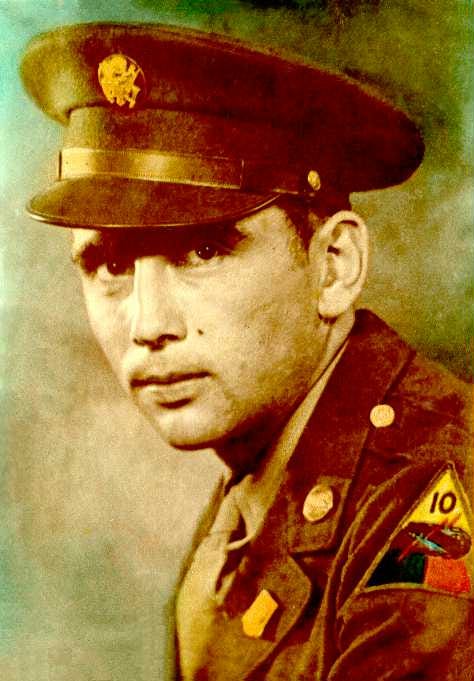
12 July, 1944
When morning came, the 12th, it was a quiet, early dawn. Everything was quiet. You couldn’t hear a shot. In fact, I heard birds singing. I was laying there, and I was really feeling bad. I was feeling so bad that I thought about dying. I wanted to.
Then Jim said, “Give me a cigarette.”
I had cigarettes, but my hands were so huge from the swelling that I couldn’t get into my pocket. The cigarettes were in there, and I wanted one, too.
The next thing he said, he swore a little bit, he said, “Jesus Christ, Jim, you’d better go get some help.”
I said, “Why?”
He said, “I’m getting gangrene in my legs. Can you see a little bit?”
It was hard to talk because I’d swelled up so much. But I knew what he said. I was desperate myself. And everything was quiet. So I crawled out through the hole in the hedgerow. But I turned the wrong way. I was confused, in terms of directions. The tanks were still smoldering. I put my left shoulder to the hedgerow and was crawling along, blind, then I’d stop once in a while and I’d look. And I was trying to call for medics. I don’t know if I got any noise out or not. And I don’t know how far I crawled, but all of a sudden I heard this awful kind of a laugh...
Two days earlier
Jack Sheppard (company commander): There are three Presidential Unit Citations in the 712th. One of them is for the first platoon, C Company. I was with it at the time.
I was taking this tank to Jim Flowers. It was one of his tanks that had been knocked out and we got a replacement for.
We got up on top of the hill and were going down towards Flowers. I was in a jeep leading the tank, with Jim Bailey as my driver, when a lieutenant colonel stopped me. He said, “I need some tanks down there. I’ve got a battalion that’s surrounded by SS and they need tank support but bad.”
I said, “Let me see if I can get Flowers released.” He was with another infantry battalion.
I called the division commander, and he by voice authorized me, so I called up Flowers, and he came back and joined us.
Jim Flowers (lieutenant, platoon leader): I left (Abe) Taylor to get the tanks filled with gasoline and stowed with ammunition. Then I took a map and marked it where I wanted, and I said, “You bring the tanks over there. I’m going ahead to take a look,” to see what the opposition has in store for us.
I got in the jeep with Sheppard. We went back over on Hill 122, and pulled up on the west side, somewhere between that rock quarry and the heavily wooded area.
That’s where I’d marked for Taylor to bring the tanks, and somebody’s got to be there to meet him. So I told Sheppard, you just stay here with Jim Bailey, that was his jeep driver, and when Taylor gets here, just wait for me. If I’m not back within an hour, you’ll know I’m not coming back.
With that, I walked out in the woods and went in an appreciable distance, and I encountered several Germans. They didn’t see me, and I sure wasn’t going to cause any trouble for them right then.
I went in maybe 200 yards. I saw enough to know that the going was not going to be real easy but it’s not going to be disastrous. There’s not all that much stuff out there to stop a tank, not even to slow us down, really. At least I didn’t feel like it at the time.
So I went back, and in the meantime Taylor had arrived with my tanks, and I got my tank commanders together.
He didn’t get there but with four tanks. One of the tanks had engine trouble or something.
We got over to Hill 122 with the tanks. My No. 1 tank, my No. 2 tank, my No. 4 tank, which was Taylor’s tank, and my No. 5 tank. Since Wiley was gone [Sergeant Judd Wiley had been injured by a hatch cover slamming down on his fingers as he went over a hedgerow while holding onto the turret ring), I needed a tank commander. So I said, “Sheppard, you’ve never been in a firefight. Wouldn’t you like to get a little combat experience in a tank?”
I put Sheppard in Taylor’s tank so I could communicate with him, and put Taylor [the platoon sergeant) in Wiley’s tank. Two tanks in the platoon have a two-way radio; the other three only have receivers. Wiley had gone back two days before to get something done about his crushed fingers.
The driver of the No. 4 tank, that’s the one in which I put Sheppard, he wouldn’t go. He wouldn’t drive that tank. They tell me this happened. I didn’t find out about this for probably several years. I often wondered why that man was not in that tank and Bailey was.
Jim Rothschadl (gunner in Lieutenant Flowers’ tank): We had backed off the line, and there was a rumor going around that another tank battalion was going to take our place. We pulled our tanks into a little field, and our kitchen trucks were there.
I remember driving into the field, standing up in the turret. Flowers was outside already, talking with somebody in a jeep.
Sergeant Speier, he was the mess sergeant, he knew I liked pork chops. He used to call me “Pork Chop.” So all of a sudden I heard, “Hey Pork Chop, you hungry?”
I said, “You’re goddamn right!”
And he tossed me up a gallon can of marmalade and a loaf of bread.
We were parked alongside the hedgerow, and somebody came up and said, “You can’t stand outside. You’ve got to get underneath the tank,” because mortar fire might come in.
There was about two feet under the tank, so we crawled under there, and took the gallon can of marmalade – we were so damn hungry – and the loaf of bread. There were four of us, Ed Dzienis, our loader; Gerald Kiballa, the assistant driver; Horace Gary, the driver; and myself. We took a Bowie knife, and we cut open this can of marmalade. And we broke the bread; it wasn’t sliced, so we took chunks off, and we scooped out the marmalade with our hands. We ate the whole gallon.
So we’re laying there, and Sergeant Speier came over and said, “It’ll take about an hour. I’ve got a hot meal for you.” We hadn’t had a hot meal since we left England. About that time, a jeep comes racing into this little field with an officer.
One of our tanks was parked about a hundred feet from our tank, and I noticed a commotion over there. Several people were gathered around it, and people were waving arms. So I walked over there to see what was going on.
And here this guy was, he refused to drive. I couldn’t believe it. “I’m not gonna go,” he was saying. “I’m just not gonna go. The hell with you, I’m not gonna go.” And they put him in a jeep, and away they went. We had been told that the rules of war, if you disobey an order on the front, you don’t have to be court-martialed, they could shoot you right there. They didn’t do that. They took him away.
Sergeant Bailey was the communications sergeant, although he knew how to drive a tank, and damned if he didn’t volunteer to drive that tank.
Louis Gerrard (gunner, Captain Sheppard’s tank): My crew at the time was Earl Holman, Abe Taylor was the tank commander, I was the gunner, G.B. Kennedy was the bow gunner, and then we had a driver, his name was Lochowitz.
I told Flowers, when I was in Louisville [at the 1988 reunion] – that’s the first time I’d seen Flowers since the day we got hit – I told him the guy, he wouldn’t drive the tank, so Bailey said, “Get out. I’ll drive the tank.”
Jack Sheppard: I said to Flowers, ‘There’s only three men in the tank. You need a driver and you need a commander, so Bailey will take over as driver and I’ll take over as commander, but you are the platoon leader, I’m just another tank in your platoon.” He said, “Okay. You follow behind Taylor.” They pulled out in front of me and we pulled along behind them.
Flowers I think fired the machine gun a few times, and all of a sudden we were with this battalion of infantry.
Then we were given orders that we’re going to attack across the road. The road went along a big open field with a hedgerow at the far end. Flowers and K Company of the 358th Infantry were going to take that hedgerow. Famous last words.
Jim Flowers: I led the tanks on into the woods and ran the Germans in front of me until I started seeing some of our own infantry, and I asked them where their battalion commander was. It turned out that this was the 3rd Battalion of the 358th Infantry, and their battalion commander was a man named Jacob Bealke from Sullivan, Missouri, a reserve officer.
When I found Colonel Bealke, he was glad to see me. To say the least, he was glad to see me.
We planned how to get him off of that hill and out of those woods. Some of that brush, it was kind of like a thicket; you couldn’t see through it much less walk through it, and they had been catching hell.
They had managed to capture eight of the Germans that I had run down that way, and from them we found out that this is part of the 15th Regiment of the 5th SS Parachute Infantry Division. These were fairly clean kids. Most of them looked like they might have been in their early to mid-twenties. They had had a bath and a shave recently, and had had something to eat, they had clean uniforms, the whole nine yards. We probably looked like a scurvy bunch of bums by then.
Bealke and I made a plan on how to get out of there. I’d take my tanks and knock this underbrush and thicket down so his infantry could get out. That’s one of the reasons they were trapped in there. I’ll knock some paths through this stuff so y’all can walk behind me to get out.
At first, the infantry was walking in front of me, but that didn’t last long. We hadn’t gone but a short distance and they fell back in line with my tanks. And that didn’t last but a few yards. They just couldn’t get through that stuff, and there was a heavy concentration of German soldiers.
Our plan was to get down the side of the hill, which in some places was pretty steep, and out of the woods onto this hard-surface road, then go on out into the fields on the other side of the road and try to get him up on the line with Pond’s battalion.
Everything worked out according to plan, except for one thing: The infantry got bogged down.
We got down to the hardtop road, and now I don’t know where the infantry is. I had no idea that the Germans were decimating Bealke’s infantry now.
As I come out of the woods and onto that hardtop road, I look both ways and don’t see a damn thing. Everything looks fine, so I go across the ditch and the hedgerow on the other side, and out into a field.
In front of me was a swampy area. I could tell by the vegetation growing there. I got on the radio and told the other tanks to look out for that as they came across the road. Don’t run into that marshy area there and get stuck.
I went around on the right side of this marsh, and as Sheppard came across, why, Bailey ran him out in it and got stuck.
Taylor, who was in Wiley’s tank, and Kenneth Titman, who was in the No. 5 tank, they went around on the left side and went on. Then Sheppard got on the radio and said, “Jim, I’m stuck back here.”
I thought, “Damn!”
“What do you want me to do now?”
“Well, you’ve still got your tank gun, your 75. You can support my advance by fire. When I have an opportunity, I’ll get somebody back there to pull you out of that marsh.”
I went on, and out in this field there’s bushes, weeds and stuff. And there’s a hedgerow up there. I don’t remember if there’s any trees, although there might have been. The thing that I do remember is that the artillery and mortar fire from the German side was falling in on us kind of like hail or raindrops, boy, there was a lot of it.
I’d run quite a distance across the second field in after I crossed the road, and Taylor’s tank and Titman’s tank are off on my left, nothing on my right. After I’d run quite a distance out into that second field, I recall seeing a blinding flash of light and hearing this big bell ringing.
What had happened, the Germans had fired an armor-piercing shot from an anti-tank gun and I saw the muzzle flash. The ringing was that the shell had bounced off of my turret.
I immediately had Gary stop and back up. I’m sure that I’m in a fire lane that they’ve cut.
At the same time, I’m on the radio telling the other tanks to look out for that anti-tank gun and giving them the approximate location of it. Let’s be careful. So after Gary backed up, I had him pull to the right and then go forward. Hopefully I’m out of this guy’s fire line. I’m sure not going to slow down to find out.
As we do that, we hadn’t pulled up too far until, I don’t know whether it was an armor-piercing shot, it might have been a bazooka, I don’t know what it was but it came through the right sponson, where a bunch of ammunition is stored, and ignited the propelling charge in this 75-millimeter ammunition and clipped off my right forefoot, and I suppose that whatever it was probably went out the other side.
Instantaneously, the tank is a ball of fire.
I like to dramatize this a little bit by saying that I’m now standing in the middle of Hell, with all these flames shooting up around me.
I get on the intercom and tell the crew, “Let’s get out of here!” And I reach down and grab Rothschadl, my gunner, who’s sitting in a seat down in front of me. I grab Rothschadl by the shoulders and yank him out of that seat, and start to push him up to get him out of the turret. At this point I don’t know that I’ve been hit.
After I pushed Rothschadl out on top, I turned around to climb out myself, and as I stepped up on that ring around where the top and the bottom of the turret are bolted together, I didn’t have anything to step with. That’s when I realized that something is happening.
I fell down to the bottom of the turret basket, and to this day I don’t know whether I fell or whether it was Dzienis climbing up my back to get out. It’s immaterial anyhow.
Jeanette Flowers (Jim’s wife): You told him to abandon tank.
Jim Flowers: Yes, but don’t drag me down in this barbecue pit!
I pulled myself and crawled out onto the turret and jumped down on the ground, and looked down, and that’s when I saw I didn’t have much of a right foot left.
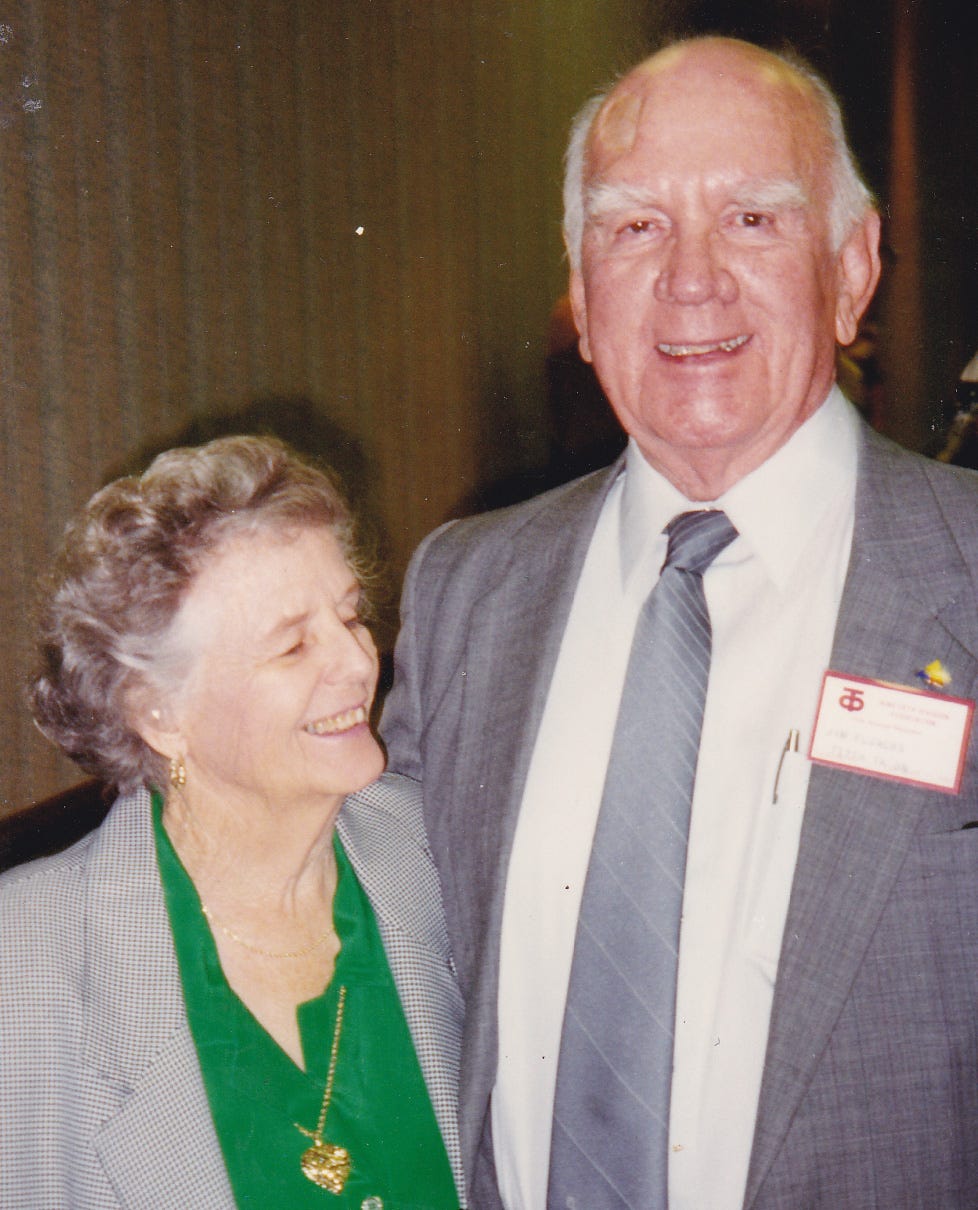
Fortunately, when I climbed out of the tank, I guess it was a reflex, I grabbed my tommy gun and hung it over my arm, and when I hit the ground, I’m armed. There was a hedgerow in front of me, and the Germans on the other side started shooting at us.
When they knocked out my tank, they got all four of my ranks, right then and there.
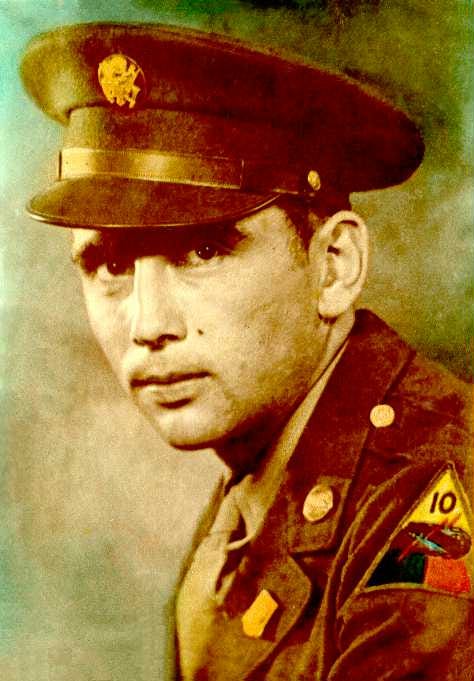
Jim Rothschadl: We were told in training, “Don’t freeze.” I guess a few guys did. They got so petrified or frightened they just froze. But I kept saying to myself, “Don’t freeze. Watch.” So I didn’t freeze. But I was damn scared.
The turret had a toggle in it that was electrical, but it also had a little wheel so you could traverse the gun manually. When my tank got hit, the little wheel was right in front of me, and it knocked four of my teeth out.
The Germans were dug in on this hill, hundreds of them. They were close together, with lots of foxholes. And some were on top, working the machine guns.
I was firing the .30-caliber machine gun. I was a little heavy on the trigger. We were told to fire short bursts or the barrel would melt. Dzienis had a pair of big asbestos mittens, and he would screw the barrel off and put on another one. The barrel got so hot that it bent a little bit and the bullets were falling in front of the tank. Meanwhile, they were firing at us with small arms and rifle grenades. The grenades were magnesium. They would weld themselves onto the tank, and almost go all the way through. They would aim at the turret circle. If one hit there you couldn’t turn the turret.
Then the first big shell hit. It lifted the tank about two feet off the ground.
Flowers was looking for the gun. He told me to traverse from the middle to the right. I quit firing the .30 and switched to the 75.
Horace Gary, he was the driver, started swearing, “God damn it! Let’s get out of this sonofabitch, we’re sitting ducks!” And Flowers told me to traverse to the right. I was trying to pick out something but I couldn’t, through the periscope. I did see a heat wave, where the blast was from, and I fired one round in there.
A few seconds later, the second shell hit. There was this humongous explosion, and racket, and heat.
The turret was open. It immediately caught fire. And the shell went right on through. Those German 88s could hit the front of a tank and come right out the back. They had double the velocity of our 75s.
I remember I was burning. I was trying to get up from my little seat. I thought just for a moment about unplugging the radio. But the tank was flaming inside. I got out by myself as far as my armpits. Then I fell back in.
Flowers helped me out. I kind of revived and got some air, and I got out of the turret as far as my belly. Then Flowers let himself off because there wasn’t enough room for the two of us. I saw him fall backwards onto the ground.
When I finally got out I let myself fall head-first onto the ground. My clothes were burning. I had my senses. We had been told in training that you’ve got to get the fire out. So I started to roll. Lo and behold, all of a sudden, plunk! I fell down into a hole. It was four or five feet deep, and there was a lot of loose dirt. I plunked down in there, and covered myself with this dirt. Otherwise I wouldn’t be sitting here.
Jack Sheppard: We pulled up to the road, all in a line, and fired at the hedgerow with the cannon and the machine gun, just raked it, and high explosive, all to hell. The platoon leader of the infantry says “Let’s go!” So we all go, tanks and infantry, the infantry behind the tanks.
We get across that road, and my tank hits a mud hole and tips over. The right track had no traction whatsoever, so we were just sitting there.
I had my head out of the turret, and my carbine in my hand.
About that time, the other tanks disappeared over the hedgerow. Then a round came in from the right and hit the gunner’s periscope. It blew up, and blasted straight on through to the other side of the tank. All of the recoil cylinders in the gun had holes punched in them, so the gun couldn’t be fired. The radio was full of holes, and it didn’t work. So we had no reason for staying in the tank, and Gerrard had his right eye hanging on his cheek, he was in bad shape. He was not unconscious, but he was in extreme pain.
My hands were outside the cupola, and it busted the stock of my carbine and injured me a couple of places on the hand. It blew my helmet off, and knocked my captain’s bars off it.
We all got out and got behind the tank, and they were looking after Gerrard. I was leaking blood all over my face, and we were trying to figure out what to do.
I said, “You all stay here and take care of his wounds, and I’ll go back across the road to see if I can get a stretcher and send it back.” I did that. But while I was jogging back, my jaw was flopping up and down, and I had a piece of shrapnel, how big is your thumb? It went through and knocked a tooth out, and it stayed right there.
Louis Gerrard: We couldn’t do anything, we couldn’t go anywhere, so Sheppard said, “We’d better bail out of the tank.”
I took my tank helmet off and put my steel helmet on, and was getting ready to come up, when “Balloom!” We got hit right on my side of the turret, and I practically flew out of the tank.
When I was laying on the ground, the rest of the crew came around me, and there was a medic. He was putting sulfa drugs on my arms, and somebody said, “Here come the Germans!”
Earl Holman started getting his gun, and somebody said, “Whatever you do, don’t fire,” because they would have mutilated us. There were 15 or 20 Germans.
I told the guys, “Get out of here, go on,” so they all went. Bailey stayed. He was the last one there, and I kept telling him, “Go, go,” and he got killed getting away. I laid there half-dead.
The Germans took the medic with them. And they took my wristwatch. My brother Jack had given me a ring with the word “Oran,” in Africa. He gave it to me when I was in England, and I wore it all the time. They tried like hell to get that off my finger. They couldn’t get it off, so they gave up on that, but they took my watch.
I didn’t say anything. The medic had told me to play dead, so I was just dead when they came. All I could hear was German. I didn’t know what they were talking about, although I could understand the word “eie.” They must have been commenting about my eye.
I was thinking I was going to get killed by these Germans coming, and I was thinking about my mother, what would she say? She took it hard when my oldest brother was killed [Gerrard learned on June 6 that one of his brothers had been killed in North Africa], and I thought, now she’ll get word another one’s killed.
The Germans grabbed me by the heels and put me up on a hill. I think they must have done that so somebody could find me. I don’t know what the reason was, but they did that. Then they heard something and they were all in a big rush; they took off real fast. I was expecting a bayonet in the back or the chest, or a shot in the head. I didn’t know what the Germans were going to do.
Charles Nuccio (Sergeant, C Company): We had a fellow named Bailey, they never did find him. Bailey was a maintenance man. A funny thing about him, every time he worked on an engine, he always had screws and bolts left over, but the tank worked. His downfall was that he had more German equipment on him than he had American equipment, and our thinking was that he got captured, and when they found all that stuff on him, they just – we found his brains in his helmet. We never did find his body. They probably cold-bloodedly killed him, finding him with all the German stuff he had on him.
Kenneth Titman (tank commander): We were coming into this open field. Three tanks were together. When we got in there, the German 88s got us. They hit my tank and it exploded, and I hollered “Abandon tank!” The tank was on fire. I looked around and I saw all these tanks running, one tank ran in front of me and hit the tank on the left and both exploded. That’s what I saw.
I jumped out of the turret and hit the back deck. Blood was coming out of the top of my combat boot, and I knew I was hit.
When I got down off the tank and looked up, I saw the loader coming out of the turret, and he was on fire when he hit the ground.
I knew [Kenneth] Cohron, my gunner, didn’t come out, because the 88 hit him directly and I had some of his flesh on my helmet.
[Clarence] Morrison, the driver, put the tank in reverse. The assistant driver dropped the escape hatch, and the tank had power enough to back off, and the two of them got out from under the tank. I don’t know where they went after that.
When I got out, I went for a slit trench, and when I got in it, here comes a bunch of Germans, and they stuck a gun at me.
I said, “Alles kaput,” and they saw my leg was all shot up. They put me on a litter and took me back to the rear.
Michael Vona (assistant driver, Titman’s tank): Before we went, Abe [Taylor] said to me, “Mickey, saddle up. This is it.” And I said in Italian, “Oom-gatz.” Saddle up. I hung out with certain guys. You didn’t know all of the platoon, because you didn’t hang out with them. Just like the first 25 miles in basic training, I carried the company flag. I got a pass for that. I said to [Frank] Perry, “Come on, Frank, let’s go.” Boom! We went to Phenix City; we were shooting pool. Oh, Jeez, they had kids over there, 12-year-old prostitutes. They were paying all the churches off to keep their mouth shut.
“Hand to hand combat [looking at a diagram of the battle].” That’s me. I was hand to hand. I had a pistol at my head. It went “click.” And we fought. The guy scratched me all up. See, these things you hate to say but you’ve got to say it because you want to know. He really gave me a good wallop. Besides, I was hit with a grenade.
Now we’re fighting. You ought to see the words I was using. He scratched me all up. If you want to know the language I used, I can’t say on account of my wife is here, you know what I mean? And there was a medic on this side, on the left of me. Now on that left side there were quite a few guys in holes. But I don’t know if Dzienis was there.
My buddy Taylor, I saw him fly out of the tank. He was up in front near the wall. And then when I got hit with the grenade, that’s when this guy started beating me up but then he put the pistol to my head. I grabbed ahold of him, and the pistol clicked. So I’m fighting and I’m swearing, he was scratching me, and I’ve got him by the neck. I’ve got one hand trying to hold where the pistol was, and I’ve got him by the neck – as small as I was, I was 129 pounds, but he wasn’t that much bigger. He had a helmet on, but I think it came off because we were fighting. I don’t remember if he had blond hair, black hair, blue eyes, or purple hair. I figured I wasn’t gonna last anyway. That’s the way you think.
Him and I, we really had it out, he was scratching me, and I was whacking him. I’m hollering, “Shoot the son....” you know, SOB and all that crap, “F” and all those words.
I used to play the harmonica. I mean, you can laugh it off at times, but it’s hard, it’s there all the time. I don’t care what anybody says. I don’t know who shot the German. There was a medic there, it could have been him. But I saw a bunch of guys – later on, as darkness came – there were Germans walking up and down. Now, the guy that I was fighting with, he’s on top of me. I jumped in a hole and I pulled him in the hole on top of me. Morrison was in a corner of the hole. He was hurt in the eye. I talked to him and he was all right, and I was smoking, with the German over me. He was still alive. He was still groaning. I thought later I should have given him his last rites.
I said, “I’ve got to see what this guy’s got.” I put my hands in his pocket. I see English money. I said this bastard took it from the English. Then I waited until it got dark. I said, “Morrison, we’ve got to get out of here.” Because I saw these guys walking back and forth ... but we had a cover over the foxhole.
I got his luger, and I’m looking for ammunition. He hasn’t got any. All he had was a bayonet. I gave that to Morrison. I said, “Morrison, we’ve got to get out of here. We’ve got to take a shot. Either we get it or we don’t.” I was shitting my pants, too, you know what I mean, like everybody else was. Then I heard somebody starting to cry. You can’t blame that, I mean.
It was Dzienis. Dzienis was directly across from me. The poor kid. I was a kid myself, I was 24, but Dzienis wasn’t a type like me. I was a runaround. Not a runaround, I was a good boy, for my age. But I had more freedom I guess. He was like a mama’s boy. But he was a nice kid, believe me. So I crawled up to him. I said, “Dzienis, I can’t take you back. You stay here, they’ll probably pick you up, or I’ll try to get somebody.” As we came back, the tank that was against the wall, that was Flowers’, it was still burning. I said to Morrison, “Let’s start walking toward” – I mean not walking, we’re lying down, and you’re crawling, and he’s got that bayonet – so we start hearing noises. I said, “Uh-oh, let’s not go near there.” There were a lot of people talking. There was light from the [burning] tank. Now we get to the wall. I said, “Morrison, we’ve got to get over this wall.” We don’t know what’s over the wall. You lose direction. I thought it was the Germans, but it wasn’t. Morrison ran into an American guy. But when he went forward, I went to the left, and I passed out, because I’d lost too much blood. That German, what a wallop he gave me in the head. And not only that, I was scratched. It took them I don’t know how many months to clean that all up. I’ve still got a hunk of steel in me from the grenade, in my chest. I’m saving that for the next war.
Jim Rothschadl: I lay there for quite a while. My hands were all burned, and my face. I stuck my hands into the dirt.
Meanwhile, the goddamn devils were firing at us. I could see tracers going over the top of the hole.
After a while the firing stopped, to almost nothing. By that time it was almost dusk. Flowers had crawled from where he was laying by the tank to a hedgerow that was about 25 feet away. There was a hole in the hedgerow that was made by a bomb or something. Flowers crawled through there and lay down on the other side.
Then he began calling my name. I could hear him plaintively. He usually called me “Corporal Rothschadl,” but several of the times he said, “Jim, Jim, please come over here. Please come over here! Corporal Rothschadl.” He said it many times, at least a dozen times, by the time I crawled through there.
In addition to my burns, the tendon on my right foot was cut. I don’t know if it was a gunshot or a shrapnel wound, but it cut the tendon. I could take my foot and pull it up until my toe touched the leg.
And it didn’t hurt. I crawled over there. I was dazed, but I had my faculties. I kept following his voice. I came through this hole in the hedgerow and there he was, laying flat on his back.
Jim Flowers: After we got on the ground, there were a few infantry soldiers and a few of the tankers. We can’t stay where we are, with these burning tanks and the Germans over on the other side of that hedgerow shooting at us. The only thing we can do is get over on that side of the hedgerow with them. So I gathered up whatever we had, and we attacked that hedgerow, and got over on the other side. It was messy, but it didn’t last long.
We ran the Germans off, and then we moved over a distance and got into a field on the right side of where my tanks were burning, and that’s as far as we’re going.
By now, the blood is squirting out of my foot, and my face and hands are burned, all the skin is falling off my hands. So I had Gary, my driver, help me get my belt off. I had coveralls on over an o.d. [olive drab] uniform. I got my belt off and put it around my right leg above my knee, and picked up a stick, and we twisted the stick to make an improvised tourniquet.
After we got that done, I had him reach in my coverall breast pocket and get out my package of morphine syrettes.
There also was an infantry soldier with us who had been hit real hard in both legs.
Jim Rothschadl: On that side of the hedgerow was a pie-shaped field, about four acres in size. We were laying there, it was still daylight, and there were some infantry boys with us. And then god damn, they started firing at some Germans that were coming across a hedgerow on the other side of this field. There was a hell of a firefight going on.
Pretty soon things quieted down, though, and by now it was getting dark. Flowers told everybody who could walk to try to go find help.
Jim Flowers: I had Gary use a syrette on each one of us – Rothschadl, the infantry soldier and me. He took a pocket knife and cut a hole through our clothing. Then I told him, everybody that you can find that’s ambulatory, get them the hell out of here.
That left Rothschadl and this infantry soldier and me out there on the ground. Rothschadl had been burned in the face. He could hardly see; his eyes were swollen shut.
I had no idea what the situation was back there with Bealke and his boys, but I said to the others, go back and as soon as you can, get an aid man and a couple of litter teams out here.
So Gary got the guys that were still around and started back. On the way back, that’s where Gerald Kiballa, who was my assistant driver, got killed.
By now it’s getting late in the day. Sometime that night, I heard something moving down the other side of the hedgerow, which was over where my tanks were burning. They had exploded in the meantime.
I listened, and it wasn’t coming from the right direction. It was coming from behind me, back where the Germans were. So I crawled up on the hedgerow and with the few rounds of ammunition I had left in that magazine, I sprayed in the direction that I could hear these boys coming from. I don’t know whether I hit any of them or whether they knew where the firing was coming from. But they didn’t bother me.
I crawled back down the hedgerow where I’d been laying and waited and waited, and sometime during the dark hours, I heard somebody coming up on the same side of the hedgerow that I was on.
I told this infantry kid and Rothschadl, “Don’t move. Don’t make a sound. Don’t even breathe deeply.” But these guys were coming right to us. And in a little bit, the one that was in front stopped and looked, and he said something in German to the fellow behind him. They were in file, and they just walked around us. I don’t know whether they thought we were dead or what. They could see that if we weren’t dead, we weren’t long for this world. But the last man, or one of the last men, in that little column stopped and came over to us, and he had a red cross on his arm.
That boy came over, and he looked at us, and he checked my tourniquet. The bleeding had long since stopped. He checked it to be sure that I had released the tension on it. And he opened his first aid kit, which was a canvas bag, and he got out a gauze roller bandage. My combat jacket had knit cuffs. He pushed those cuffs back up. I had a wristwatch on my left arm and an identification bracelet on my right. He just slid them up as much as he could to expose these burned hands, and he went to work bandaging each finger individually, and then my whole hand up to a point above where the burns were. He looked at my burned face. Of course there was nothing he could do about that.
I asked the man for water, and he didn’t give me any. It’s possible he didn’t understand, but I think he did, so he probably just didn’t have any water.
Then he went over and bandaged Rothschadl, and he looked at the infantry soldier.
That’s the night of the 10th. I don’t know how many German soldiers moved through. I thought for a while it was a whole German army, but it was probably 12 or 15 men.
Jim Rothschadl: Later that night these Germans walked up to us. One of them stopped and knelt down alongside of me, and I could see a red cross on his arm. The swelling in my face had closed my eyes, but I could see if I pulled the skin down below my right eye. And I was so goddamn thirsty. I said “Wasser.” I could speak a little German; my dad could speak German. I looked up and he was kneeling down, and he pulled out a canteen. I saw this canteen and I thought, he’s going to give me some water! And he took the cap off and tipped the canteen upside down. He didn’t have any water. But he bandaged my hands. He put some gauze on them. Then he did something with Jim, and there was an infantry boy that was laying there, too, who was still alive.
The infantry boy was moaning. He was trying to talk. He was in really bad shape. He was wounded in both legs, and he had a bad wound in the stomach.
Jim had five morphine syrettes. He gave me a shot early on, while I was still in a state of shock. That lasted about three hours. And I guess he gave himself some, and he gave the infantry boy some. I got one shot, I might have had two, I don’t know.
The next morning, we were still laying there. We didn’t sleep much. The Germans set up their line right there, and they were walking back and forth past us all the time.
I can’t figure out why they didn’t kill us. They must have thought we looked so damn horrible that we weren’t gonna hurt anybody.
That day, our people – we must have been quite a ways out there from our lines because they put artillery in, and they don’t put artillery in at close range. The Germans were lined up where our tanks were burned out, and our people knew they were lined up there. So they laid a hell of an artillery barrage, not knowing that we were there. Even if they had known they would have done it.
It practically plowed up that field. And one shell landed between Jim and the infantry boy. I heard Jim scream. And I looked over there and Jesus Christ, his other leg was gone.
Somehow he managed to get a tourniquet on it. It’s Sunday night now. We were out there the night of the 10th, and this is the night of the 11th.
During that night, the Germans did what they did many other times: They picked up their stuff and moved back a few hedgerows.
Jim Flowers: Sometime on the 11th, our artillery shelled that position, and it ended the war for some of the German kids because I could hear them screaming. And one of the shells landed just right to hit the infantry boy and me. Shell fragments hit the infantry soldier and me, and did an almost complete traumatic amputation of my left leg this time, about seven inches below my knee.
I had to get this belt off of my right leg and over to my left one, because I haven’t got all that much blood left, especially since I’m pretty well dehydrated.
I took the belt off of my right leg and put it on the left, and then pulled it up as tightly as I could, twisted the stick, and slowed the blood down. Then I checked Rothschadl. He didn’t get any shell fragments.
The infantry boy had been hit. He’d been hit hard.
I crawled, and pulled myself on my elbows over to him, and he’s a bloody mess. I can’t just lay there calmly and let this boy join his ancestors. So with whatever mobility I had left in my bandaged hands, I managed to tear some of his clothing off of him and get it ripped up into strips to put some compresses over the places where he’s bleeding badly.
We made it through the rest of the day. That night the Germans evacuated that position, and in the meantime our artillery had stopped trying to kill me. There’s a boy named Frank Norris who was a lieutenant colonel commanding a field artillery battalion in the 90th Infantry Division, and who became a major general after the war. I’ve accused Frank of trying to kill me. He said hell, he didn’t even know me. We laugh about it, and he admits that it could have been his battalion that was firing on that position.
Sometime on the morning of the 12th, this infantry soldier told me he wasn’t going to make it, and he asked me to administer the last rites to him. I don’t know whether I told him but I’m not a Catholic boy, I’m a Baptist. I don’t understand anything about the last rites of the Catholic church, but I can pray, that was one thing I can do. So I crawled over and did the best I could, but at the same time I admonished this boy for even thinking about dying, and asked him to just hang on a while longer, they’ll be here eventually to get us.
He didn’t make it.
Jim Rothschadl: When morning came, the 12th, it was a quiet, early dawn. Everything was quiet. You couldn’t hear a shot. In fact, I heard birds singing. I was laying there, and I was really feeling bad. I was feeling so bad that I thought about dying. I wanted to.
Then Jim said, “Give me a cigarette.”
I had cigarettes, but my hands were so huge from the swelling that I couldn’t get into my pocket. The cigarettes were in there, and I wanted one, too.
The next thing he said, he swore a little bit, he said, “Jesus Christ, Jim, you’d better go get some help.”
I said, “Why?”
He said, “I’m getting gangrene in my legs. Can you see a little bit?”
It was hard to talk because I’d swelled up so much. But I knew what he said. I was desperate myself. And everything was quiet. So I crawled out through the hole in the hedgerow. But I turned the wrong way. I was confused, in terms of directions. The tanks were still smoldering. I put my left shoulder to the hedgerow and was crawling along, blind, then I’d stop once in a while and I’d look. And I was trying to call for medics. I don’t know if I got any noise out or not. And I don’t know how far I crawled, but all of a sudden I heard this awful kind of a laugh. There I was, sitting in front of a German machine gun nest. There were three guys behind it. It was a water-cooled machine gun, because it had the big casing on the barrel. And they were looking at me. They were saying something and they laughed. And I thought, “Okay, shoot me. Go ahead.” I didn’t give a damn.
They must have thought I looked awful. My clothes were burned, I suppose, and I was all puffed up.
After a few seconds I turned around. I put my right shoulder to the hedgerow and I crawled back. I came back to the hole and continued on past it, and I’d stop every once in a while and try to call for medics. There was nothing wrong with my hearing, and I heard a little noise. So I opened my eye up, and there was a GI. He must have been down on his hands and knees because I saw the helmet down toward the ground, and a head. Even though I couldn’t see that well I immediately recognized that it was a GI helmet. So I must have hollered or something, and pretty soon three or four of them came from around a corner in the hedgerow.
They picked me up and carried me some distance. It wasn’t too far. They were going through water. I could hear water. I was so goddamn thirsty. They had me down, and I was begging for water. And I heard one of the guys say, “Just give him a little bit now.” I could have drank a barrel. “Don’t give him much now, just a little bit.” And I was angry about that, because I was so thirsty.
I got that water down. Then I was telling these guys – by that time there were eight or nine of them – that my lieutenant is laying back there. I begged for them to go back and get him.
So they left. They came back in a few minutes and said, “He’s dead.”
I tried to get up, and I said, “No, no.” I was begging and begging, and they went back again. They brought Jim and laid him down alongside of me, and they sent for some people with stretchers.
They carried us on stretchers until they came to a jeep, and they laid us both on the hood of the jeep, crossways. The jeep took us to an aid station, and then they put us on the hood of a different jeep, which took us down to the beach.
They took us down to the beach, and this jeep went right into the water, and took us to an LST. And it was full of wounded men. They left space for walking, but the LST was full.
Jim Flowers: Sometime that morning, I heard some noise coming in my direction.
The first clear recollection I have is hearing this voice say, “Well, here’s some more of ‘em.” Then he said, “Wait, here’s another one.” This is coming my way. When they got up close to me, one of these boys says, “Here’s one I think is still alive.” After I assured him that I was still with it, he came over with a lieutenant. It turned out that this is G Company of the 357th Infantry, and the lieutenant was a boy from the western part of Texas, his name is Claude Lovett.
Claude looked at me, and I asked him for a drink of water, so he gave me some out of his canteen. He got on his radio and called back and told them to get some litters up there.
Jim Rothschadl: When we got to the hospital in Southampton, Jim and I were still together. I was on a gurney and he was laying over to my right.
Some doctors and nurses came over. They were looking at me, and one of the nurses hollered, “Jesus! Come and look at this guy. They must be using gas over there!” Then the chaplain came in, and he gave me the last rites. I didn’t want him to. I said “Damn!” I swore at him, and told him to get the hell away from me. I made it this far I’m gonna make it. I don’t need no last rites. I was really angry. But he went through the procedure.
Jim was still nearby, and I heard him talking. The last words he said before we were separated, he said, “Goddamn it. Take good care of that corporal. He’s the best goddamn gunner in the United States Army.”
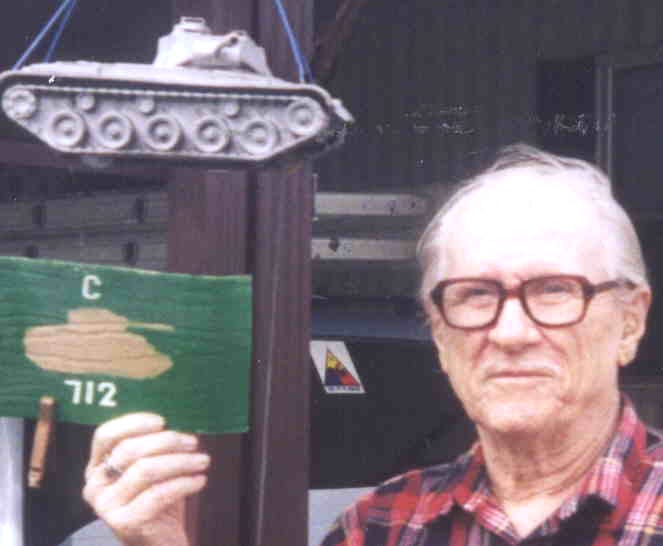
Jack Sheppard: After the infantry took the area, I went up with the first sergeant, and we looked in the tanks, and there’s nothing but ashes down on the bottom.
Right next to one tank was a foxhole, and in it was Abraham Taylor. He had a rifle leaning over the edge, and he was dead. He had been shot through the head. But he was the only one I knew for sure was dead. All the rest you wondered about. Did they get out and were taken prisoner, or what?
After that, we were down to seven [out of an original 15] tanks in the company, and not many men. When the first replacements came on, we weren’t wearing any insignias, because the snipers would use them as targets, and the only way you could identify an officer was I had a white stripe, about an inch and a half long and about four inches wide, down the back of the helmet. If it was up and down it was an officer, if it was sideways it was a sergeant, so you knew who the command was.
These recruits walked up to us and we’re all just standing there, and one of them looks at me and says, “Hey, Mac, what in the hell happened to you?” And the first sergeant says, “Shut your mouth. That’s a company commander!” That must have made their day. If a company commander can get looking like that, what’s going to happen to them? I still had my combat jacket, and it had blood stains on it. And my face was bandaged, my hand was bandaged, and I still had two of the most glorious black eyes from the concussion.
Kenneth Titman: The Germans took me to an interrogating officer. And he said, “You know, your battle is over. You’re going back to the rear.”
And I said, “Oh?”
He said, “Yes. The war is over for you. What outfit are you from?”
I wouldn’t tell him.
Then he said, “How many men are back there [in the tanks]?”
I said, “I don’t know.”
I was sitting there, and while this guy was asking me all those questions, they opened up one of those burp guns. And I said, “What was that?”
He said, “That’s somebody who wouldn’t talk.”
Well, I figured that’s just a gimmick. So I said, “I’m not telling you nothing.” The Germans to me, a soldier’s just like a doctor or a lawyer, that’s their profession. That’s the way they think. And they appreciate somebody who doesn’t tell them information.
He said, “We’re going to take you back to Rennes, to the hospital, and when we get there you’ll have good care.” Then they put me in a meat wagon and took me down the road. We had artillery firing all around us, our own artillery, and they took me to this hospital. They put me in a bed there, and my leg was so bad, it was full of shrapnel and infection was setting in. The French nurses came around with these sticks; when the wound’s all opened up, they put the sticks on there to try to burn the pus and everything off. That hurt a little bit, and she said, “Just take it easy, because we might get liberated.”
They put a big red cross on top of the hospital. We didn’t have anything to eat. All we had was peaberry coffee and moldy bread. When I got liberated I weighed 110 pounds. And Dr. Powell, my doctor, told me when I got liberated and they took me down to the field hospital, “If you’d have been there ten more hours you’d have lost your right leg.”
They put me on a plane and took me over to Swindon, England – that got to me, because Swindon is where we were before we made the invasion. Dr. Powell looked at my leg and said, “You’ve got a piece of shrapnel up next to your bone and one back behind it. We’re gonna cut that leg open, and we’ll give you a spinal shot, to deaden it. You’re not gonna feel a thing.” And he opened my leg up and took out two big pieces of shrapnel, each of them about as big as my thumb.
Louis Gerrard: I lay there all night, and then this artillery opened up, and the dirt and cinders and everything, stones were coming off the road, they were hitting me on the head. I said, “I’ve got to get the heck out of here.” So I crawled back up the hill, and I heard this one guy say, “Get over here!” There were some GIs in a big slit trench. I got into that, and then they called for a stretcher.
They put me on the stretcher, and put the stretcher on a jeep. They had another soldier on the other side, two of us going down a big narrow road. I could hear the small arms fire. I thought I was going to get killed before I got back to the beach.
Jim Gifford (a lieutenant in C Company): When I got into the 712th, they told me to go over to where Jim Flowers’ tanks were. That was my first contact with the 712th. I had the shitty job of going back to those tanks and getting the dog tags of those that had died. We made up a little box. If you found anybody’s remains, you always put their dog tags in that box. It went with the body.
These guys had all been incinerated, because the tanks were like a furnace. It was like getting into a furnace after something’s been destroyed. I’d go where the tank driver was supposed to be sitting and I’d find a dog tag. I wouldn’t even find the body. This is the way it was. It was a very horrible experience, especially when you’re gonna get in a tank yourself the next day.
There was one tank in particular that, one guy, a gunner, had survived a little bit, but it’s a gruesome story, I probably don’t even want to tell it to you. He was still sitting in the gunner’s seat. There was nothing left of him but maybe his hips. And when I was looking for the dog tags I pushed this thing, I thought it was a piece of the machinery, and a piece of it came off like a turkey, like the skin on a turkey came off, this big black crust, and then I realized it was what was left of him.
Those guys never knew what hit them. Those tanks exploded. You’ve got all that hundred octane gasoline, nobody had a chance.
Michael Vona: I go by Taylor’s neighborhood all the time. I go down to Bristol (Rhode Island). I don’t know if you’ve heard of Bristol, that’s where they have that big parade on the Fourth of July, a lot of New York outfits come up here.
Taylor was tall and skinny. He was a good egg. He was good to everybody. Him and I, we used to kid each other. We could say anything, even though he was Jewish. He would call me a guinea, a wop, come on. And I could call him other things.
When his father first came here, he was a tailor, that’s how he got his name, because when they arrived in America they couldn’t talk English.
Abe said, “Mike, don’t tell them I did this” – he wanted to give me his dog tags. I said, “Throw the goddamn things away, will you?” He was scared. I said, What the hell are you gonna give them to me for?” This was a few days before [Hill 122], because it was going around that they used to kill – in other words, if you were Jewish, Boom, that was it. That was what they were saying. I didn’t see any of that. But you believe it, you know what I mean?
I don’t know if he did throw the dog tags away. But he was a good sergeant. He took orders, and he gave orders, nice orders, in other words he wasn’t a bastard. He was a regular guy. He treated you as a human being.
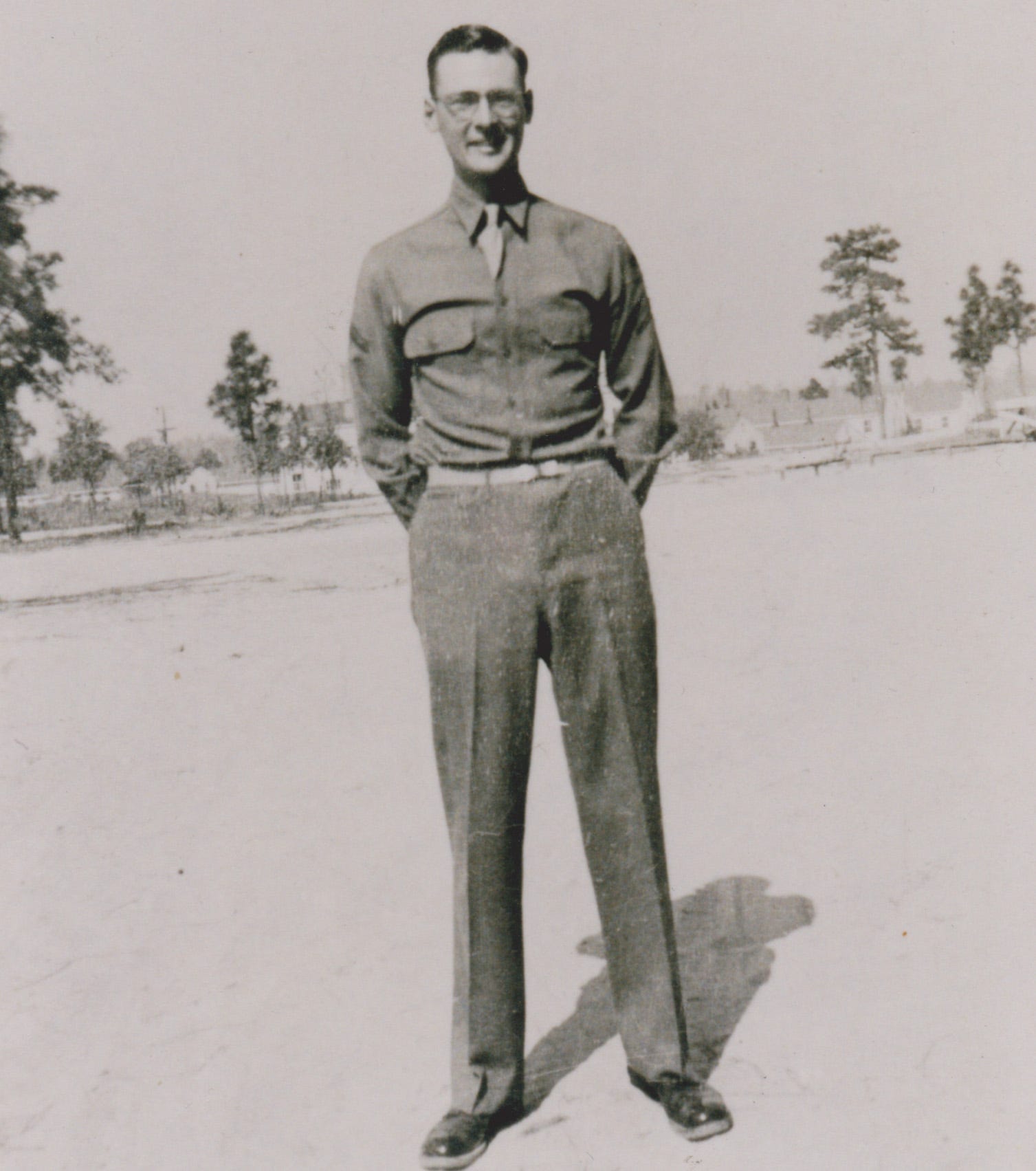
Cliff Flora (a mechanic in C Company): Eugene Tannler was in C Company maintenance, and Jake Driskill was the motor sergeant. Tannler was a good friend of mine, and he told me one day in England, “I want to get out of maintenance and into a tank. I was trained to be in a tank.”
I said, “Stay with us. You’re better off here.” But he went and told them about it, and they made a loader out of him. He was a smart boy, I think he went to the University of Pennsylvania.
Shortly after he was killed, we were sitting in a field in Normandy, and they said, “Mail call.” The first sergeant came out with a big box, and he had a kind of sad look on his face. He said, “I don’t know what to do with this. This is for Tannler from his mother.”
It was a box of cookies.
He said, “You guys might as well have it.”
It was kind of sad. Here we are eating his cookies and thinking his poor mother doesn’t even know he’s dead, and we do.