
The past as prelude
A few remarks on my last couple of Substacks

Just a reminder of how present is the past: Following the publication of Part 2 of my work in progress “The Best ‘Little’ Tank Company in the E.T.O.,” I received the following email from Normandy historian Christian Levaufre: “Sometimes things all happen at the same time and this edition about the D company /712th TB followed the visit of Jennita Wingate, Claudis Jenkins' niece.” [Jenkins was one of two crew members killed when a light tank ran over a string of mines and flipped over, killing Jenkins and one other crew member, while two crew members survived.] Christian forwarded the Substack to Jennita, who emailed him back, saying “Christian, thank you for this article. As sad as the circumstances, I’m glad to have this information. I can take comfort from the fact Buck probably did not suffer since the Sgt. has no memory of the attack. I will share this with the rest of the family.”
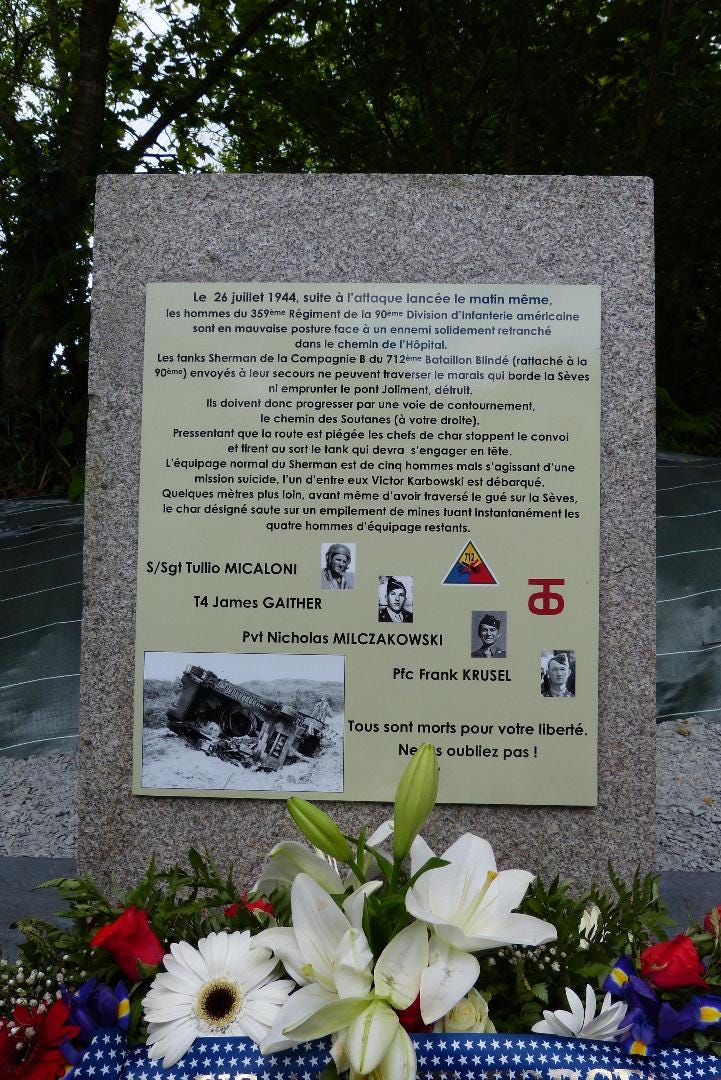
Following the publication of Part 3, Christian commented “May I mention that for the case of Micaloni’s Sherman tank on July 26, 1944 not all the 5 crew members were KIA but only 4 because he got one man out (Victor Karbowski). Thinking that it was not fair to pay tribute to Tullio Micaloni only with a statue at the 4 Braves memorial, like for Reynolds’ Stuart a few years ago we erected and dedicated a small memorial close to the place where the Sherman was hit. (See picture at top of this post). Suzanne Michelony (anglicized version of Micaloni) will come to visit it next October.”
The last few days I’ve been reviewing the transcripts of my lengthy interviews with three members of D Company, as well as the D Company journal and the battalion’s after action reports, and I’ve found some pretty interesting stuff. For one thing, I had assumed the after action reports condensed the material from the journal and left out the names, but the after action entries and journal entries were actually almost vetbatim, so I was wrong in my assumption; I just had never read the after action reports this closely. And I realized that material in the interview transcripts sometimes adds color and detail that even the journal lacks.
Case in point: I have to backtrack to the battalion’s third day in combat, July 6, 1944. This is the journal entry for July 6:
6 July 1944
The 2nd Platoon under 2nd Lt. Lex E. O’Brient was attached to the 2nd Battalion 358th Inf. Regt. And moved to an intermediate position at 250-840. It made no attack and withdrew to the company assembly area about 2200. Cpl. James G. Benda, the platoon leader’s gunner, was lightly wounded by enemy artillery and was evacuated.
So here I am reading the transcript of my interview with Andy Schifler, who was the driver of the platoon leader’s tank.
One time we were in an area, we were resting, there must have been about, oh, I don’t know, maybe five or eight tanks. We were there for about four hours. And then one of my friends, Benda (James G.), he wanted something eat, I said, “Come up in my tank,” and I’m leaning out of the tank, there was an airburst or something, and as he climbed over, he got hit in the arm, instead of me getting hit right in the head. I went under the tank, it’s that high. I looked in the tank, it’s all rations, everything [scattered about]. So that was a close one. Benda saved me there.”
A little later in the interview (about 30 single-spaced pages of the transcript later!) I returned to the incident, and asked Andy to tell me about it again.
AE: You had said that one time somebody got in your, not in your way, but blocked the airburst that would have...
AS: Yeah, Benda. He got hit, shrapnel or something, that airburst. Jimmy Benda.
AE: Describe that again.
AS: Well, he said he wanted something to eat, and I was leaning, like this here [pointing to a photo, which I don’t remember; I’m not even sure whether they were inside or out of the tank!], see we were sitting down here, our heads were up against there. I said, “Go ahead, Jim, go over,” and he climbed over me, he had to go over this guy, too, and he climbed, and he had to go on my side because I had stuff on the transmission, it’s on my side. He climbed over me, the first thing I knew, the tank went up in the air, and we popped back under it, it was high enough, it was that high. And Jimmy got hit with shrapnel; they would have caught us right in the head. But he seemed to be right in the way. That’s the closest one I had coming to my head I mean. He saved me. He was the best man at my wedding, Jimmy.
That was the battalion’s third day of 311 days in combat, many of them on the front lines in the European Theater of Operation. Andy Schiffler would drive his tank 4,000 miles in combat, through France, Belgium, Luxembourg, the Battle of the Bulge, the Siegfried Line, across the Moselle River twice and the Rhine, through the heart of Germany and into Czechoslovakia, without being seriously injured.