
Time has succeeded where the Luftwaffe failed
RIP Jim Baynham, a 20-year-old B -24 pilot who was the last surviving participant in the ill-fated Kassel Mission of Sept. 27, 1044

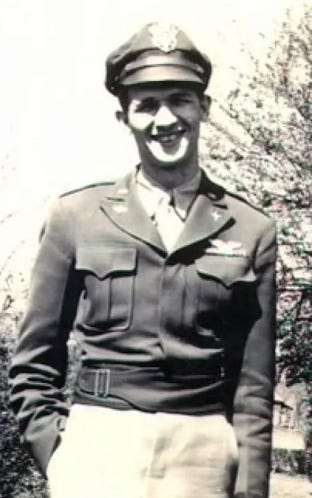
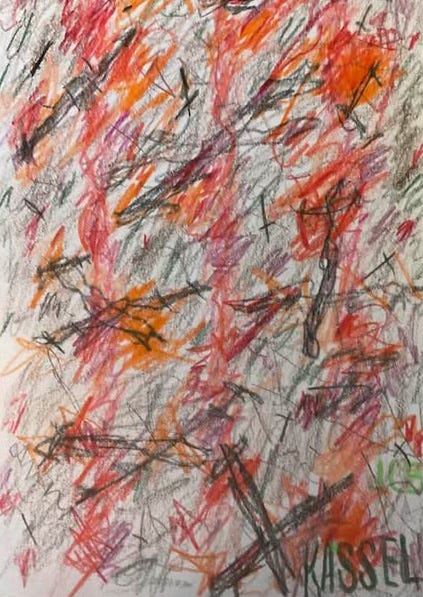
Jim Baynham, who was the last living participant in the ill-fated Kassel Mission of Sept. 27, 1944, passed away in Texas this week at age 101 following complications after suffering a fall. John Ray Lemons was a waist gunner on Baynham’s crew. The Kassel Mission pitted 35 Liberators against an estimated 120 Focke-Wulf 190s and Messerschmitt 109s. The bombers were unescorted after flying off course while their fighter protection remained with the 300-plane bomber stream. More information on the battle is at KasselMission.com, and the full transcript of the interview is available at Amazon in a booklet titled “King Kong Down.”
Feb. 10, 2010, Dallas, Texas —
Jim Baynham: I’ll tell you what, all military and war is nothing but just one mistake after the other. Whoever happens to make the fewest wins.
Ray Lemons: Kind of like what I told one of my friends. We were watching the Super Bowl [Super Bowl XLIV in 2010], and we had a funeral that same day. We came back from the funeral and were watching that, and I told one of the cousins, “The one that makes the mistake today, you mark my words, the one that makes the first big mistake, they will lose the game.” I said, “I have no idea who that may be, but it’d either be Brees is gonna throw a pass for an interception or Peyton will throw a pass and interception and that’s going to wind up ...” and so he called me and he said, “You’re right.”
Jim Baynham: That was a good game.
Ray Lemons: It was. I didn’t mean to deviate.
Aaron Elson: Oh no, that’s okay. Now, tell me about the Dessau mission.
Jim Baynham: It wasn’t anything eventful until this plane up above us got hit by a direct hit of flak and dove into the one in front of us, and when it did, we went right into the fireball. We had serious damage to that plane. The left wing had a big hole in it. The canopy over our heads and the flight deck was crushed in, and the fuselage on the right side was crushed. The bomb bay door was messed up.
Ray Lemons: It wouldn’t close.
Jim Baynham: We still had our bombs, and some of them broke loose. It damaged the hydraulic lines and all kinds of stuff. So it was a pretty fierce day. And then, all the guys, Ray said in the back that they thought we were going down so they grabbed their escape shoes ...
Ray Lemons: Wired around the parachute harness ...
Jim Baynham: And headed for the hatch but because of the centrifugal force they couldn’t move.
Aaron Elson: That’s something I never heard before, escape shoes?
Jim Baynham: Your old GI shoes. All we had was those felt things to try and keep our feet warm, so we carried regular shoes with us so if we bailed out we’d have a chance to do some walking.
Ray Lemons: The ones we actually got were black high-top, British made. You were supposed to wire them to your harness so that if something happened you got your shoes, because like you said, you had those little booties on and the insert, and I never did wire mine on.
Jim Baynham: I don’t even remember having mine. I’m sure I did.
Ray Lemons: I never even put my harness right. I had a brand new harness on the Dessau mission, and the leg straps were so loose they were just dangling; there were several inches of space, and when that chute would have opened I know what it would have done...
Jim Baynham: It would cut you right in two. You’d be cut to pieces.
Aaron Elson: Really?
Ray Lemons: Oh, yeah. You had that harness just perfectly fit, but if you didn’t you just ...
Jim Baynham: You hit it like that ... Because when that chute opens it’s a tremendous jolt. It certainly is a shocker.
Ray Lemons: The only thing that I could add to what he just said was that there were supposedly three planes that went down, which there were three planes that went down, that was noticeable to the rest of the formation. In fact Bill Dewey was on that mission, and I think he wrote up a story about that later on, but we were the third plane, which, I think, what did you say we pulled out at?
Jim Baynham: Ten or twelve thousand.
Ray Lemons: I said ten thousand feet.
Jim Baynham: It kind of, when it happened, of course we started trying to turn and it blew us on over, so we went straight down, and it took a long time just trying to pull back out. But we finally did, and went home by ourselves and nobody got us. It’s amazing somebody didn’t knock us off.
Ray Lemons: That’s right. And besides, like I think I mentioned to you, that Lord, the one he just mentioned earlier, was waiting, and we weren’t there. And they’d already said there’s three planes went down, so he was sure it was us.
Aaron Elson: Did a third plane go down on that mission, or just the two?
Jim Baynham: The two went down, and they reported us as down. We never caught the formation. We went home alone.
Aaron Elson: That must have been pretty harrowing.
Ray Lemons: It was a long ways in.
Jim Baynham: It was dangerous.
Ray Lemons: Yes, it was.
Jim Baynham: Because we were ...
Ray Lemons: Three and a half hours away, wasn’t it?
Jim Baynham: Just a sitting duck if a fighter had seen us, they’d have come after us, because that’s what they did is pick off the easy ones because they didn’t have all the gas they needed. But we got back, and I don’t think that ship ever flew again. It was like warped 20 degrees, the fuselage was.
Ray Lemons: I imagine it was junked. I never did know for sure.
Jim Baynham: But it got us home, that’s the main thing.
Aaron Elson: Your original plane, did it have a name?
Jim Baynham: I had one I’d like to have, but we never did have an original plane. You know, there were a thousand, 1,200 ships flying, and the romance of having your own name was sold in the movies, but it didn’t happen. You flew whatever was running, and every day we’d come back with flak holes and stuff in the ship so they’d be fixing a lot of them and the ones that got fixed would fly.
Ray Lemons: How many names do you remember that we flew?
Jim Baynham: I remember Weeping Willie and King Kong, that’s the only two I remember.
Ray Lemons: We flew Win With Paige, remember that one?
Jim Baynham: I don’t remember that.
Ray Lemons: Willow Run. (This may have been Willer Run)
Jim Baynham: I remember Willow Run.
Ray Lemons: King Kong, the one you just named.
Jim Baynham: Weeping Willie.
Ray Lemons: I don’t remember Weeping Willie.
Jim Baynham: You may have been off that day.
Aaron Elson: You said you would like to have given a name. Did you have a name in mind?
Jim Baynham: I had. I’d drawn a little thing, I think my sister’s still got the little deal, it’s just a little cartoon drawing of a whistling privy ... of an outhouse with wings, because whenever these things came over you when we were coming in, they’d just whistle like a banshee.
Ray Lemons: I remember that name. I didn’t know it was your name, because I don’t know how we got the Whistling Privy. I remember that, but we never got it.
Jim Baynham: An outhouse with wings. That’s about what it was. The B-17 guys called it an accident going somewhere to happen.
Aaron Elson: Now, Kassel was your 11th mission?
Jim Baynham: Yes.
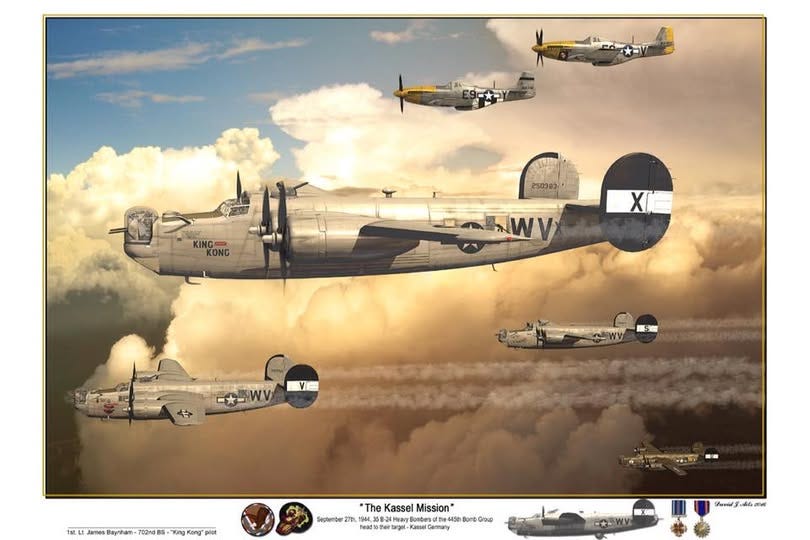
Aaron Elson: Walk me through that, from the beginning. Was there anything at all unusual about the briefing?
Jim Baynham: Not that I remember. We never did get an easy mission. During that time the group was flying a lot of Calais buzz bomb missions and you just were up a couple of hours and you were home. You just flew to the edge of France and back, and they just racked up mission after mission, it was great, but we never got one of them. Every mission we got was deep in Germany, and so this was another one of those. I can always remember the guy at the front of the room saying, “Well, today, boys, we’re gonna bomb so and so,” and I always thought, “We ain’t gonna do nothing, you’re going back home and go to bed.” And he did, too. But, no, I don’t remember anything at all about it that was any different than any other, until we got to the target area and got hit. And I didn’t know we were out there by ourselves until people started telling us.
Aaron Elson: Did you know you were off course?
Jim Baynham: No. We were leading the group, so everything that was happening happened behind us. We just kept on traveling along.
Ray Lemons: There were 300 in that formation that day and we were the lead group. We were leading the 389th, the 453rd, I can’t remember the others that followed us but there were 300 planes, including us. Out of our 39 takeoffs we only had 35 that got there.
Aaron Elson: But you were the first group of the 300?
Jim Baynham: So the second group caught the mistake and turned, and we were just ...
Ray Lemons: Kept on going ...
Aaron Elson: Were there any radio exchanges?
Jim Baynham: Not that I heard. I can’t remember what the radio system was. Was it Charlie that was on ... I was on the intercom and he was on radio? I think it may have been that way. I don’t remember hearing any warning before the first attack. And all of a sudden you guys started hollering that we were being hit.
Ray Lemons: We were on fire, I would say ...
Jim Baynham: From the first round ...
Ray Lemons: I would say we were one of the first planes hit.
Jim Baynham: We got the smoke out of the cockpit, and then some more started coming in. Our generators were on fire, and so we opened the windows and blew the smoke out. I remember we had one front pass, that’s the only time I really saw all the planes, because they were coming at us and the light was blinking as they were shooting, but most of them came from the back.
Ray Lemons: I think we were hit below. The best I remember they were coming up right under the belly, and they were either shooting on the right wing side or the left wing side, and of course the tail gunner was right in the middle of all of that.
Jim Baynham: We didn’t have those ball turrets. They came underneath us with 30-millimeter cannons I guess, or 20 ...
Ray Lemons: Twenty and thirty both ...
Jim Baynham: And just lobbed them into us. Broke up the formation with those. The first plane I saw was the, we were leading the, what, the low element?
Ray Lemons: We were the high right. Not the high high right but the high right.
Jim Baynham: Okay. And the lead element, the right wing ship just erupted in flames. Every crack in it you could see burning, and just tailed off like that, and that was the first real one I saw go down, that was really in trouble. You guys could see more than I could.
Ray Lemons: Yes, we could see back there. Of course it was happening so fast you just didn’t have time to observe anything except you could see stuff, the sky was full of stuff that was going everywhere you looked.
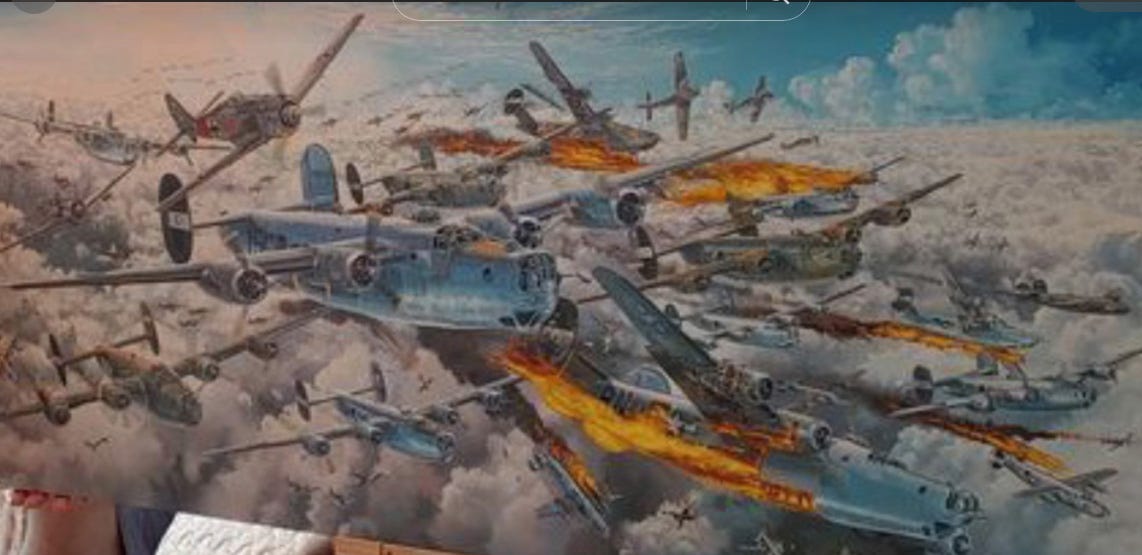
Jim Baynham: But after you guys jumped, that flight deck looked real empty. It’s lonesome looking. And I looked down and didn’t have my leg things hooked up, so I had to hook my chute up, and then I thought, “Maybe I can get ’em to quit shooting at us, I’ll lower the landing gear.” I figured maybe they’ll figure they don’t need to do anything else. And a 109 came up on my left wing, right next to it like he was flying close formation, and I looked out and saw him right before I got out of the seat. I’d like to know who that guy was.
Aaron Elson: Did you see his face?
Jim Baynham: No, he had a mask on. I’m sure I don’t remember much about it. All of it’s just fleeting images really, there’s not any continuity. But when you jump out at 23,5 and pull the ripcord you’re right in the middle of it all. That’s not a good thing to do.
Ray Lemons: I can tell you one thing, an ME-109 was no further, the wingtip wasn’t as far as that plant from me, and I thought he was either dumping my chute ...
Jim Baynham: I’m surprised it didn’t ...
Ray Lemons: Or he would knock me down or run through me or something, and I could see his face, he’s looking at me and I’m looking at him.
Jim Baynham: I’m surprised your chute held up.
Ray Lemons: I am too. Oh, it did do this, man, it did a lot of that.
Aaron Elson: Was it like a pendulum?
Ray Lemons: Yes, swinging around.
Jim Baynham: That’s prop wash.
Ray Lemons: But I was at 23,000 something.
Jim Baynham: Long time getting down.
Ray Lemons: Oh yeah, and I passed out of course, because I’d been out of oxygen probably a minute or so before I got out of the plane, at least a minute and a half.
Jim Baynham: I didn’t open mine. I bailed out about 12,000 ...
Ray Lemons: That’s about right.
Jim Baynham: And then I ...
Ray Lemons: Went through the clouds ...
Jim Baynham: I didn’t open until a couple thousand ... they’d always told us that if you were free falling that when the ground started getting larger it’s time to open your chute and that’s what I did. I figured I was about 2,000 feet.
Ray Lemons: When I saw the clouds finally coming, I’d already come to and I must have been a thousand or so feet above the clouds, and we were solid cloud that day. When I came through, then I started like you say seeing the ground, man, I know where I am. I saw woods, and trees, I don’t want to do that, you’ve got to guide now.
Jim Baynham: I tried that, because there was one of those high power lines that I was drifting to, so I pulled the cord, the slip, and got myself swinging right before I hit ...
Ray Lemons: You got your butt ...
Jim Baynham: I hit my butt, and then my head. It kind of knocked me out for a few seconds. And then, because when I got my sense back, I was getting dragged along with the wind.
Ray Lemons: Did they get you right away?
Jim Baynham: Oh yeah, potato farmers were sitting right there with pitchforks. Well, they said those old guys were still bragging about capturing a young American terrorflieger.
Ray Lemons: Do you know where you really landed to this day?
Jim Baynham: I don’t. I know that somebody knows a little village I went into...
Ray Lemons: You don’t remember the name of it?
Jim Baynham: No.
Ray Lemons: I never did know either.
Jim Baynham: And there was this other kid that went in, I don’t remember who he was. I’ve got a sheet somewhere that has his name on it. I think he was a navigator maybe. Two of us wound up there.
Ray Lemons: Together?
Jim Baynham: Yes. And it was one of those scenes just like everybody ran into, it was violent, because of one guy that was really leading the cheering section.
Aaron Elson: How did they express the violence?
Jim Baynham: Red face and shouting in German, and shaking fists and all that. But there was a woman who spoke English, and somewhere or another I thought I knew that she was an English teacher. That may or may not be true, but she spoke English and she calmed everybody down.
Ray Lemons: The word I always remember hearing the Germans, and like you say, they were red in the face and yelling and screaming, they’d say “Chicago gangsters,” they could say that. And “terrorflieger, terrorflieger, terrorflieger, terrorflieger.” And you just worried walking through the crowd what they were gonna do to you, whether they’re gonna come after you or whatever.
Jim Baynham: Well, the press had cartoons of us diving, machine gunning children on the schoolyard, things like that, and add that to the fact that, I think they told me that day that this guy had had his family killed in a bombing raid, put all that together and it’s ... but we just, I was there for a little bit and then they walked us I think for a mile or two to some little village where there was kind of a little city hall with a one room jail in it. There wound up being several of us before the night came, and when night came they took us and walked us somewhere to a station where a train was stopped, and we got on it. And then we went into Eschwege, which was an air force base fairly close by, and we almost got lynched on the platform there. Our guards went inside the station to contact the base, and the crowd was a big crowd, and they all got violent. There were eight or ten of us, and I think we were not far from being lynched, and the guards finally came back out and they calmed everybody down.
We spent the night in that air base, and then we went to Oberursel, to an interrogation center outside of Frankfurt. I remember coming into that Frankfurt station, and a big old barrel like you see in Casablanca or somewhere with the trains steaming. Some guard must have spoken English because he told one of the guys in our group that the night before they had lynched some flyers from some of the steel girders. And then we walked the streets of Frankfurt probably for a mile or two going to a place, and it was just brick rubble everywhere, a lot of buildings standing. It was a spooky place.
Aaron Elson: Do you remember any of the other people who were in that group?
Jim Baynham: No. My mind, the details, is blank. The first guy I saw that I knew after I got, two days later, to Wetzlar, the temporary camp, was Ray, and he was on the other side of the fence in another compound. We just happened to spot each other, and his face was about this big, it looked like he’d been beat up. It was swollen badly.
Aaron Elson: You were beat up?
Ray Lemons: By the burgomeister of that town. He got me with a pistol.
Aaron Elson: He pistol whipped you?
Ray Lemons: M-hm. It was a mess. He was just irate. There were about a dozen, or 13 or 14 of us in this little group and I happened to be in the front row. These two young Wehrmacht soldiers had brought us to this town, and he stopped us, and he was vehement in his anger. He was up there just swinging at everybody in the front row and I was in the front row. I bolted out of that line and that that was a mistake. I should have stayed, and that’s when he pulled that pistol. I thought he was gonna shoot me, and he started bopping me with that pistol, in the face. The two young soldiers finally realized that they had to get control of that group and they started yelling “Raus!” and he walked off and left us. Luckily for us, I think.
Aaron Elson: What was your interrogation like?
Jim Baynham: It was scary, but looking back on it, it was nothing like Guantanamo I think. We were put in a cell, and they had suggested that we read a couple of books that somebody had written, English guys that had been in prison camps, and it was good, because everything that I’d read was where I was, so it was familiar, and that did help. It was probably a six foot wide room and twelve feet long, and no window, and a little eye thing on the door, and one bunk, just a flat piece of wood bunk, and I was there for two days I guess. And so I went in there and stayed all night. The next day, nobody, then they slid something to eat, a piece of bread or something, for breakfast, under the door. But just not knowing what was going to happen next was the worst part of that. And then they took me out and took me to a room and two guys interrogated me. They told me they were going to shoot me, that I was a spy, you know, the normal crap you hear, I guess.
Aaron Elson: Now you say that, but what did you think then?
Jim Baynham: It was really unnerving. I knew it wasn’t true, but it was still unnerving. It was seriously unnerving. So that probably went on an hour and it happened twice, and then the second morning I was taken out and taken over to a headquarters like building, and taken into a big office. A captain, old guy, grey headed, was behind the desk, and I sat down across the desk from him. He was patronizing, congenial, and pulled a big book out of a rollout, and it was our group. He knew the name of the weather man, blah blah blah. He even knew that I grew up in Texarkana, Texas. That was surprising, really, that they knew so much. That was probably not worth anything but it was impressive, the details that they had. And that’s all that was, was to impress me I guess. It didn’t turn into anything.
Ray Lemons: They all had them. It’s like you said, they told me who my mother was, and they knew I had a kid.
Jim Baynham: Isn’t that something?
Ray Lemons: That, my mouth kind of opened, my baby was six months old or something like that at that time.
Jim Baynham: It’s information that’s out there, but to go through the trouble of getting it is really surprising. But I’ve got to believe that they knew they were wasting their time on a first lieutenant. He didn’t know anything. If they got a major or a colonel in there, they might be able to learn something.
Ray Lemons: They did the same thing with an enlisted man. An enlisted man doesn’t know anything about what’s going on, probably only knew he was going on a mission somewhere, didn’t even know the name of it. And the guy, I remember the one that got me and he was, like Jim says, they play all this beautiful stuff, Jim was talking about reading a book. I remember the film, they showed you a movie, I don’t know whether you saw it ...
Jim Baynham: I remember it.
Ray Lemons: I saw this movie, and I remember that movie just like that. I’m sitting there in this movie now. This guy’s doing what the movie’s saying. But finally the guy says, “I can tell you where you’re from.” And he told me, “You’re from Texas.”
I said, “The way I talk, is that what you’re saying?”
He said, “Yes, that’s one thing.” And he finally said, “But you know what? I lived in the United States until ’39.”
I said, “Where?”
He said, “Buffalo, New York.” He said, “By the way, would you like a Lucky?” Lucky Strike. I didn’t smoke. I didn’t want one anyway. And he goes on, and he finally says, “We’d like to ask you what were you doing there? What did you guys do this morning? What were you all preparing for?”
“My name is John Ray.” Name, rank and serial number. Same old stuff. I did that fifteen or twenty times.
He finally said, “Well, I guess we’ll have to do what we have to do with you. The Gestapo will be here for you tomorrow morning. I’m going to put you in the cell and they’ll be here tomorrow and they’ll get you then.” It was a bunch of crap. They threw me in a cell all right, and the cell was about from there to there. There was another guy in there already, and I didn’t know whether he was a plant or what. I said he must be a German to myself. So I didn’t even know my name. Of course I was there for two days. Like you say I think it was part of their procedure.
Jim Baynham: It seemed like they wasted a lot of time.
Ray Lemons: But the book did impress me. When this guy reached up there and got it and said, “Well, let’s see...”
Aaron Elson: Did he know your family also, he knew you were from Texarkana ... were you married at that point?
Jim Baynham: I was, but he didn’t bring that up.
Ray Lemons: He didn’t bring my wife’s name, but my mother’s name, and he knew I had a baby.
Jim Baynham: And he knew my granddad’s name was Freiburger.
Ray Lemons: Is that right?
Jim Baynham: Because he commented on I was one of them almost.
Ray Lemons: The thing that got me, though, was he says, “I know what crew you were on. You’re on the Johnson crew.”
I said, “Is that right?” I wasn’t on the Johnson crew. I never did say anything. I never did say that. I don’t know, we had a Johnson of course, but I wasn’t on Johnson’s crew.
Jim Baynham: Maybe some of his guys had mingled in with your group. Anyway, it was a time to be young and a kid would live through it.
The full transcript of my interview with Jim Baynham and John
Ray Lemons is in “King Kong Down,” available at Amazon in print and for Kindle.