
Two tonsillectomies, Joan Bennett, a horse named Rambling Jack, and the 1974 International Harvester fire
Oh, the stories I've heard! These are from a conversation at the 1999 mini-reunion of the 712th Tank Battalion in Bradenton, Fla. (Warning: Graphic content)

Art Horn and Ed “Smokey” Stuever
January1999, 712th Tank Battalion Bradenton mini reunion
Art Horn: It was a prison for young men that were in trouble. And it became a hospital for a long time. It had changed a little bit. There was a little store outside, and that was still there, and the guy says, “Oh yeah,” he says, “I remember it.” And he says “Now it’s a prison. You can’t go in there.” [more on this later]
[In the cavalry], we were right on the fence that separated Mexico.
Ed Stuever: You know, before that became Camp Lockett there was a church in that triangle, that intersection, the highway going in there, and we’d go to Sunday Mass and meet people, ranchers, from the area. And I became friendly with a ranch family right near there, where the Camp Lockett was on. The government bought their ranch. So they invited me for lunch, where I spent Sunday afternoon with them. So after church instead of going back to camp I went with them and spent the afternoon. They had a young son, and they took me all around the area there, and there were caves where Pancho Villa’s men hid their loot in. He would throw rocks in there and he’d say, “Okay, there’s no rattlesnakes in there. Let’s go in.” We would go through them caves and we’d come out on the other end.
Art Horn? In Mexico?
Ed Stuever: No, no. I mean, it was right near the fence. The fence was half-down. It was just to keep the cattle from crossing over. I don’t know if you remember, there was a border patrolman from Mexico, they had to cross over in and out of the state line in order to get from here to there, to Yuma over that way, and somewhere he ran off the road and got pinned underneath the car right alongside of a stream, with his young son with him. And we looked for days and days and he was getting ready to shoot his son and then shoot himself because he couldn’t take it any more. The hot sun would just murder them during the daytime, and that water running right there, and he’s pinned in there, and the kid was pinned under there. Anyway, we went past that area a couple of times, and finally, one little, a corporal, he happened to see some brush bent down, and he looked down in there and here was the car down there, and they found them.
Art Horn: They still were able to breathe, in the car?
Ed Stuever: Yeah, and they brought them back. There was a big celebration. Well, that was Camp Campo, the tent camp, you weren’t with us.
Art Horn: I was down in Seeley. See, you were up in the mountains.
Ed Stuever: Yeah, fifty miles along the border. And Seeley is further north.
Art Horn: Yeah, well we, what they called headquarters, Headquarters, A, B and C Troops. I was in B Troop.
Ed Stuever: We had about four or five companies. I was in E Company.
***
Ed Stuever: I’ve got a bunch of CC [Civilian Conservation Corps] stuff with me. There’s a Red Rock Canyon near Denver that the CCC boys made. They carved all these steps out of that rock, chiseled all that, there’s a great big bowl that holds a couple of thousand people. You get down in here, and you don’t need a microphone; you bellow out and it echoes, and natural. It’s a natural amphitheater.
Aaron Elson: And how did you get this?
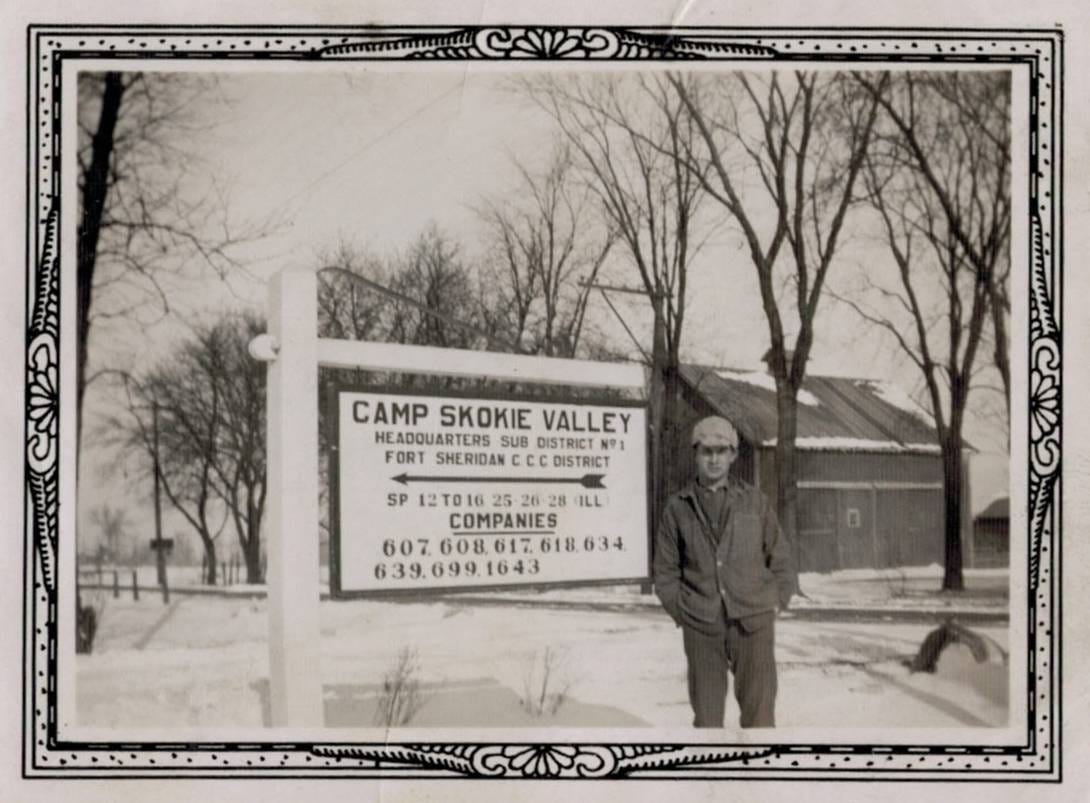
Ed Stuever: A publication by the CCC, they sent it to me. It showed the things that we did. And I was in Camp Skokie Valley up north of Chicago. They had Skokie marshes, and the burning peat under the ground, and weather like this where we have fog here, it gets fog up there with the smoke, and it made it so dense that the Skokie Boulevard, which was the main thoroughfare at that time north of Chicago going from Chicago to Milwaukee, there were so many accidents, and the Corps of Engineers had to do something with that, so they built five or six lagoons in that area, and it was all made by CCC boys with the wheelbarrows. And the first job I had was to wheel the cement; we made a dam. And the steward, the cook, the guy that was in charge of the cooks, he took a liking to me and he said, “Boy, I sure could use you.” So I became a Number One cook. Till my tonsils were so bad, we had that burning coal stoves, and we used that soft Illinois coal that smoked to beat hell, and it poisoned my tonsils so bad that I could be laying in bed and I’d hear myself snore; the people always were yelling at me to shut up. So they sent me up to Fort Sheridan, the big soldier camp, and they had sent me back, they’re too infected, we can’t take them out when they’re infected like that. And maybe six months later I went back up there and I says, “I come up here to get them damn things out and I’m not going back till I got ’em out.”
“Is that so?” So he goes in his cabinet and he gets a bottle of Canadian Club out, and he’s looking at me, and my tongue must have been going like this, he says, “You want one of these?”
I says, “Yeaaahhh. Boy, I sure could use one.”
So we had a drink together, and I says, “How about one for the other tonsil?”
Then he put that bridge in my mouth, and he had me strapped in that, it’s just like a barber’s chair, a simple old thing; he had me strapped in there, and he put that little cuspidor underneath me, had that bridge in my mouth, and he says, “Boy, you’ve got a little mouth for such a big guy.”
And he says, “Come on, talk to me.” I couldn’t talk. He froze both tonsils. And all he had was just like a god darn pencil, it had a little loop on it, and there was a frog sticker on the bottom of it, you know, a little needle with a hook on it, and he’d go in there, put it in a pan, took the other one out, and they were about that big. There they were in the pan, he says, “There they are. How do you want ’em, medium rare? Well done? Well, boy, talk to me.”
Art Horn: You couldn’t talk, though.
Ed Stuever: I couldn’t even eat for two weeks. All I could have was broth and soup, ice cream. And they put me in a tent with the soldiers, they came back from maneuvers up in Wisconsin, from Camp McCoy, something like that.
Art Horn: That’s where we went when we were drafted, from Chicago.
Ed Stuever: And them soldiers, they had them wraparound leggings. Here, they put me in this great big tent right outside the hospital building, with all these roughnecks.
Art Horn: The doctor always told me I should have my tonsils out, and when I was in the service, when we went to Fort Benning and I says, Gosh, I can get ten days leave, see. So I went to the doctor and he says, “Well, have you had problems with it?”
And I said, “Yeah, when I was younger, and I’ve been thinking about taking it out.”
He says, “Well, yeah, we’ll set it up.” And there’s about four or five guys in a row. The next morning the nurse sits us and gives us a pill and I drank a little water with it, and the rest of them down the line. Then all of a sudden we fell asleep and they woke us up; we dozed off, and then they says, Well, one wheelchair after the other. One would be outside the door and the other guy’d be in the room. It was a little room with a little chair, and the guy, you know, the light had come on, and he starts a local anaesthetic, and he says, “Did you eat anything?”
I says, “No, I just drank some water with the pill that she gave me.
And then he says, “Oh, okay.” Because I was gagging. He took the tonsils out. I could feel him cutting it on each side. So he didn’t give me any, just the local anaesthetic.
Ed Stuever: All he did was just freeze them. He stuck the doggone needle right in them.
Art Horn: That’s what he did with me. But I could still feel him cutting. That didn’t bother me. Finally, he said “Okay.” He was satisfied because I didn’t gag anymore. He put me back in the room. I lay down there, and fell asleep. There’s one fellow here, here, here and here. There’s four of us, and the first one, I was sound asleep and the nurse says, “Do you want a drink?” And when he woke up, why, he took a drink. And then she came to me, she woke me up, and I was thirsty as all hell, and I took a big swallow, and do you know what it was? Lime ade. And I swallowed that, and ohhhh, I went up in the air like that. The next guy was awake and he saw it, and he wouldn’t take any. Well, it was too late, I took the swallow. All that lime on that soreness there, oohhhhhh, did it burn. But do you know, that evening I was able to eat soft foods? I went home the next day, and I got back to camp, and I says, “Do I get ten days leave?”
So he says, “Yeah. We’ll give you ten days leave,” and I went home.
Ed Stuever: I couldn’t open my jaws for two weeks.
Art Horn: Oh, no. The next guy that didn’t take that, he was in the hospital for a whole week yet. I found that out later.
Ed Stuever: When I got back to camp, they took me out to the north end of Chicago, we went to a big night club area, and boy, what the hell, we had Green River whiskey, I’ll never forget that brand. Boy, we’re sitting in the cab, we’re on our way back to camp, and I’m heaving out the window, and I says, “There goes one tonsil. ... There goes the other one.”

Art Horn: It wasn’t the tonsils, it was just you. Well, in a way I was glad that I swallowed that. That healed it right away. Did you ever get a cut and put a piece of lemon on it, how it burns?
Aaron Elson: Did you go down into Mexico when you were in the cavalry?
Art Horn: Before the war, yes. I went to church with a couple, and they invited us to, they lived in Calexico, El Centro, then Calexico, and Mexicali was across...She says, Come on, her husband worked for the post office, and they drove us across there, and we bought some souvenirs there in Mexicali. I think I still have them setting up there, I got them for my wife. I wasn’t married yet, it was just before Pearl Harbor that we got married. I came home on the first leave that we got when we were in camp in California. So then we got married. I says, “Well now, I’ve got about another month right after Christmas. I says, “Come down. I should be getting my one year’s service over with.” And then we’ll come down there and we’ll start our honeymoon and go back home. Pearl Harbor came along, after I was married, on November 15th, and I got back there oh, about the 27th or so, and before I know it, bing bing bing, I went to church on Sunday, went to a show, on the 7th of December, watching the show, and all of a sudden the lights go on, then the big sign appeared, “All military personnel report back to their stations.” And the show was over. I don’t remember what the name of the show was. But we got outside, and everybody’s running around. They said, “The Japanese bombed Pearl Harbor, and it’s a mess.” So they took, some of the women were driving taxicabs, they took us all back to camp. I don’t know, it cost us a dollar or something, that is, if we had it. Some of us didn’t have that. It cost us about a dollar. Then we moved from there on to Camp Lockett; that’s where we were stationed all the time. Then we had new barracks built up there, and that’s where we spent the rest of it until we shipped on to ... Oh no, I was sent to, I got an assignment to go to Hollywood and make a training film for a month, and that was after the war was declared. We used to go to the Republic Studios, and we’d have our uniforms on. We were carrying .45s with us, and they says, “What movie are you making? Are you making that Pearl Harbor?” They had a big area there where they had a big water area, and they had little battleships and everything in there. They were gonna be the ones that were gonna bomb Pearl Harbor, and they said, “We’re gonna make Pearl Harbor.” It wasn’t completed for quite some time after that.
But I think he said, “Are you making that picture?
I says, “No, we’re real soldiers.”
Some of the extras that were there, they talked to us, “You’re real soldiers?!”
And I says, “Yeah. This is a real .45.”
What we used to do, we were on Darryl Zanuck’s ranch making this training film, but we had to take the truck in there. We used to get firewood because we slept in tents out there on his land. And during the night it used to get pretty chilly. I was supposed to be there for three weeks; it took a month. Some of the days weren’t sunny, and what they had reflections so that they had plenty of sunlight to take pictures. They were all cavalries and mounting and platoon groups. And then, one night I went into town. If I had an early guard duty, I’d take my guard duty, then I used to go into Hollywood and visit around, go to a show or something. And one night I’m coming home, and I’m walking down this road, I got a lift and I had to walk down this road because nobody went down there, it was just homes. And one day I come to a certain spot, and there’s a car out there and someone is trying to start it; it’s spinning and spinning. And I walked up and I said, “What seems to be the problem?”
She says, “I can’t get the car started, and we just pulled out of the,” visiting some friends of theirs.
And I says, “Let me see what I can do.”
And she moved over. There was another gal next to her. I get in there and I got real close to her because when I opened the door it lit ... you know who it was? It was Joan Bennett. And I knew it was her; I used to read about the movie stars. Joan Bennett, her husband was a captain, Walter Granger, she was married to him at that time and he was a captain. She said, “My husband’s a captain in the Army.”

I says, “Well, let me see what the problem is.” I get in there. In those days, they had starter buttons. You had to step on the starter on the floor in order to get it going, and what she did, she pulled out, and she said, “Oh, my car is broke down. I got this car to replace it so that I could visit.” And what she did, you had an ignition switch, and if you turn it the other way, the starter would work but it wouldn’t start. And I got in there and I just automatically, without thinking, I said “What the hell, it’s the wrong way.” I turned it the right way, and I hit it, and it started up right away, and I said, “Okay. You’re all set.” And I wanted to talk to her, but both of them were frightened, I could see it. And I said, “Oh, I’m not gonna give you any problems.” So I said, “Okay. I’m down here at Darryl Zanuck’s ranch and we’re making a training film.”
Oh, she says, that’s fine. Thank you.
And when I told the guys it was Joan Bennett...
Aaron Elson: What’s this?
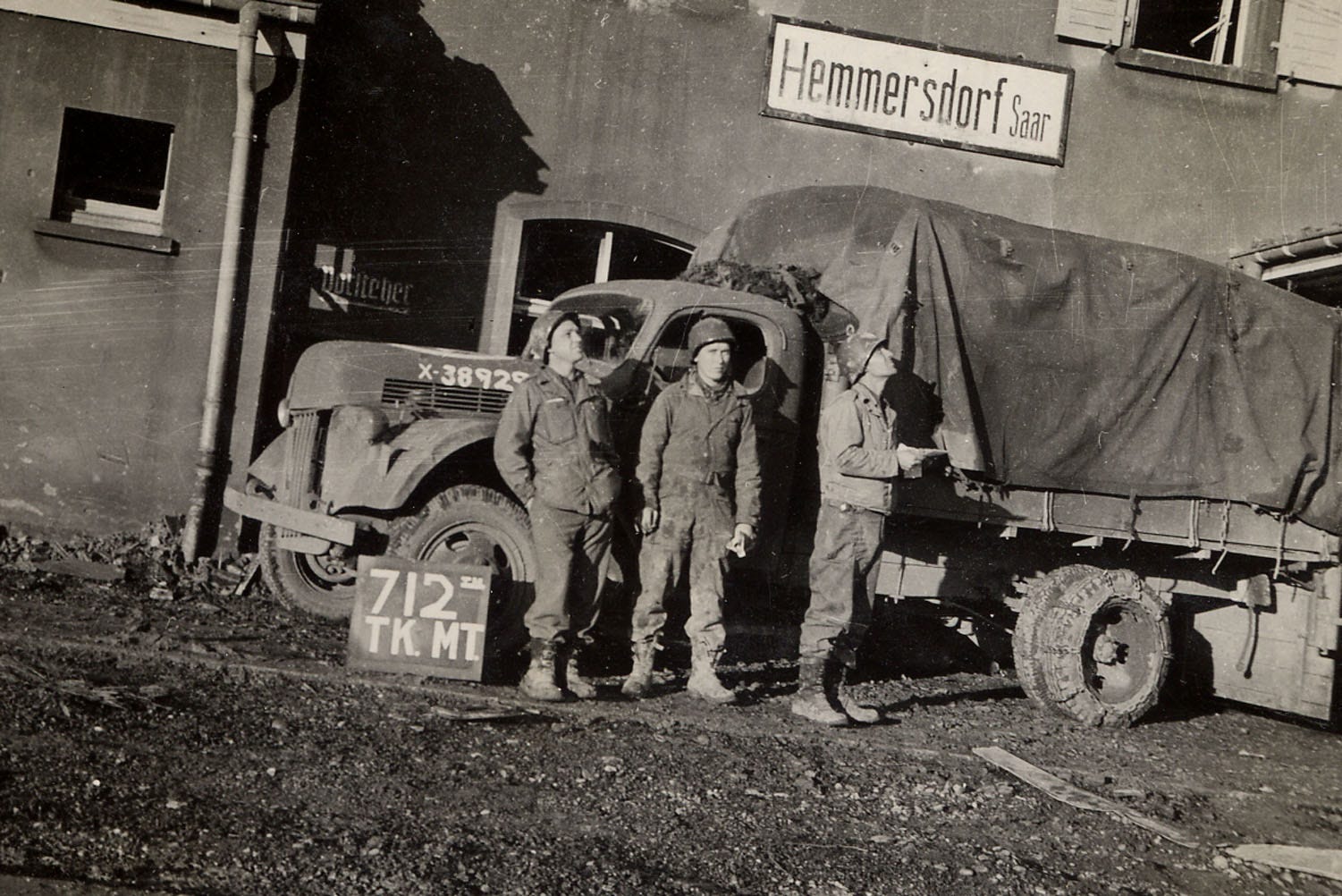
Ed Stuever: It was in the Tribune. This is the old book. This is me. We’re putting these pontoons, tracks on all the tanks, we’re changing equipment, heavy steel ones on before we went up to the Battle of the Bulge. This is at Hemmersdorf, and this, a shell came in there and hit that building and it tore, where the hell’s my souvenir ...
Art Horn: Let me tell you something about this story. It says, “John Wayne in his prime would have been perfect.” I met John Wayne at the Republic Studios when we were making that training film, and he was just a young movie star and he was so engrossed in his work he wouldn’t talk to anybody. I tried to talk to him and he wouldn’t; to me, when I came home, I says, “John Wayne,” I had no, he wouldn’t talk to anybody. The other movie stars there, when they found out we were real soldiers why, they’d talk to us and wanted to know what it was all about. Now this story, it starts out here, “John Wayne in his prime would have been perfect. Today Keanu Reeves or some other hot young Hollywood actor seems to excel, but it’s a shame that Wayne considered his love of westerns and war movies and never got a shot at the title role ...” He didn’t even, when we were in our cavalry uniforms, he didn’t even talk to us. That was after Pearl Harbor.
Ed Stuever: That was in ‘42, because ‘41, December the 7th was at the end of the year, and ‘42, we left Campo around May, or June.
Art Horn: Yeah, it was about six months into ‘42. And then you went to Fort Benning. I was in the, I had yellow jaundice and I was in the...
Ed Stuever: Oh, man, there was a bunch of them had that. Some guys had it real bad.
Art Horn: Yeah. I was in a hospital, and then they came back, and then three of us joined up with, we had a nice train ride...
Ed Stuever: I was going to tell you, when an artillery shell hit this in the morning, our ten ton wrecker was parked over here, and I had to go to the bathroom so I had taken my coveralls off and I had, I usually had this up here, I always wanted to save my heart. But I happened to put it in my back pocket, and that’s what the shrapnel did, it went through the coveralls, tore this, oh, I had taken my coveralls off and threw them over the spool of the cable on the wrecker, on the back end of the wrecker, and the shrapnel just ripped that right up. This was an Army officer’s notebook. And we weren’t supposed to have a diary, but this was a record of all the engines we changed, and the miles that we made that day. And I had a lot of notes in there that I tore out, because if it fell into the enemy, they would ... I had used a pencil; if I had a pen, why, you would be able to read all that. It was a record of all the tank engines that we changed. It used to take two days to change a tank engine, but we did it one morning. We started after breakfast, and when we broke for lunch, the tank was going down the road for a road test. [Forrest] Dixon remembers it. He says, “Oh yeah. I remember that. You were buttoning down the hatches, it went down the road.”
This was a watch that everybody used on guard duty, and there was times I wouldn’t see that watch for months, until the company got together, and they’d say, “Whose watch is that?”
“It’s mine.”
And I was offered, oh, thirty dollars for it. I bought that thing for a dollar before the war, and I took it with me when I went in the service.
This was the CC camp I was in. It was the largest CC camp in the United States, Camp Skokie Valley.
Art Horn: CC camps were all over the United States. I almost went in, but then I got myself a job with International Harvester.
Ed Stuever: Well, my father and mother were deaf mutes, and they couldn’t get no public assistance because there was two of us eligible sons, and one of us had to go to the camp.
***
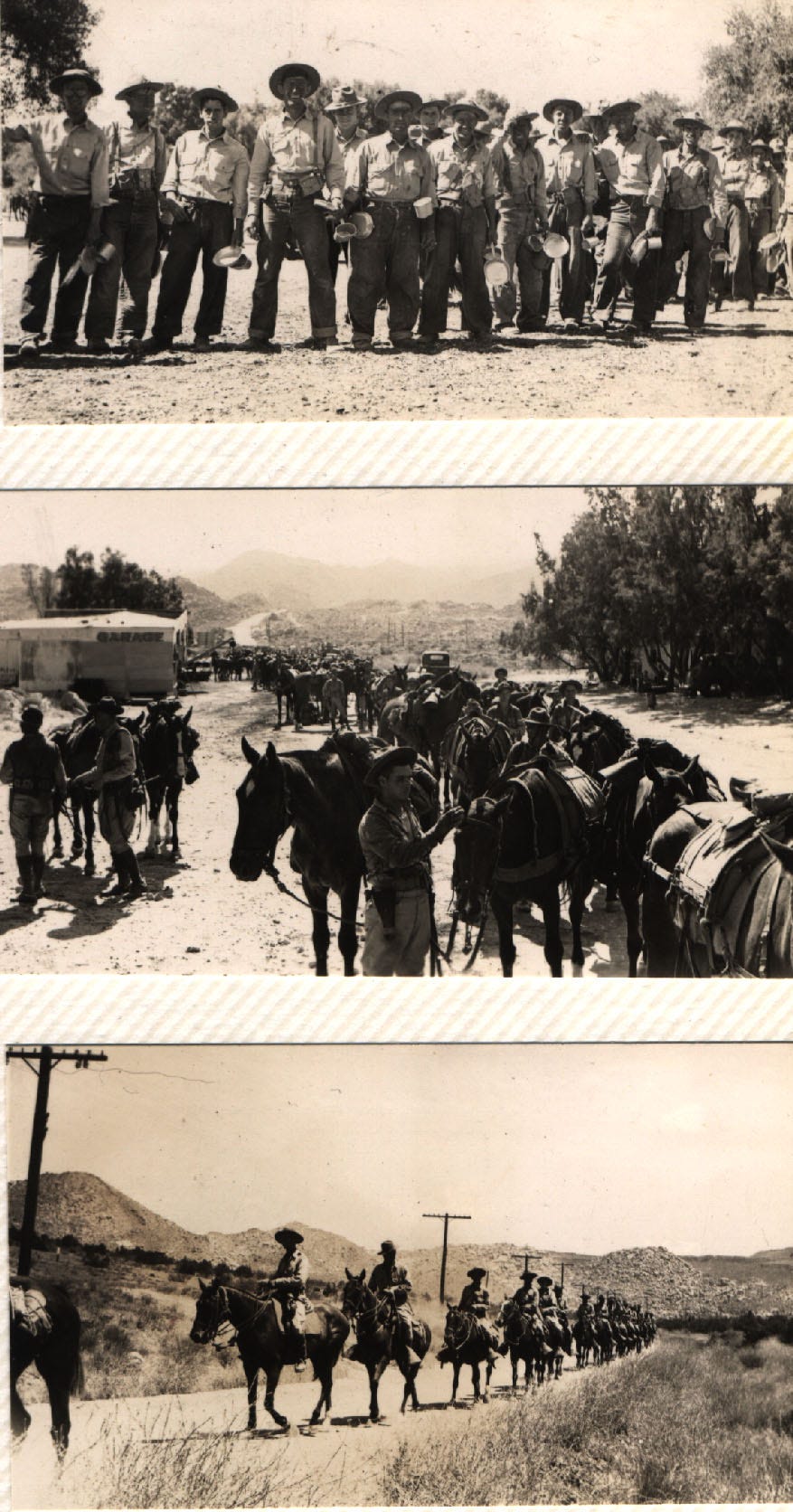
Ed Stuever: All these I’ve turned in to them already, these are copies of what they’ve received. So this was at Bing Crosby’s race park at Dover Beach, California. We were on exhibition for two weeks. Of course Betty Lawrence, she had, I don’t know, how much silverware, that’s all over her saddles and everything, and we had two machine gun squads there, and we’d line up in a straight line and they’d blow a whistle and we’d take off at a gallop and he would blow the whistle again and we had to dismount and let off a burst of ammunition – they were blanks – and usually it was four or five, seven, sometimes eight seconds from the time they blew the whistle to the time they got the shots.
Art Horn: Oh, you had to take the machine gun off the horse, set it up and then fire it? You didn’t fire it on the horse?
Ed Stuever: They finally stuck me with the job of controlling the other four riders’ horses, you know, they dismounted. They threw the reins at me, and boy, I’m going around there, and they’re pulling in all directions, trying to keep these horses together. It was quite a show we put on for them people.
This was our camp. We had all tents. Now, I’m trying to figure out, just so I could figure out how many companies there were. E Company was on this side, and D was on that side. But every evening they called that retreat. They’d lower the flag. And everything was by the bugle, when to get the heck out of your tent and stand in line, and another bugle call to march to the stables. Here we’re exercising our horses before suppertime.
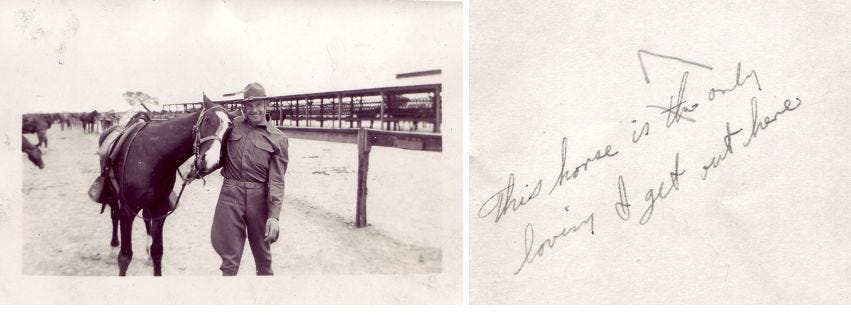
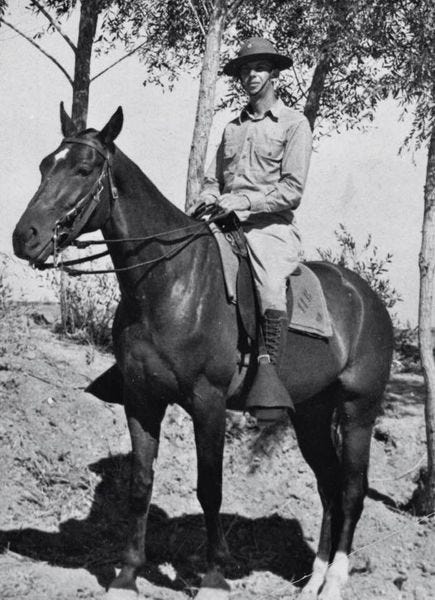
We had a horse that participated in a big San Diego County Fair show. He was quite a high jumper. This was me with my horse Rambling Jack. Rambling Jack was his name.
Aaron Elson: Who named him?
Ed Stuever: They did that way up at San Luis Obispo, before they went down to Seeley. There was an old mean horse, you know; during the first six months you had to train a horse from a wild horse that was ridden once, and you had to go out in the corral and train that horse yourself. So I trained this beautiful horse, and the day that they issued the horses to us, I was so proud, I walked up there with that horse.
“Sorry. He’s been taken by Officer Clemens.”
“What do you mean? That’s my horse! I broke him in! I’m going over the hill. The hell with you guys!” Oh, man, I was mad.
The first sergeant, he was a mean old bugger. He put his arms around me, and he says, “I know how brokenhearted you are. How you worked, you trained that horse. There’s a few good ones left. You see that one with his ears sticking up there? That’s Rambling Jack. We’ve had him awhile. He’s a good horse on parade. You be good to him, he’ll be good to you. He won’t let nobody interfere.”
So his name was Rambling Jack. Ohhh, I’m disgusted. I go up there, “Come here you little probate.” And I saddle him up and boy, he gives me a mean ride. And I said, “Why, you ain’t gonna get the best of me.”
I learned that he was mean. If you weren’t ready, he’d go back and bite you. Well, he grabbed me here and he tore my overalls, but he didn’t hurt nothing. But I knew that anytime I went to saddle him up I always had my elbow in him. And he’d go to bite me, I’d hit him here with my elbow, and that’s a sensitive spot (on the cheek). Boy. “Jack!” I’d always yell at him, “Jack!”
When we’d go out in the corral and we had to get our horses, everybody had to run and oh, trying to catch their horses. I’d say “Jack!” Oh, he’d come to me and I always had oats in my pocket. So when we went camping, we used to camp out overnight, and the enemy would come and steal our horses from another troop over there, they’d steal our saddles or our horses or whatever. So they came to steal my horse, they put me on the outpost because they knew that he would bite them, and he did bite one of them, he got him by the arm and he wouldn’t let go. And he’s screaming bloody murder.
So he was good in a way. And he was hell on maneuvers. When he met the enemy and they blew the bugle charge, I couldn’t hold him. He’d lock that bit in his mouth and he took off. Ohhh, he was mean. He went right through everything. I couldn’t hold him back. They’re yelling at me, Control that horse! Control that horse!” You couldn’t control that horse.
Then on maneuvers we’d come to a river. Real steep bank. And we had to cross that. There was deer paths and cow paths going down there; it was quite high, it was maybe 20 feet, oh, more than that, 25 feet, and down to the river bottom there. So they couldn’t get across that. The first sergeant says, “Stuever, come up here with Rambling Jack. You get up there with him, and he’s gonna lead us across. I’m gonna be right behind you.”
I says, “Ahhh, you’d better be.” Because I knew he loved water. He couldn’t wait to get down. He almost left me up there. Then when he gets down there, in the middle of the stream, he lays down in it. He’s got my leg under him, my gun went in the water. What a predicament I was in. And you couldn’t wear spurs, oh, you couldn’t touch him. He was mean. He didn’t like you touching him with spurs. So I didn’t have my spurs on, and I give him a real good one. Boy, he flew up and he was mad. What a horse that crazy nut was.
Side 2
Ed Stuever: This was how they transported us to the San Diego County Fair. This was at our show. This was the stables at, while we’re on maneuvers here, camping at Jacumba. They’re dragging the bales of hay. See the boots we had? Boy, I had a pair of shiny boots that anytime anybody wanted to go to town for the weekend and we had a Friday afternoon inspection, they’d borrow my boots so that they could get a pass. That’s the stables. This was at the San Diego Fairgrounds. Here we’re at the new campgrounds and it snowed, and every Saturday morning we’d pass in review, the whole outfit, and there would be people from all over, from San Diego would come out and watch us. We put on quite a show. This was our camp.
Here we are passing in review. And if you look, you can see groups here, all the way around. It lasted about two hours.
This was at the San Diego County Fair. This was the speaker’s stand, the grandstand was on this side, and here we are coming up from the stables. We’ve got machine gun packs in here somewhere. This was Lieutenant Clemens. This was me here. This was the road to San Diego, was that something. Going to San Diego they had a runaway truck, couldn’t stop it, it had no brakes, and everybody was getting off the road to let us get through. The guys were getting ready to jump off whenever they could. They didn’t. Finally, there was a hill to climb, and they made the driver hit behind another truck, and that stopped it.
This was my tank driver that got killed, Shorty Kubeczko. We were together all through the war, all through the cavalry and through the war. I had to lose him. I was home on a leave just before I went overseas, and my son was six months old at that time. Here’s where we’re camped out. Two guys put a tent together and we each had a shelter half. One time I was rolling up the bottom half of my tent, and here was a snake that big around, and he must have been that [three feet] long. I didn’t take time to roll up that tent. I threw the whole thing on the horse and got the hell out of there.
This was at one of our shows, we were crossing a dam. This was how it looked at camp. We had a little stove in here.
Aaron Elson: Shorty, what was his family like?
Ed Stuever: They were Polish. He had four sisters and there was a breakup of their marriage, the family’s. So he was a little bit irritated. He didn’t care what happened to him. I don’t know, I often wondered why he had to go.
Aaron Elson: Did he ever talk about his family?
Ed Stuever: Not much.
Aaron Elson: His parents were divorced?
Ed Stuever: No, I don’t think they divorced. They just separated. In those days, you know, there was heavy drinking.
Art Horn: I’ve gone through all these pictures [in the cavalry yearbook] and I don’t know why I’m not on one of them because that’s where I was, in B Troop. I must have been on guard duty. Because when they took pictures that time, I was on guard duty on the big picture with the whole troop, and each time I must have been on guard duty because I’m not on any of these major pictures. I know all the guys here, Pfc Mauser, I gave his wife, here’s Mauser, this is a little guy, I just presented his wife with the memorial certificate, a couple of years ago. This is our first sergeant, and when we left the cavalry, they sent him to MP and he became a captain in the MP s. His name was Sergeant Roberts.
Aaron Elson: Was he the guy who could bend over and touch his toes?
Art Horn: Yeah, he was married and had a daughter and everything and he’d go home every night. And he was as mean as could be. But when we left, he didn’t follow us, they sent him to MP school and I found out later that he was a captain in the MPs, and he shot somebody. I don’t know what ever happened. He was ready for retirement then already, he must have been about 45 years old. And all these ... Mauser, Sergeant Roberts, Kramer, this guy always had a little mustache. George Ellis. He was an elderly guy. Hidalgo. This guy, he used to work for a bandleader that was killed during the war.
Aaron Elson: Glenn Miller?
Art Horn: Yeah.
Aaron Elson: Who was this?
Art Horn: This was Hidalgo. He was trying to get back to Glenn Miller’s band. He just worked for him. He wasn’t in the band, but he was very good friends with him. This was Corporal Weisberg. When he got telling stories, he could tell you the darnedest story and he used to get us in stitches every once in a while if we had a beer bust in the hall. Weisberg. Taylor. I think they shipped him out a little bit later. Prendergast. Schifler. I went to his wake. And then Corporal Merrick. And Sands. Sands decided he was going to go in the paratroopers, and I guess he got killed while he was training. Funny, how I can remember those names when I first went in.
Aaron Elson: You had said a while ago, when you got back after starting Joan Bennett’s car, when you got back to camp, what did everybody say?
Art Horn: Oh, I didn’t ballyhoo it too much because we were moving, getting ready to move out to go to Fort Benning. Then I got yellow jaundice and then I was in the hospital for a while.
Ed Stuever: Oh, those guys that had yellow jaundice, man, they looked terrible. They had yellow eyes, and yellow scalps.
Art Horn: This fellow right here I talk to every day, he lives in Des Plaines, Pat Shortall.
Aaron Elson: He’s still alive?
Art Horn: Yeah. He says, “I can’t see. I had to get rid of my car,” but he says, “I can get around.” He has coffee with some of the fellows. He lives in kind of an apartment, they do all the work; he’s been there for about 40 years, he says. And his son used to take him to Las Vegas to watch boxing, and once I wanted him to come to a reunion, and he says, “My son’s taking me to Las Vegas to watch boxing,” and I says, “What the heck do you want to watch boxing?”
“Well,” he says, “when I got out of the Army, that was it.” All the years I used to call him, I never got to visit with him to this day yet. And I says, “One day I’m gonna come over and visit with you and just talk to you,” but every time I call him, from the time we got out of the service, I started looking for all the guys that we could get to the battalion reunion. All the guys from Chicago, I spent a lot of time, because I was a service manager, I had a phone at my desk during working hours and I’d call; if I found a phone number I’d call.
Aaron Elson: Where did you work as a service manager?
Art Horn: International Harvester. At a branch in Chicago. And when things were quiet, everybody was working, I could sit down a little bit. But most of the time I didn’t spend my time in the office, just to do my paperwork, and then I’d be out there cracking the whip and I’d get involved with all kinds of work on engines, diesel and gas engines.
Ed Stuever: I worked there for a little while, heat treating crankshafts. Until one time I picked up a crankshaft, it was an 87 pounds, I picked that sucker up and I was waving it over Mr. Moon’s head, he was the supervisor, or slave driver. I says, “I’m gonna straighten one of these things out over your damn thick head one of these days.” And my superintendent walked up behind me and tapped me on the shoulder and said, “Put that thing down before something happens. What’s this all about?”
I said, “Well, this goddang slave driver you’ve got here is dragging 33 tons of iron out of us a day manually. And he’s not satisfied. He wants more.”
“Thirty-three tons?”
I says, “Yeah, that’s what those damn tanks weighed, 33 tons, like we had in the Army.”
And he said, “Let’s sit down and figure this out.” We went in that little room where the section was, “Yes, you’re right, me boy,” he says. “You come with me. You don’t need to do this work.” And he gave me a board with a clock on it and he wanted me to time people and oh, man, you think that would have been a good healthy job? I turned one guy in; I found a bunch of oily rags stacked under an idle machine and I said, “Oh, nobody around. I’ll put that down.” And the next day, they were waiting for me. “Are you the guy that turned us in?” It wasn’t healthy.
Art Horn: No, you had to go along with it. Because I walked into a new branch that we were gonna move into when I first got in; I left tractor works. I decided, talking with my mother-in-law, and she says, “If you’ve been in wheeled vehicles in the Army, why don’t you make the transfer?” So I go to tractor works and I says, “I want to transfer into motor trucks,” and I showed my release from the Army, that I had been a wheeled vehicle mechanic in a tank company, and they says, “Oh yeah, we’ll give you a tryout as a mechanic.”
Ed Stuever: That other one was down there around Sacramento Boulevard, 31st Street, somewhere down in there?
Art Horn: Yeah, that was the first one, that was in the area of International Harvester, the tractor works, and we had that little motor truck. After we were there for a while, business started, it took almost two and a half years before they had enough trucks to sell to customers; everybody’s trucks were just about out. And I transferred over there and I got a ten cents an hour raise higher than I was getting at tractor works and I was getting the highest pay that they had there for order takers, but then I worked 48 hours a week at time and a half with eight hours on Saturday, and I says, “Gosh, this is a big jump for me.” And I decided I’d work like a dog; before you know it, why, they says, “Art,” he says, after I was there about a year, “We’re gonna need somebody to get up on the desk to talk with the customers.” I can talk to people. “I want you to take care of the desk, and when there’s no customers coming in, why, you can take your toolbox and do small things on trucks, carburetors, adjustments, and put your time on as an inspector, and do mechanical work when there’s no customers.” So I did that. And before you know it why, they says, “You know, we’re gonna, the service manager,” he says, “Come on with me, I’m gonna go into the new branch that we’re gonna have set up for us.” It was a block long, and it ran from the street to the alley on Archer Avenue. I went in there and I looked at it and I said, “You know, if this place burns, it’s going to the ground.” It was bricks. It had wood beams from the street to the alley, from the sidewalk to the alley, that long, all trusses. When you had a fire in a garage and it reached the beams, that was it. And I told him. He says, “Don’t say that.” He says, “The district manager has picked this place out,” and he says, “I don’t want to hear you say that again.” And we moved over there, and I was working there. I became the night foreman. And just at the time we changed the shift, the service manager was there, the day foreman and myself were sitting in the office and I’d just got these men started and I’d sit there and the guy says, “Art!” He hollered at me. And I look out the window, I’m sitting at the service manager’s desk, and I could see the whole thing, and he says, “Fire!” I grab the phone and call the fire department right away. Then I went through it and I got all the guys on the other side out, I opened the door to get out, and one of the fellows that was burned, we had been building a new front end alignment and they had a big pile of sand there, they grabbed him and he had his coveralls were burning, they rolled him in the sand and saved his life, because if that sand wouldn’t have been there, he’d have burned because he had gas or something on him. One of the tanks between the engine compartment, the fire started when the guys were pushing it in there, they kind of missed the driveshaft and they knocked off the cap, that’s all I can say started it. For seven years I had to go to, they had a statute of limitations for seven years, I’d have to go every year and a half and give a deposition of what the fire was. I never did realize what it was until I talked to somebody that told me after that that’s how it started.
Aaron Elson: How did it start?
Art Horn: Well, it changed the whole system. You see, after the war, things were growing, and little things like this would happen and when they built new garages, everything was built from mistakes that they didn’t have, and you had all these things covered. You used to have a dip tank, but the fire that warmed that dip tank was not in the same room where the trucks were worked on. They had them in separate rooms. They had a big wall in between so there was no way for any fumes to get in. I’ll tell you, I stayed with the company all those years and became service manager and so forth. It was quite a thrill. And then I finally retired. They says, “We’re gonna sell all our company owned branches to dealerships.” He says, “We’ll put you back on the floor.”
I says, “Oh, you can’t do that anymore. Harvester says if you’ve been in the company 30 years and you’re a service manager after 30 years, you’re entitled to take a retirement.”
So I retired. I was 57 years old. Somebody said, “You’re too young to be retired.”
I said, “I know. I’m going to get a job somewhere else.”
A fellow that knew me said, “I’ve worked for a Buick dealer since I was 17 years old,” and he was older than I was. He was close to 65 or 70 years old, and he was retiring. He said, “Why don’t you come and take this job. You’ve been a service manager. You know how to handle this.”
So I worked there until I was 66 years old before I retired. Plus I was getting my pension. It turned out pretty nice.
Aaron Elson: Do you remember the fire that Dale Albee got burned in?
Art Horn: Oh, yeah. I remember it, because they had my radio in the shop that burned up. But I was with the company, I was driving a 6 by 6 and we were on maneuvers that day; because I was in charge of all the wheeled vehicles, I had to go out with them. There were no tanks. We went there and we got to an area where it had been raining and at Fort Benning, this is another thing I discovered, we were driving along there and all of a sudden one of the trucks broke through the crust and all of the trucks stuck. Once you broke that, then it became mud. Three trucks ahead, that was the first time I ever saw that happened.
Smoky Stuever: It was a hell of a place for tanks. We had to corduroy them to get them out of there. We had to cut down trees.
Art Horn: I’ll never forget that. I’ve never had that experiences of the crust cracking.
Smoky Stuever: How did Dale Albee...I’m trying to remember, that fire.
Art Horn: You see, I was the wheeled vehicle mechanic, and I had to go with the trucks. We were on some kind of maneuver, and the motor sergeant and Albee and Freeberg and Mills, they were working on the tanks, and something started on fire, and the shop burned. I guess they were trying to put it out. I have no idea what that was.
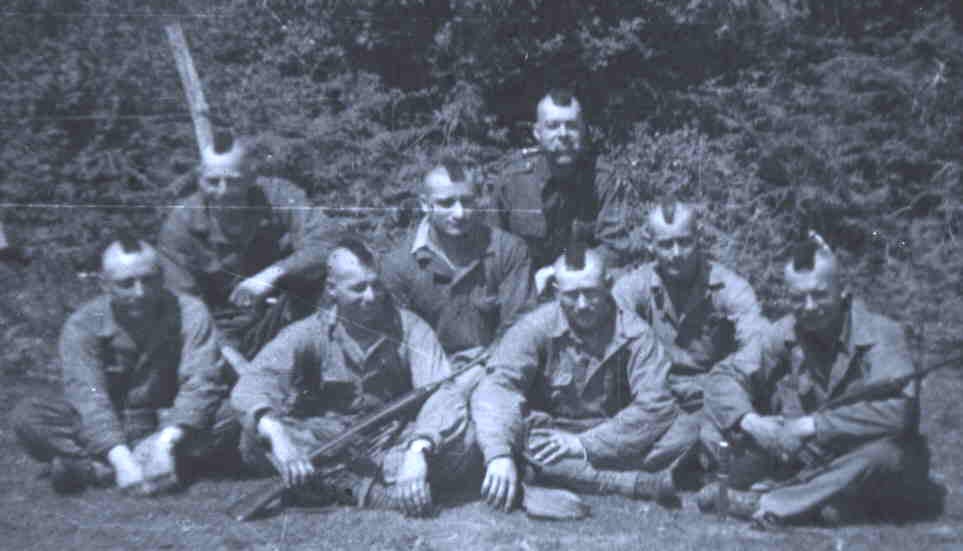
Ed Stuever: I’m trying to picture it in my mind. See, somewhere there was a fire. I didn’t see it happen, but after it happened.
Art Horn: So I come back, and he says, “Art, we took your radio, and it burned up.” My wife had sent me, my sister and my wife, they got together and they bought a radio and they sent me a nice new radio. And the guys took it out of my barracks, most of the time I had it there but I was gone and I didn’t bring it that morning because I was on this trip. He says, “Oh, we burned your radio.” I said, “Oh well, there’s nothing I can do about it.” But I’ve been studying this picture, all these fellows, there were two trainloads from Chicago that came down and these are all the fellows, most of them were from Chicago or the vicinity.
***
Aaron Elson: What was that you were saying before that, when you were eleven years old, was it your father took you down to a jail or something? [I had not yet pushed the record button on the tape recorder]
Art Horn: Oh yeah. Well, my father was in the furniture business. Then he sold the business and he got himself a job working for a furniture manufacturer. And there was a special, in the newspapers at that time, they would say somebody was looking for somebody that has experience in furniture manufacturing and had quite a bit of training. My father had gone to a trade school in Grand Rapids, Michigan. Grand Rapids was a furniture center at one time. In 1912, 13, 14, my father was in Grand Rapids learning the trade. He was from Chicago, and him and my mother got married, and it wasn’t until recently that I found, my sister had my mother’s wedding certificate and she showed it to me and I says, oh, during the heavy snow we didn’t go anywhere and I went over to visit with her, and she said my brother in law got this out of storage. And I said, Let me read it. Part of it’s all in German. But I could read the dates. My parents were married on March 15, 1914, and my dad’s address was Arthur A. Horn from Grand Rapids, Michigan. But I knew my dad was born in Chicago and grew up there. “Ohhh,” I said. “My mother said that she used to go to Grand Rapids for a visit once in a while,” see, “and then she said she lived there for a while.” They got married and my dad finished his apprenticeship there, and after a certain period of time he went into the furniture business. He had a store and he was selling things, but then World War I came along and he said things got kind of bad after World War I, and then he sold the business and he went to work for some furniture manufacturer. He read this blind ad in the paper, in those days they did it that way, they ran blind ads, he went there and the guy says, Pontiac, Illinois is the state reformatory for young men that are put in jail. And he says, “We have a furniture business down there that we want somebody that has knowledge of instructing and also to operate,” and my dad decided, he took it. And he says, “We don’t want you to move down here right away; after maybe a year,” because it was only about sixty miles from Chicago. And every Monday morning he’d go, and he’d sleep in the guardhouse. And then he says, the one weekend, it was the Fourth of July, this is when school was out, he took me first, and I was there and I slept in the guardhouse with him because some of the guards were on vacation. I stayed there from early Monday morning because he had to leave, oh, I would say 60 miles in a 1920 Chevy that would go 45 miles an hour; it was a pretty long haul. I stayed there, and he says, “I’m gonna show you the prison. I’ll show you solitary confinement.” What they did in those days to prisoners, that was before there was any radios, and solitary confinement was stone, brick buildings with a pot and a chair, and if they were bad, they tried to escape and they got caught, they’d come back and they put them into solitary confinement for a week. And in between, they were all brick, with the bars in front, but in between they had all big curtains so they couldn’t talk to each other; well, they could talk to them, but they didn’t know which one it was.
I was almost 12, and my father says, “You know,” he says, “this is what happens to bad boys when they grow up and they get into trouble.” And he says, “Learn from this. Everybody doesn’t get this type of,” he took me to places, when people go to a prison, they never show them that. He said, “I’m showing you everything here.” They had a solitary room that had only a peek hole in it. He said that if a guy was real bad, they’d tie him up so he could barely get his feet up and stand there for hours at a time, and they’d peek in. I didn’t, I was scared stiff. I said, “I don’t want to go to jail.” I guess that’s why I lived an honest life. So then my brother, too, he went there a little bit later. But he wasn’t as impressed as I was because he’s two years younger than I was. I don’t think he remembers it as well as I do.
My brother’s the only one that came to Camp Randolph. After the war in Germany, he came to Camp Randolph looking for me. He said, “I don’t know how many people” he talked to, because I was gone. I went to the 108th Airborne Division was going home first, so they would ship those that had enough points to go there.
Aaron Elson: What was your brother in?
Art Horn: My brother went in the Army well after I did, and when he went in, he was trained and then they shipped him to Africa, and he was in the chemical warfare division. It was supposed to be big, but they were attached to an air force, and most of the time they didn’t do much in chemical because they didn’t want to get involved with chemical warfare. That was the last straw. But then he would travel around, and they said, “We’re going to put you in charge of billets for air boys that had so many flights, they get R and R.” After he got through Africa they came to Italy. And he gets a hotel and he takes over, he takes the best room for himself, close to the barber shop, and he hired some Italian barbers, and all the flyboys that had R and R, whether they were sergeants, whatever they are, then he’d set them up. And he said, “Every morning I’d get up and I’d get a shave.” He had a nice time. He got in trouble once. A captain said to him, “I’m gonna send you up to the front.” Then he says, “Oh yeah? My brother’s up there. He’s with General Patton.” Then about a half hour later [the captain] comes back, he says, “Forget about whatever I said. One in the family working with Patton is enough.” He told me that little story after we were home.
After the war was over, I took a trip to [one of the concentration camps]. We went in there and they had shower stalls and then they had the pipe coming through there, and on the other side, why, they’d take the bodies and they had a big furnace and a crematory, and downstairs they used to have all the ashes and anybody who wanted ashes, they had barrels, they’d give them an urn of ashes. That’s when I took a trip, after the war was over. I said I wanted to see some of those things. Not that, it was disgusting to see how they had worked it all. It was about the worst. How could they all do that? You know, when Hitler took over, why, he was the worst of the bunch. Of course he was not German, he was an Austrian. But everybody in Germany, when he built all those autobahns, when the GI s came home, they said, “Gosh, we’ve got to build these autobahns.” That’s when we started building interstate highways from one spot to the other. I think the only one that we had in the United States then was the Pennsylvania Turnpike, and that was only in Pennsylvania. I don’t know if you remember that or not.
Ed Stuever: I’ve driven over it.
Art Horn: The first vacation I took, we went ...
Clifford Merrill: 1941, I drove over it.
Art Horn: After my second, my first son was born during the war and the second one was right after, then the third one, and I took my family and we went from Chicago to New Jersey, and we went through the whole Pennsylvania...I said, “We’re gonna ride on that Pennsylvania Turnpike.” That was the only thing that was still going. None of the new ones were that far ahead that you could go anywhere.
– – – –