
"Who's the blankety blank commanding officer of this blankety blank outfit?" You can fill in the blanks
Arnold Brown Part 2: Meeting General Patton.

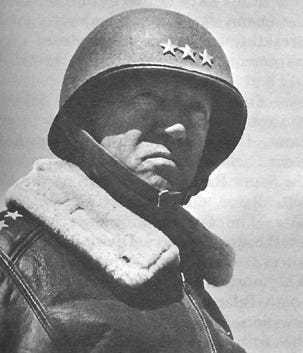
Arnold Brown: Shortly after that was the Normandy breakout, and the armored forces were pursuing the Germans twenty to thirty miles a day, some days more than that. We in the infantry were trying to keep up. So we were marching down the road, single file, on each side of the road, and here comes a jeep. My first sergeant said, “Do you know who that is?”
I said, “No.”
He said, “That’s General Patton.”
Well, I’d heard a lot about General Patton but I’d never met him. I didn’t realize I was getting ready to get acquainted with him. But he got right even with G Company, and he said, “Driver, stop here.”
I thought, “I don’t see how anything could be wrong.” My biggest responsibility at that time was keeping the stragglers moving along. In our battalion march order, I was the rearmost company, so some of the stragglers were from other companies.
General Patton got out of the jeep and said, “Who’s the blankety blank commanding officer of this blankety blank outfit?” You can fill in the blanks.
At that time I was hoping the Germans would start shelling us so I could jump in a hole. And then I was thinking, well, if he relieves me of my command, with the experiences I’ve had in the past, he’d be doing me a favor. I stepped out and reported to him and said, “I am, Sir.”
He looked me over a little bit and made a few comments. Then he got back in the jeep and drove on. It was just his way of letting everybody know that he’s in charge of things and he’s up there. So I’m one of those who could brag about being chewed out by General Patton.
Prior to the closing of the Falaise Gap, in August, we had moved into a bivouac area, and they decided they would have a little break and pay the troops. The troops hadn’t been paid for a month or two. So they told me to go back to the division rear and pick up the payroll.
By the time I got back up to my company area, it was late afternoon. So I started paying off the troops. Most of them would take a few dollars, and they had a system where you could put it back and send it back to your family.
I got through about one platoon, and we got an emergency order. We’ve got to move right away. I had to stop paying off the troops and move into this other area, and by the time we got there and got situated it was dark, and I could hear the Germans out in front of me. I could hear the vehicles and tanks running around. This was during the closing of the Falaise Gap. The Germans had broken through in one spot, and they wanted to plug the hole with us.
Before daylight, I get orders that we’re going to make a daylight attack. What am I going to do with this payroll? I can picture me galloping across this field with a .45 pistol in one hand and the payroll in the other. I thought about it and thought about it. Finally, I turned this payroll over to my driver, who was a Pfc. He was a pretty reliable guy, and I told him, “You guard this with your life.”
So we launched this attack, and we came under mortar fire. A mortar round exploded nearby, and I felt something jerking my trousers below my knee. I jumped in a hole until the mortar barrage lifted, and when I started to move out, uh-oh, something’s wrong with that leg.
I look down, and pull the britches leg up. There’s a piece of steel sticking in my leg.
Aaron Elson: Your left leg?
Arnold Brown: My left, just below the knee, right inside. It didn’t hit the bone. So I took my first aid packet, and thought through my first aid training. The first thing I did was to sprinkle this sulfa powder around the wounded area.
Aaron Elson: Did you leave the steel in or did you pull it out?
Arnold Brown: I left it in. And I put a bandage around it. Then I took my sulfa tablets and drank half a canteen of water, and checked it. Well, this thing’s got to come out of my leg before I can go any further, so I call the executive officer over and put him in charge of the company going into this attack, and I go back to the aid station. On the way back, I run into a Mexican who was in my company. His right hand was shredded, and it looked like there was no meat on his fingers. He said he was throwing a hand grenade and it hit an apple tree and bounced back, and he picked it up to throw it again and it exploded.
We had to cross an open field to get back to the aid station, and whenever we got into the field a German machine gun opened up on us. So we ducked down in this ditch. We lay there a little while, then we got up to move back again, and the Germans opened up with that machine gun a second time.
There was no way we could get across this field with that machine gun shooting at us. So we lay down again, and got up a third time, and the same thing. Now this Mexican takes his carbine in his left arm, and he’s up there looking for that machine gun.
I told him, “Stay down here! There’s no reason to commit suicide.” So we lay there a while longer. Of course, my company and the other elements of the battalion were moving forward with the attack, so the Germans must have got out of there or something. Eventually we got up, they didn’t shoot at us, and we got back to the battalion aid station.
They had quite a few casualties there. The battalion surgeon looked at me. I wasn’t hurting, and I wasn’t losing any blood, so he just put another bandage on top of the one that I had put on. Then he gave me six sulfa tablets and told me to drink half a canteen of water. I said, “I’ve already done that, Captain.”
“We’ve got to get it on the record,” he said. So I took it.
Then they sent me back to the regimental clearing station. Here again they had heavy casualties, and I’m waiting for them to treat everybody. Finally they looked at me, and all they did was give me six more sulfa tablets.
I said, “I’ve already done this twice.” The doctor at the battalion aid station had forgotten to put it on my tag – well, you can understand in combat how they forget all these things. So I had to take the tablets, and by this time I was more concerned about overdosing on sulfa drugs than I was about my wound.
I went back to the division collecting station. There they had hospital tents set up, like M*A*S*H* on TV. Here again, they take care of the most seriously wounded first, including the Germans. So I was the last one that they took into surgery. I was wounded at 9:30 in the morning and here it is midnight.
When they removed the bandages from my leg and pulled that piece of steel out, blood squirted up. That hot steel had cut my artery and sealed it at the same time. You see what would have happened if they’d pulled that out any other place? This is the sort of luck I had all through this war.
Aaron Elson: Had you thought about pulling it out yourself?
Arnold Brown: No, because I had enough training to know to not do this. It’s all part of, it takes luck and training and everything combined to get through this.
Aaron Elson: Do you remember any of the other casualties in the aid station?
Arnold Brown: The only place that I stayed any length of time was the division collecting station, and there you saw all types of injuries. You saw tankers who had been burned, and they were bandaged up to the top of their head, all you could see was their eyes, just like a mummy. That was something. When it got to midnight a Red Cross girl came around and lit a cigarette.
After the division collecting station I was evacuated to England, and within two weeks I was back at the front line. All this time I was wondering what happened to that payroll. So when I came back through the division rear, I had enough nerve to go in and see the G-1, and I kind of whispered to him, “What happened to that payroll?”
“Ohhh!” he said, “We had a heck of a mess with that. We counted it up and we finally figured out that $82 was missing. We started wondering whether to charge you or not.”
I was getting ready to say, “You aren’t charging me for nothing! I couldn’t help that.”
Then he said, “We had a little slush fund back here so we put in the $82.” But all I could figure out, the Pfc that I turned the bag over to, a Pfc got about $82 a month, he must have took out his $82 and forgot to sign the payroll.
After I came back, they assigned me to Company C of the 358. And this company had the best non-commissioned officers. They had good morale. In other words, they’re combat-trained now, they know what they’re doing. And believe me, that helped boost my morale, too.
I had a few skirmishes, but the first major thing of importance was the period of time when they ran out of gas. We were in a bivouac area, and the rumor was that we were going to bed down for the winter and make a spring attack. I realized later that this was just a ploy to fool the enemy, but we were even cutting down logs and building log cabins and hauling straw in so it would be comfortable for the men. All the activity that was going on was just some patrolling by each side. And we thought, well, we’ve got it made until spring.
While we’re going through all this, we get a message from the regiment: “All officers report to the division rear.” So we don’t know what’s up. They had a building back there, some kind of sports arena where they can get all of the officers in the entire division in the building. I thought, “They’re taking quite a chance. What if somebody dropped a bomb?” You can imagine how many officers were in that building. It has a stage up in front, and we’re all waiting to see what’s going to happen.
The first thing, here comes old General Patton walking across the stage. He walks from one end of the stage to the other – can you picture this? – and he walks back and stops. And he says, “Men, this is it.”
I’m not going to quote all his curse words. He said, “We’re going to cross that damn Moselle River at 2 o’clock in the morning.”
He said, “I want to tell you a little bit about the enemy over there. Now, in these fortress battalions, the Germans don’t have their best troops.
“Their armored forces, their crack troops, are back in reserve. Some of the fillers in these fortress battalions are old men.”
He said, “Kill the sonofabitches.”
He said, “Some of them have been slightly wounded in combat, or maybe they’ve got a crippled leg or one arm missing,” but they can man those machine guns in these forts.”
He said, “Kill the sonofabitches.”
Then he said, “There’s this business about taking prisoners. When you accept an enemy as a prisoner, you’ve searched him and disarmed him and he’s in your possession, you treat him according to the Geneva Convention.
“Now there’s nothing that says you can’t shoot the sonofabitch before you’ve accepted him as a prisoner. What I mean is, some of those snipers, they’ll take camouflage in a tree, and some of them are going to let you pass and are camouflaged behind you, and they’ll kill a few of your men. Then, when you locate his position, he wants to come out and surrender.”
He said, “Don’t accept that sonofabitch. Kill him.”
Aaron Elson: He said that?
Arnold Brown: Yes. Oh, let me tell you, you talk about putting blood in your eyes.
The Moselle River was flooded at that time, and the ground was wet. We had to carry those assault boats from our covered position, to keep it secret from the Germans that we were going to make this surprise attack. Well, the boats were way back in covered positions. And in my command group, we were carrying loads of wire, radios, other stuff. I helped carry that boat. And the terrain was rough. My shoulder was black and blue for two or three weeks before it cleared up.
We finally got down to the river, and launched our boat. Now since this was a surprise attack we had radio silence until contact with the enemy was made. They were laying wire all the time so we could plug in our telephone any time and communicate with the battalion if we need to.
When we got down to the river we had to plug in a large cable that was insulated and waterproof, and it was maybe an inch and a half in diameter. We plugged that into our telephone line, and when we began to row across this river, in the strong current, as we’d roll this cable off from the rear of the boat, the current kept swinging us downstream. And these men weren’t skilled oarsmen to begin with. My company’s crossing up here and here I am going way down below, and I said, “Throw that damn wire overboard!” When we got across we were maybe 100 yards down from where the company was. It’s a good thing there was no enemy there. And it was a complete surprise because we had to wake the Germans up to tell them we were over there. So the strategy worked out, but nobody had thought about how strong the current was.
My mission in the Moselle crossing was to capture this little town of Bessehahn. The battalion was attacking Fort Koenigsmacher, and Bessehahn was where the battalion wanted to move in up everything. So we did this.
A and B Companies made the attack on Fort Koenigsmacher, and they had so many casualties that they couldn’t go forward. So now they’re going to commit me, and also G Company on the other side. So, should I tell this story? Do you want me to tell everything, good and bad?
Aaron Elson: Everything.
Arnold Brown: This is the first time I’ve made this public. Okay. So, prior to us making this crossing, they were doing away with the old cannon company. The regimental cannon company was artillery. Some of its officers were sent to the infantry. And they sent me a lieutenant from cannon company. His name was Lieutenant Gordon.
The old infantry style is to attack with two platoons forward and one in support. So I put him in charge of my support platoon until he could get his feet on the ground and get acquainted with his men.
When they were getting ready to make this attack on Fort Koenigsmacher, I took all of the officers on a reconnaissance into the area that A and B Companies had already captured and occupied, to see what the situation was. So when I got back and issued an attack order, Lieutenant Gordon was missing. I reported it to the battalion commander.
So we captured Fort Koenigsmacher, and right after the capture, we started setting up our defenses, because the Germans have a habit of trying to attack you before you get organized on your objective. Just as we got reorganized, I got a message to call the battalion commander.
He said, “We located Lieutenant Gordon.” He ended up back at cannon company. He claimed he was shellshocked. The battalion commander said, “Do you want me to send him back up there?”
I said, “If you send the sonofabitch up here I’ll shoot him myself.”
“Then I guess I’d better not send him up there.”
Now, while we were on that reconnaissance there was a few harassment artillery shells, but none of them hit really close to us, so how could he have gotten shellshocked? I’ve seen men shellshocked. If they’re shellshocked, they’re just as likely to go forward as backward, they don’t know what they’re doing, and he knew what he was doing.
Then they sent me a questionnaire to fill out. You know how the military is, they want so many copies of about a two-page questionnaire.
The last question on that was: “Even though this officer is unqualified for combat, do you think he’s qualified for some rear area job in administration, supplies, communication, etcetera?”
I said, “No.”
They said, “If your answer is no, state why?”
I wrote, “In my opinion, the purpose of Army officers is to lead troops in combat. There’s only one test of that ability. If they fail that test, they do not deserve a commission in any capacity, period.”
So what do you think happened? He was some big shot’s son back here in the States, so they assigned him to a rear area job. And me and all of the officers, whenever we’d go back to the rear and had to see him, he’d want to be friends, but we just gave him the cold shoulder.
Some time later I was reading an article in the Stars & Stripes. It was an article on how to fight the Germans in the city. I said, “This is very good. This is the way I’ve been coaching my troops.”
Who do you think signed it? Lieutenant Gordon! You talk about wanting to go back there and shoot him myself, and all he knew about it was what I briefed the company there when we were going across the river to take Bessehahn. Now today he’s a veteran, with all privileges, you see? Where’s the justice? There is none.
Aaron Elson: When you attacked Fort Koenigsmacher, how was it defended?
Arnold Brown: Well, the problem that the two companies that attacked the fort had was that these Germans were coming out of tunnels and attacking them from behind. So as I would pass one of the entrances to a tunnel, I would blow it. That way, they’re gonna come back behind me after we move out. And all of a sudden, we started to get a bunch of small fire coming over the top, see, we’re down low. I was deploying my men to start returning this fire, and I thought, what the hell, I said, “Hold it! That’s M-1 fire!” That was G Company on the other side. And I pulled my men back down and let G Company go.
At about that time the Germans were coming out and surrendering. I went through one of the tunnels. They even had an aid station in there, with a bunch of Germans racked up. It was kind of like inside a ship, where they have them lined up on each side.
Aaron Elson: When did you have your children?
Arnold Brown: I had two children at the time I was, I had two prior to World War II and I had two after. Now this is the copy of the citation that gave me the British Military Cross.
Aaron Elson: [reading] “For gallantry in action during the battle of Oberwampach, Luxembourg, on 18-19 January, 1945. Upon capture of the town, Captain Brown’s unfaltering courage and outstanding leadership greatly contributed to making possible the defeat of strong enemy counterattacks against his company’s position.
“During the battle for Oberwampach, Luxembourg on 18-19 January of 1945, Companies B and C had the mission of taking and holding the town. This they accomplished easily, and then set up a defense with Company C holding the eastern part of the town and Company B holding the western part. The night after the capture was effected, the enemy launched a series of very strong counterattacks on C Company’s position with about 20 tanks and self-propelled guns supporting the infantry.
“The platoon of tank destroyers protecting the company’s flank was knocked out and for two days and nights the enemy assaulted the position from the high ground they still held. One platoon had their building set afire by enemy tank shells and were forced to evacuate it. Under the severe enemy fire Captain Brown went to the platoon’s position and directed the evacuation to another position. During the critical night attacks, Captain Brown was everywhere, directing artillery fire, rallying his men, keeping the ammunition open and available and occupying an OP in the highest building in the face of intense tank fire. He stayed at his post, directing the artillery fire that smashed three more strong enemy attacks.
“Captain Brown’s unfaltering courage and his tireless efforts in directing the company resulted in hundreds of the enemy being killed, 50 taken prisoner, and about 11 or 12 tanks destroyed. His utter disregard for the heavy enemy fire, his outstanding leadership and cool decisive thinking kept his men going in the face of heavy odds. His disregard for his own personal safety is in accordance with the highest traditions of the service.”
Arnold Brown: They always exaggerate when they write those. I didn’t even know, they didn’t consult me on writing that up. I thought the only important thing there was when those two senior sergeants come to me and suggested that this was the roughest they’d ever experienced, that we’d better withdraw or we might have to surrender, and I told them we were going to hold it to the last man. I thought they ought to put that in there.
Don’t get me wrong. This was primarily for, not just for the, they used that for justification of giving me, because of all these other operations on which I’d been. But I wish they had of put that part in there.
See, I had the, that being the highest building, intensive fire, well, we were under a lot of fire where I was, but I had two O.P.s [observation posts], see, there’s two platoons up there, I had one on the right and one on the left, and so some of that artillery was being relayed by these two people; in other words, I got it tied together.
(to be continued)
Wow. That’s almost as many buttons as a finely tailored made in Hong Kong dress shirt! If you’d like to tailor your Substack feed for regular stories like this please hit that subscribe button only don’t hit it so hard that you break the screen on your desktop or phone. And if you missed Part 1 of this three-part interview, here it is:
I have a Patton story. My uncle was in the 3rd Army’s 119th AAA Gun Bn. (Mobile), with 90mm cannons. In Mar. 1945 they were providing protection for 3rd Army Rhine bridges against German air attack. Their deuce and a half trucks were also often used for 3rd Army or lower unit supply. One of the vets I met researching my uncle’s war service, Jack Paton of Worth, IL, was a WO and Bn. Personnel Officer in HQ Btry. He was leading a convoy of Bn. trucks across one of the pontoon bridges, west to east. They were carefully obeying the 3A speed limit (subject to fines for an infraction) going across. While crossing, up comes a Sr. Officer staff car, behind, furiously blowing its horn like they were moving too slow. When they get to the east side, out jumps this general from the car - all piss and vinegar. It was Patton himself, cussing up a storm (for them slowing him down). He growled to WO Jack, “Who’s your commanding officer, I want to speak to him!” So, Jack rang up by field phone the OOD, Captain Abbott of A Btry, and told the aid on the line that “Patton wanted to speak to the Capt. “ Capt. Abbott thought he meant “Paton” (Jack) and said something like “Oh, go jump in the River,” or maybe something more colorful. Well, that got “Ol’ Blood and Guts” even more livid, and he shot off an epic rant of profanities, and then beat it out there, on his way. Jack got such a kick out of that. I can hear him laughing about it even now (God Rest his Soul). Jack was a lifer and had some great stories - a really great vet. (119th AAA photos (they often used their 90mm cannons for field artillery, like German 88s): https://flickr.com/groups/3010306@N22