
This episode is personal
The Best "Little" Tank Company in the E.T.O.: Part 6

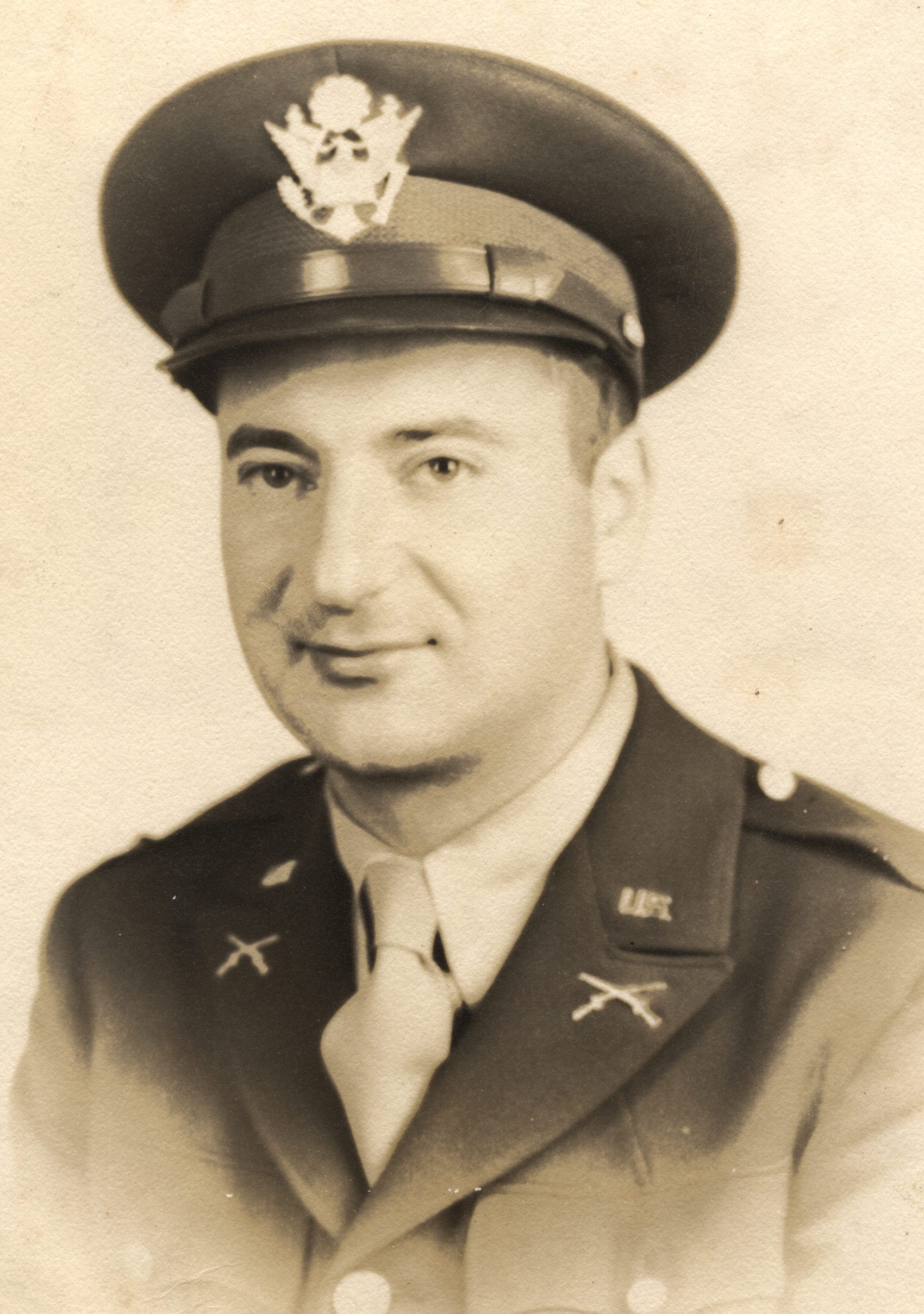
Over the years as I attended reunions of the 712th Tank Battalion and listened to hundred of stories, I myself became the subject of a handful of stories. Like the time Lieutenant Jim Flowers was telling some grandchildren how he lost both his legs in Normandy and was awarded a Distinguished Service Cross — the whole story takes about 40 minutes and Jim was having a little trouble with a detail, so I opened my mouth and provided it. Jim glared at me and said, “Who’s telling this story, me or you?” Or the time Caesar Tucci brought his copy of the D Company log to the 1993 reunion, and I was sitting at a table in the hospitality room reading it. I turned to the section on Dillingen, where my father, Lieutenant Maurice Elson, was wounded on December 10, 1944. Although he was in A Company, he led a foot patrol composed mostly of D Company men to bring supplies to the tankers and return with wounded soldiers. I thought there might be some detail about the patrol.
21 December 1944
SUBJECT: Company Journal
To: Commanding Officer, 712th Tank Battalion.
The following is a daily journal of this Organization from 11 December 1944 to 20 December 1944.
11 December 1944 - (This day’s activity has previously been written and submitted under the date of 10 December 1944 for the purpose of getting the complete story of the action at that time. The portion belonging to this day is being resubmitted.)
The return trip was made without event except that the point was missed by about 1/2 mile to the left. A wet and heavy snow began to fall that made travelling conditions even worse. A group consisting of Kwiatkowski, Sparks, Mallak, Kittelson, Roderick, Doyle, Murray, Vincent and twelve others formed a party to carry bundles of litters. About 8 minutes after the party left, Vincent reported back to the 1st Sgt. after his partner was unable to continue from exhaustion. The balance of the men from the group reached the chateau with the litters.
An enemy pill box had been captured several days before and was being used as a forward medical station. The position had become too hard to hold with the available forces, and that section was forced to retreat. There were 25 litter patients in the pill box that would have to be left behind to be captured by the Germans unless evacuated by forces other than the holding forces. The litter carrying group at the chateau volunteered to try to evacuate these patients. Each man took a litter, and, placed under the command of Lt. Elson they started towards the pill box around 0300, taking cover advantage of trenches wherever possible. Heavy artillery, mortar, and small arms fire was encountered all along the way. While crossing a road, Lt. Elson was hit three times by small arms fire believed to come from our own troops. [Paul Wannemacher, the battalion secretary, was seated nearby, and he liked to tell how he saw me jump out of my seat. The group was ordered to drop the litters and return back to the chateau to check on our own firing and to wait until the enemy fire had moderated. Again the group started for the pill box, recovered the abandoned litters, and proceeded slowly onwards. Progress was very slow due to the extreme darkness, thick woods, and rough terrain, and still heavy enemy mortar and artillery fire. The pill box was reached about 0700. The litters were loaded and the trip back was started with the litter patients, about 40 wounded that were able to walk, the small group of medics, and the holding force that amounted to about 15 soldiers. It was soon discovered that the group was headed in slightly the wrong direction, and Pfc. Sparks volunteered to carry the Red Cross flag and try to lead the group back to the proper place. He hid his weapon in the folds of a blanket and set off on a new course, waving the flag as he went. Fortunately the Germans respected the flag and ceased small arms fire, but the men were still subjected to air and tree bursts from artillery. A German machine gun nest was passed that had just been knocked out by the Infantry. This nest was passed on the way up to the pill box and must have been in operation at that time. The chateau, or forward C.P. of the 357th Infantry was reached with the 25 litter patients. The time was about 1030. This group was released, but had to remain at this C.P. until the river could be crossed under the cover of night.
In the meantime, at about 0300, a group of about 50 P.W.’s were assembled at the river supply dump and they were ordered to carry rations to the advance C.P. along with the balance of the carrying party which included Pfc. Vincent. On the way up a very heavy barrage of mortar and artillery fire separated them from the rear. After quite a length of time had elapsed, 1st Sgt. Thompson attempted to get to the advance C.P. to get information on this carrying party, but was stopped at an underpass within 500 yds. of the objective by very heavy mortar fire to the front and artillery fire in the rear. After waiting about 45 minutes with no let up in firing, he returned to the river dump, joined Pvt. McLeskey, and caught the last boat across the river at 0500. No word had been received from the last carrying party, but it is believed that they reached the C.P. without loss. Lt. Hiatt, 1st Sgt. Thompson, and Pvt. McLeskey returned to the company at 0800.
The group remaining at the advance C.P. volunteered to guard the 333 P.W.’s due to a shortage of M.P.’s. They marched them down to the river at night, took them across the river to the interrogation point, and returned to the Company at 2400 without Pfc. Vincent.
The balance of the Company remained at Neunkirchen.
Some things I’ll never know. The last few years of his life my father lived with my sister in Massachusetts, and he told her a German stood over him and pointed a luger at him, and that he was treated by a German medic. I never heard that directly from him but I don’t doubt that that could have happened, judging from other stories I’ve heard. I don’t know why he was left behind, other than that in the darkness the men on the patrol may have thought he was dead; or how he made it back to the American lines or how he got across the Saar River, although his was a chest wound, so he would have been ambulatory.
12 December 1944
Pfc. Vincent returned to the Company in the morning. He had missed the last boat across the river in the early morning of 11 December, had remained at the advanced C.P. during the day, and had volunteered to be a carrier again that night.
The 1st Platoon was outposted around Kerprich-Hemmersdorf, Germany, to act as guard for the Division C.P.
\A carrying party composed of 1st Lt. O’Brient, T/Sgt. Albee, Sgts. Radwan, Kovac, Ziebarth, Tec. 4 Borden, Cpl. Holt, Tec. 5 Harmon, Pfc’s. Miller, C., Galbraith, Muniz, Pvts. Gordon, Seal, Widenhouse, Stewart, King, Parker, Russell, Williamson, Vydra, carried rations , ammunitions, and medical supplies. Artillery and machine gun fire was again encountered, but the work was completed without any casualties.
The 8th Armored Group tank was taken across the river to be used as N.C.S. for the Armored O.P. located in Dillingen, Germany. The tank was floated across the river.
13 December 1944
Another carrying party composed of the following men crossed the river: T/Sgt. Albee — in charge; S/Sgts. Murphy, Raynolds; Sgts. Zimmanck, Morrison; Tec. 4 Massar, Borden, Loop; Cpl. Lazorjack; Tec. 5 Mills, Inga, Solomon; Pfc. Dye, Bourgeois, and Pvt. Jordon. This group made two trips to the advance C.P. carrying rations, ammunition and medical supplies, and made return trip with 3 litter cases. At one time the group was subjected to rather heavy artillery fire. An E.M. from Hq. Co. was injured by a sniper.
As noted in the first of this series of Substacks, Dale Albee, whose copy of the D Company journal was handed down to me, noted that the “old man,” Alton Wagnon, the company commander, threatened to court martial the company clerk if he was caught making copies of the journal. After the December 13 entry, there are no more entries until January 8. Since the company log was the source of D Company’s contributions to the battalion after action reports, I decided to check the after action reports, which I have in a sometimes barely legible pdf.
The D Company entry for the period from 1-10 December is pretty spare.
D Company
Company remained at Neunkirchen. On 5 December Company furnished two .50-caliber machine guns and crews for a shoot across the Saar River from vicinity Fremersdorf, Germany. The targets were selected pillboxes and a general harassment of the enemy in aid of the crossing at Pachten. The firing was in bursts and at prescribed times. Rations and supplies were taken to crews under cover of darkness due to enemy observation.
Although the D Company log doesn’t appear to have contributed much from this period to the battalion after action reports, the reference to firing across the Saar came up in my conversation with Caesar Tucci, who brought the journal to that reunion, and Walter Galbraith, who was then-Sergeant Albee’s gunner.
“Around the first of December,” Tucci said, “they requested volunteers to man gun positions on the Saar River to kind of make a fake for the Germans, to make them feel that we were coming across in strength at that point. So there was a lot of firing to be built up at that point, and I volunteered to go down there. They said this would be a mission of about two or three days. So I went down and manned a .50-caliber machine gun at that position.
“On the way down, a sergeant from I think Headquarters Company was in charge. We had .50-caliber machine guns and mortars that we were going to set up inside the houses and various areas on this side of the Saar River to fire across and fire at the forts of the Siegfried Line. So I volunteered for one of those positions, and I went there, so I traveled light. They said it would be two, three days. I didn’t take anything else. Not even any shaving equipment, I figured I would shave and clean up when we get back.
“So we go down there, and to get there we had to reach the top of a hill, and then the halftrack had to make a mad dash to go down because it was exposed to direct fire from the Germans on the other side. And it was like going through a gantlet. We went down there just as fast as we could go and they were firing at us, but we beat it; we got down into the town and then we were out of their view. When we were in the town, we were only subjected to mortar fire and machine gun fire.
“So anyway, we got down, and we set up our headquarters in a brick apartment building on the opposite side of the street from the river from where we had set out. My partner and I sandbagged the machine gun in a kitchen in a German home on a porcelain kitchen table with sandbags and had it fixed to shoot out the back window of their kitchen across the river.
“These fire missions would be announced to us on the radio, start a fire mission, we would go, run across the street, put the back plate on the machine gun — we’d never leave the back plate there because patrols would come through the town — and when they gave us the word to fire, everybody, mortars, .50-calibers, everything, they’d fire across that river, to show a real, real show of force. That would go on for about four or five minutes, and the gun would get real hot, the barrel would, so what we had to do was then, when the fire mission stopped, I had to reach out with an asbestos glove, take the barrel off, ram an oil patch through it right away, and then take the back plate off the machine gun and beat it across the street back into the middle portion of that building. Our room was in the middle portion. It was built like a court, like, a square, and in the middle of that square were the outhouses, and we were in the middle portion of that. So we get back, and as soon as we got back, the Germans would start returning fire with mortar and machine guns. And one of the mortar shells I remember hit the craphouse, right in that square, it went right in there and hit that, demolished that outhouse there. And I’d stand guard in the hall, it was a long hall, and they told us, watch for German patrols, they come through the town at night, and I’d stand just inside the doorway where they couldn’t see in but I could see out, and I’d see the German tracers coming across the river, and they’d be hitting high, because, there again, if the trajectory was high, they couldn’t hit very low, but I could watch them way up in the building. Well, I was doing that one night when this was happening, when all of a sudden we got that zhooom, a damn mortar hit, you know those outdoor cellar exits, it was beside the door, it hit down there, and the concussion of that damn thing pushed me all the way back ten feet in the door, but that’s all it was, no shrapnel or anything but the concussion pushed me back there.”
“At the time you’re talking about,” Walter Galbraith said, “if you ever wanted to see anything so beautiful, the river was there, and our pink tracers was right across, and then you’d see the white phosphorous from the Germans, with all the beautiful colors and all. So anyway, we’re coming down that road to get to the river, and by the way, they had these lights shining up against the clouds to give it a light effect, and all those beautiful lights would just shine up into the clouds so we could see where we were going.
“So anyway, we’re not allowed to wear our helmet straps, because the concussion would break your neck, so we had to put the damn things around, and your helmet’s going like this on your head. So every time a shell would come over as we were going down the road, we’d fall, we’d hit the ground, and our helmets would come off. It looked like spittoons bouncing all over the road. But the colors were so beautiful, the pink tracer, the red tracer coming back.”
“But anyway,” Caesar said, “that shelling that night was rough as I remember. It hadn’t been that rough, but what it wound up being is this: We weren’t there for three days. We got relieved from that position on my birthday, the 16th of December. But one time we had a fire mission, and I had to go through all the rigamarole, I got the barrel off, the back plate, didn’t make it in time. So the only thing I could figure out then, on one end of the living room of this German home, and they had all ultramodern furniture in there, mahogany tables and everything. So I took a wall from where the shelling was coming from, there was a buffet under there; I dove under that buffet and watched the shrapnel come bouncing in through the window while they were shelling. Right after that was all over, I got the hell back across the street, and got out of that.”
There’s more in the after action reports for D Company but I discovered an item in the AAR for Headquarters Company that answered a question I always had about my father and also changed my understanding of his story. I always wondered whether he volunteered or “was volunteered” to lead the patrol across the Saar. The answer turns out to be in the after action report for Headquarters Company.
On 9 December crews of the Assault Gun and Reconnaissance Platoons were detailed as a carrying party to carry supplies across the Saar River up to the Infantry CP’s vicinity of Pachten, Germany. The supplies were carried under cover of darkness via assault boats, the party being under constant enemy small arms and artillery fire. One officer and 10 enlisted men volunteered to remain across the river to evacuate wounded to aid stations. The following night the officer was seriously wounded.
Also, as he was technically a platoon leader, I always thought the reason he led a foot patrol was because the tanks of A Company had crossed the Saar before he arrived at battalion headquarters. But according to the after action reports, two of A Company’s three platoons had not yet crossed the river. Then I realized all three platoons already had platoon leaders; the Second Platoon, which would have been his, was led by a recent arrival, Lieutenant Wallace Lippincott. If my dad returned a couple of weeks earlier, he might have been placed in charge of the second platoon, and he would have been killed instead of Lieutenant Lippincott in the Battle of the Bulge. Back in Normandy, where he was first wounded, he was sandwiched between two lieutenants — George Tarr and Arnold Lund — both of whom were killed on their first day in combat. I doubt that he knew just how lucky he was, although he did say he was lucky he was only wounded because the lieutenant rode with his head sticking out of the turret.
There are still some things I’ll never know, though. Why was he left behind when he was wounded? It was 3 in the morning on a pitch dark night, and the men on the patrol, who didn’t know him, may have thought he was dead. He told one of my sisters he was treated by a German medic. How did he make his way back across the Saar. After he retired due to health problems, he took a trip to Germany and visited Dillingen. It never occurred to me that he was seeking closure.
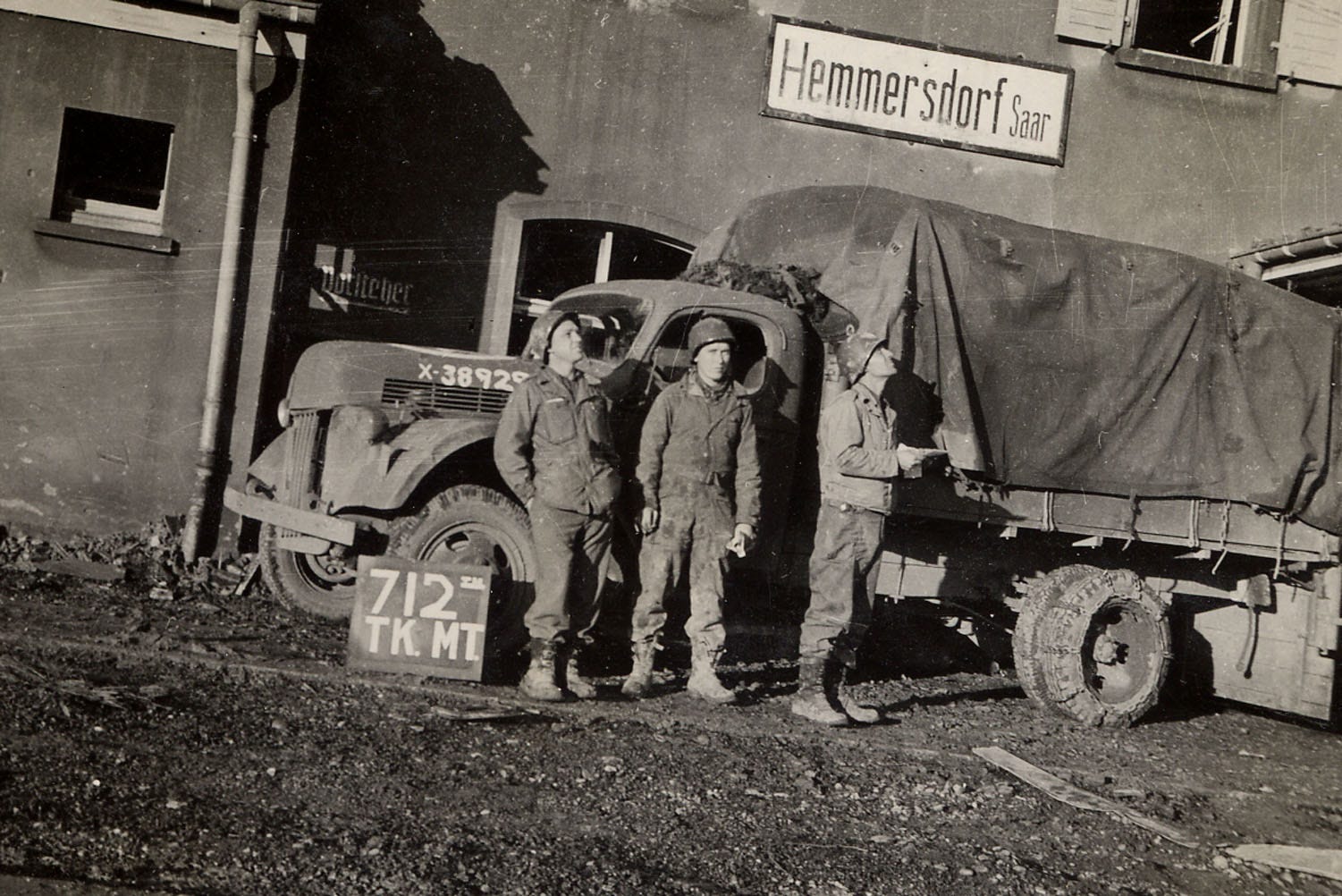
The following entries were also in the after action reports but not in the D Company journal:
12 December a platoon was detailed to outpost Division C.P. at Kerprich-Hemmersdorf. Another carrying party was furnished to carry supplies across the river to the infantry each night from 12-15 December inclusive.
17 December one light tank was ferried across the Saar for use at Battalion forward C.P. at Pachten.
20 December two tanks were detailed to river crossing control point to cover the crossing of the battalion vehicles from Pachten.
And then from the period 21-30 December:
22 December the platoon guarding the 90th Division C.P. was relieved. The Company moved from Neunkirchen at 1215 to Kirchnaumen (056-896). The crews of the .50-caliber machine guns were returned to the company. During the 17 days in position vicinity of Fremersdorf, they fired over 25,000 rounds across the Saar at enemy positions.
23 December a V-1 buzz bomb panned over area at 1630 going SE. It cut out and landed 5 miles from C.P.
24 and 25 December 3 tanks were used to demonstrate the method of attacking pillboxes as part of tank-infantry team. Demonstration was staged at Veckring (015-830). Two tanks used for road reconnaissance in Battalion area. 27, 28 and 30 December one platoon engaged in a tactical problem. Several enemy aircraft passed over area and were fired on by our .50-caliber machine guns.
The entry for December 22 corroborates Caesar Tucci’s account of the .50-caliber machine gun detail.
“What it wound up being is this: We weren’t there for three days. We got relieved from that position on my birthday, the 16th of December. But one time we had a fire mission, and I had to go through all the rigamarole, I got the barrel off, the back plate, didn’t make it in time. So the only thing I could figure out then, on one end of the living room of this German home, and they had all ultramodern furniture in there, mahogany tables and everything. So I took a wall from where the shelling was coming from, there was a buffet under there, I dove under that buffet and watched the shrapnel come bouncing in through the window while they were shelling. So right after that was all over, I got the hell back across the street, and got out of that.
“When we got out of that, we stayed in that area. We celebrated New Year’s Eve there, and this French family baked a lot of sweet cakes, pastries, so they invited us to participate. We were sleeping in the schoolhouse on the floor, and the French family was upstairs in it also, they were living there as refugees, so they invited us, and we had a combination of Calvados and pastries, and boy, there were a lot of sick guys. I never in my life got drunk, but that night I got sicker than a dog. And I got through and I went to bed, I went to my blanket and lay down, and geez, I got woke by Joe Masser, he said “Tooch, Tooch, it’s your turn, come on, get up!” I sat up like a zombie, Oh, my god, I said, what an awful feeling. And I went out to stand guard, my head spinning, sick to my stomach, the longest three hours I ever spent. Oh, my god, I felt terrible. This is the time that our battalion was ordered to move up to the Bulge area. So everybody packed up and we started up that way. This was the worst trip of my life, honest to God. After that night, I had what they called the GI shits, and what I was wearing, I got my underwear, my o.d.’s, and on top of that I had my combat suit, you know, like a ski suit. The convoy was so slow going up, it was bumper to bumper, so they’d stop periodically, and they’d have a few minutes, and every time they stopped I was out the back end of a truck heading for the side of the road, pulling all those clothes off, I had to get rid of my problem. Unfortunately I couldn’t go fast enough and the convoy would start up again and I was chasing after it trying to pull up my pants, it was a circus. Oh, it was an awful trip I had, I said never again would I do any kind of drinking like that.”
Next: “Dad Tells the Truth Once in a While”